Exodus Series — Episode 17
🔥 Prologue — The Wilderness Teaches Through Repetition Having been filled with manna and quail, the people set out once more.
But the wilderness never finishes teaching with a single lesson. Before the memory of Marah’s waterless complaint had even faded, a lack of water arises once again. And in the second half of this chapter, an entirely different kind of event awaits—Israel’s first war in its history.
Exodus 17 contains two events that seem, at first glance, unrelated. Water flowing from a rock, and a war with Amalek. Yet both are bound together by a single truth: Israel’s survival and victory come, from beginning to end, not from their own strength, but from God.
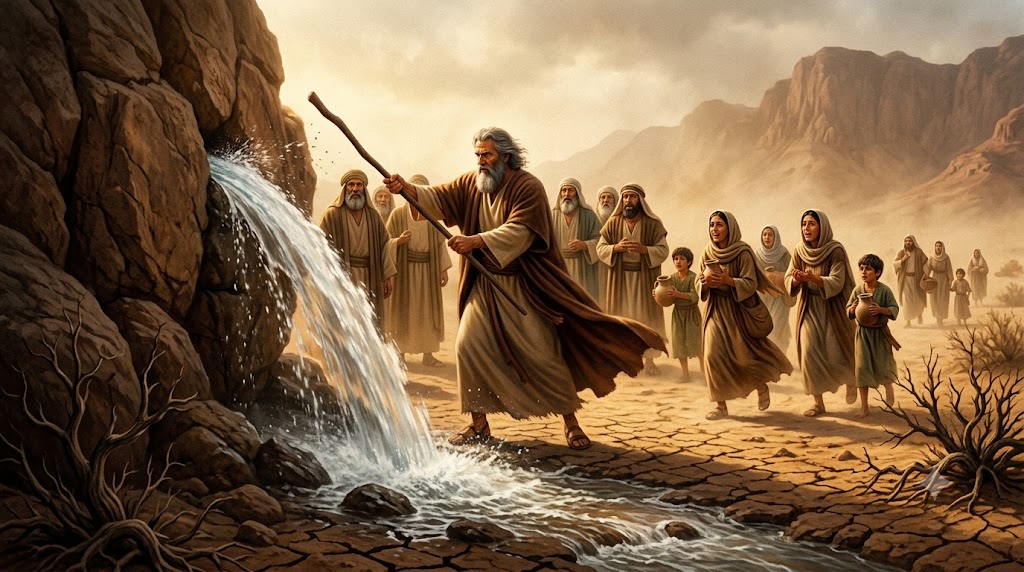
💧 Act One — The Waters of Meribah, Flowing from the Rock (Verses 1–7) “Then all the congregation of the children of Israel set out on their journey from the Wilderness of Sin, according to the commandment of the LORD, and camped in Rephidim; but there was no water for the people to drink.”
According to the commandment of the LORD. This phrase matters. The people had not chosen their own path. Even having moved in obedience to God’s command, they arrived at a place with no water. The fact that deprivation can come even in the midst of obedience—this was the first paradox of the wilderness.
“Therefore the people contended with Moses, and said, ‘Give us water, that we may drink.’ So Moses said to them, ‘Why do you contend with me? Why do you tempt the LORD?'”
Why do you tempt the LORD? Moses identifies the deeper issue hidden within the people’s complaint. Their contention was not merely a grievance over lack of water—it was an act of testing whether God was truly with them.
The people’s complaint grows more intense.
“And the people thirsted there for water, and the people complained against Moses, and said, ‘Why is it you have brought us up out of Egypt, to kill us and our children and our livestock with thirst?'”
Moses feels fear in the face of this situation.
“So Moses cried out to the LORD, saying, ‘What shall I do with this people? They are almost ready to stone me!'”
Almost ready to stone me. A moment revealing just how precarious a leader’s position could be. But once again, Moses did not complain as the people did—he brought it directly to God.
God’s response was concrete and practical.
“And the LORD said to Moses, ‘Go on before the people, and take with you some of the elders of Israel. Also take in your hand your rod with which you struck the river, and go. Behold, I will stand before you there on the rock in Horeb; and you shall strike the rock, and water will come out of it, that the people may drink.'”
Strike the rock. The very rod that had turned the Nile into blood was now used as an instrument giving life. The instrument of judgment and the instrument of grace resided in the same hand, the same rod.
“And Moses did so in the sight of the elders of Israel. So he called the name of the place Massah and Meribah, because of the contention of the children of Israel, and because they tempted the LORD, saying, ‘Is the LORD among us or not?'”
Massah, or Meribah—meaning testing, or contention. This place-name became a permanent marker, forever recording the event. Israel’s failure was, in fact, left behind as a lesson for their descendants.
Is the LORD among us or not? This question was the heart of the event. Even having witnessed the pillar of cloud and fire, the miracle of the Red Sea, and manna and quail, the people still wavered before this fundamental question.
⚔️ Act Two — The War with Amalek, and Hands Held Up (Verses 8–16) And without warning, Israel’s first war in its history begins.
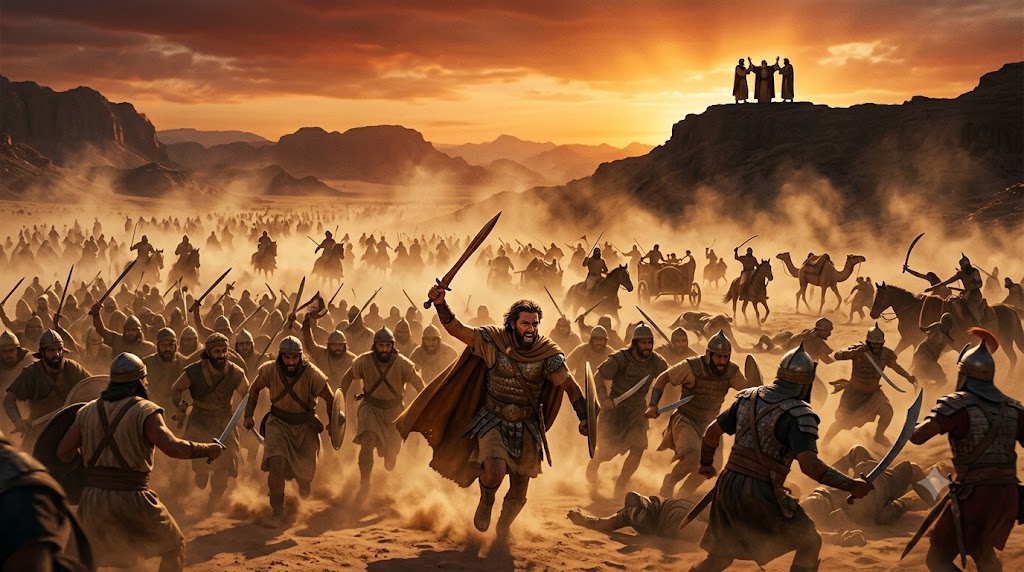
“Now Amalek came and fought with Israel in Rephidim.”
Amalek came and fought. There was no warning, no attempt at negotiation. It was a sudden attack. Israel had, until now, witnessed God fighting on their behalf—at the Red Sea. But this time, a different kind of battle was required.
“And Moses said to Joshua, ‘Choose us some men, and go out, fight with Amalek. Tomorrow I will stand on top of the hill with the rod of God in my hand.'”
Joshua appears in Scripture for the first time in this chapter. The man who would one day lead Israel into Canaan takes his first step here, as a commander in battle.
The battle began.
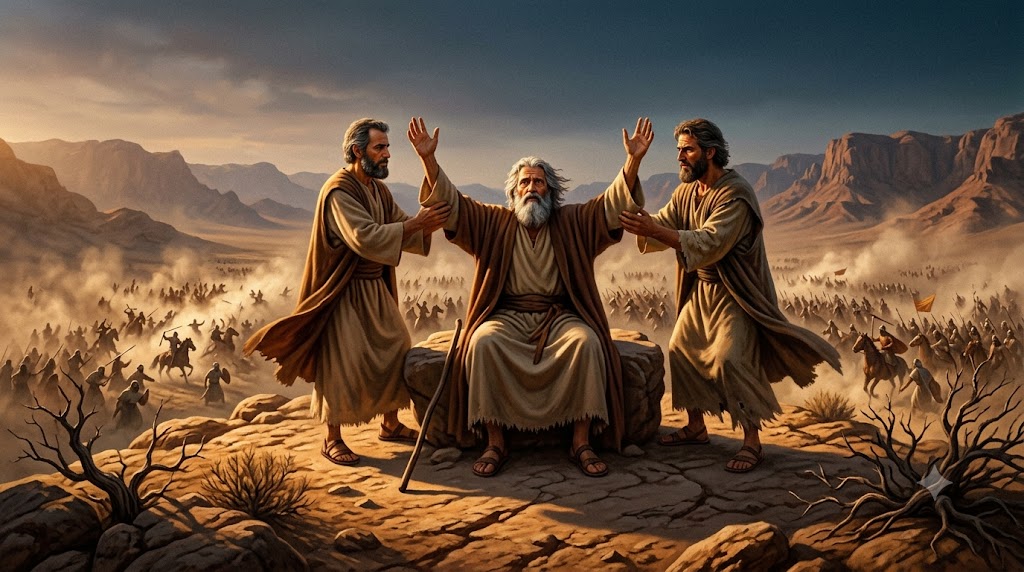
“So Joshua did as Moses said to him, and fought with Amalek. And Moses, Aaron, and Hur went up to the top of the hill. And so it was, when Moses held up his hand, that Israel prevailed; and when he let down his hand, Amalek prevailed.”
When Moses held up his hand, Israel prevailed; when he let down his hand, Amalek prevailed. This is one of the most symbolic scenes in all of Scripture. The battle on the field was led by Joshua, but the outcome depended on hands lifted on a hilltop. A visible battle and an invisible battle were being fought simultaneously.
“But Moses’ hands became heavy; so they took a stone and put it under him, and he sat on it. And Aaron and Hur supported his hands, one on one side, and the other on the other side; and his hands were steady until the going down of the sun.”
Moses’ hands became heavy. Even a man of God had physical limits. Moses was not superhuman. But that limitation produced a beautiful scene—Aaron and Hur held up his hands, one on each side. When one person’s faith wavered, the community held him up.
His hands were steady until the going down of the sun. What had been impossible alone became possible together.
“So Joshua defeated Amalek and his people with the edge of the sword.”
Victory is proclaimed.
“Then the LORD said to Moses, ‘Write this for a memorial in the book, and recount it in the hearing of Joshua, that I will utterly blot out the remembrance of Amalek from under heaven.'”
Write this for a memorial in the book. This event was not merely a record of victory. It was testimony for the generations yet to come.
“And Moses built an altar and called its name, The-LORD-Is-My-Banner; for he said, ‘Because the LORD has sworn: the LORD will have war with Amalek from generation to generation.'”
The-LORD-Is-My-Banner. With this name, Moses confessed that the source of this victory was not his own wisdom or Joshua’s courage, but God alone, entirely.
🕊️ Reflection — The Hand That Tests, and the Hand That Is Held Up Two kinds of hands appear in Exodus 17. One is the hand of the people, contending and testing God. The other is the hand Moses raised toward heaven. Within the same chapter, two entirely different directions of hands are depicted.
At Meribah, the people tested whether God was truly among them. But that test was carried out even while ignoring the countless evidences they had already witnessed. We too, often, having already experienced God’s faithfulness many times, still find ourselves doubting all over again in the face of a new difficulty.
But Moses’ lifted hands reveal an entirely different posture. He tried not to let his hands down, even as they grew weary. And when his own strength was not enough, Aaron and Hur helped him. This reveals the essence of a faith community—we cannot always hold our hands up alone. Sometimes someone else must hold our hands up for us.
And the water flowing from the rock. This scene is later understood in the New Testament as pointing to Christ (1 Corinthians 10:4). When the rod that had once been an instrument of judgment struck the rock, life-giving water flowed out—as though, when judgment fell on another in our place, life flowed forth.
“Which direction are your hands turned toward right now? Are they hands testing and contending, or hands held up, even if only because someone else is holding them?”
📣 Coming Up Next Exodus Chapter 18 — Jethro’s Visit and the Reorganization of Leadership Moses’ father-in-law Jethro comes to visit him in the wilderness. Seeing Moses carrying the entire burden of leadership alone, he offers wise counsel. The first step toward sharing one man’s burden among many unfolds in the next episode.
#Exodus17 #WatersOfMeribah #WaterFromTheRock #Massah #WarWithAmalek #JoshuaFirstAppears #MosesLiftedHands #TheLordIsMyBanner #TheExodus #BibleStudy #ChristianBlog #Exodus #OldTestament #Scripture #Church #DailyDevotional #BiblicalFaith #GodsPower