Exodus Series — Episode 18
🔥 Prologue — Another Crisis Arrives After Victory Israel had won the war against Amalek.
The water crisis at Meribah had been resolved. The people were beginning, step by step, to learn how to live in the wilderness. But Exodus 18 opens not with war, not with a miracle—but with a quiet, personal event. Moses’ father-in-law Jethro comes to visit him.
Yet this chapter is far from a minor aside. The issue it addresses was a fundamental challenge Israel would need to resolve in order to endure as a nation going forward. One person cannot carry everything alone.
Some problems cannot be solved by miracles. This was a problem of wisdom and structure.
👪 Act One — A Family Reunited (Verses 1–12) “And Jethro, the priest of Midian, Moses’ father-in-law, heard of all that God had done for Moses and for Israel His people—that the LORD had brought Israel out of Egypt.”
Jethro heard. Everything that had happened in Egypt—the ten plagues, the miracle at the Red Sea, the journey through the wilderness—this news had already spread as far as the land of Midian. What God had done could not be hidden.
Jethro brought Moses’ wife and two sons with him.
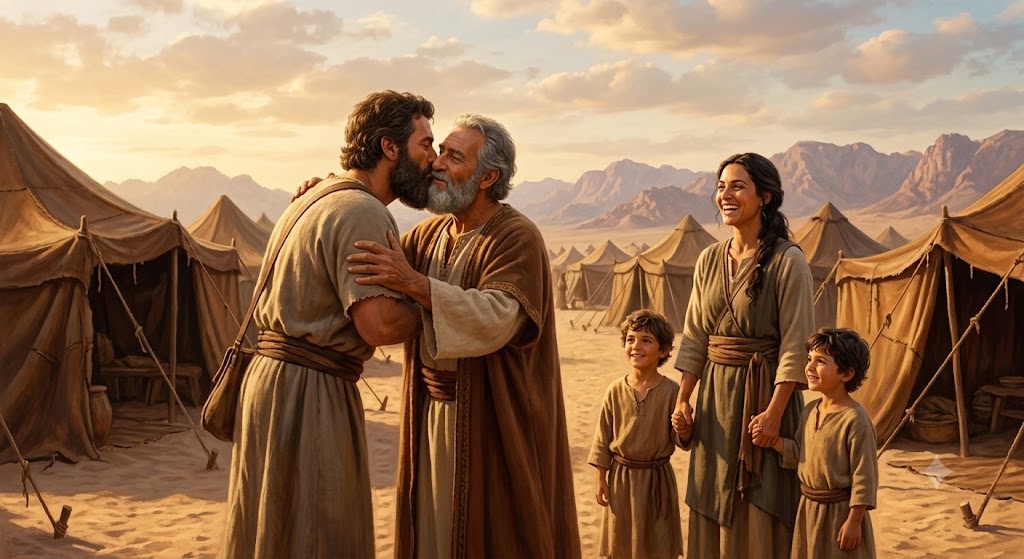
“Then Jethro, Moses’ father-in-law, took Zipporah, Moses’ wife, after he had sent her back, with her two sons, of whom the name of one was Gershom (for he said, ‘I have been a stranger in a foreign land’).”
After he had sent her back. This brief mention hints that Moses had been separated from his family amid the upheaval of his mission. Even as God’s great work was unfolding, one man’s household carried its own story of separation and reunion.
The reunion is described warmly.
“So Moses went out to meet his father-in-law, bowed down, and kissed him. And they asked each other about their well-being, and they went into the tent.”
Moses relates to Jethro everything God had done in detail.
“And Moses told his father-in-law all that the LORD had done to Pharaoh and to the Egyptians for Israel’s sake, all the hardship that had come upon them on the way, and how the LORD had delivered them.”
And Jethro’s response is the first climax of this chapter.
“Then Jethro rejoiced for all the good which the LORD had done for Israel, whom He had delivered out of the hand of the Egyptians. And Jethro said, ‘Blessed be the LORD, who has delivered you out of the hand of the Egyptians and out of the hand of Pharaoh, and who has delivered the people from under the hand of the Egyptians. Now I know that the LORD is greater than all the gods.'”
Now I know. Jethro, priest of Midian, a foreigner, was praising the God of Israel. God’s saving work extended beyond a single nation, becoming a testimony to the watching nations around them.
Jethro even offers sacrifices personally.
“Then Jethro, Moses’ father-in-law, took a burnt offering and other sacrifices to offer to God. And Aaron came with all the elders of Israel to eat bread with Moses’ father-in-law before God.”
⚖️ Act Two — The Problem Jethro Witnessed (Verses 13–16) The next day, Jethro witnesses an unexpected sight.
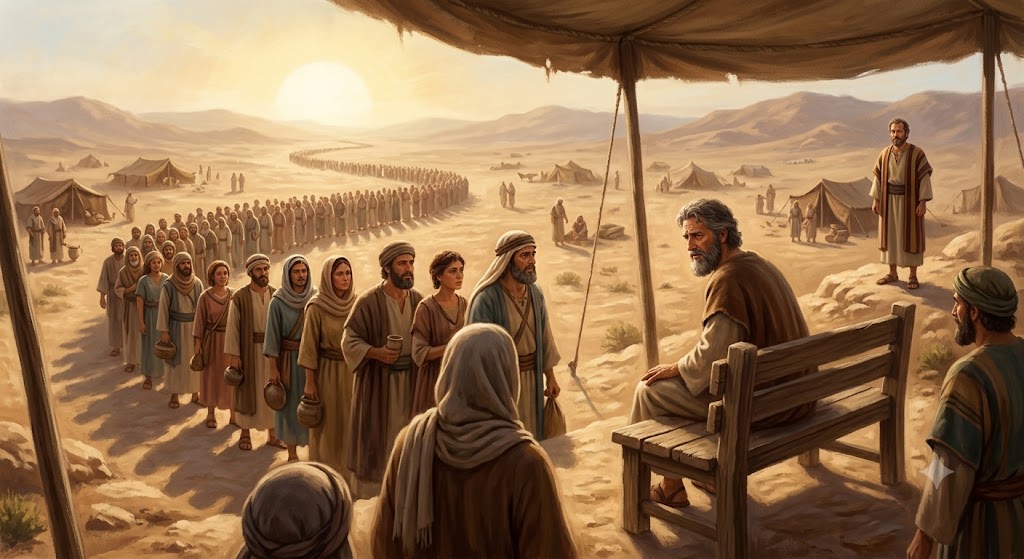
“And so it was, on the next day, that Moses sat to judge the people; and the people stood before Moses from morning until evening.”
From morning until evening. Moses alone was bearing every dispute and every question. Whenever a problem arose among the more than six hundred thousand people, they came to Moses. And Moses had to sit in that place, all day long.
Jethro asked.
“So when Moses’ father-in-law saw all that he did for the people, he said, ‘What is this thing that you are doing for the people? Why do you alone sit, and all the people stand before you from morning until evening?'”
Why do you alone sit? This question was not mere curiosity. It was a fundamental challenge raised by a wise observer’s eye.
Moses answered with his own reasoning.
“And Moses said to his father-in-law, ‘Because the people come to me to inquire of God. When they have a difficulty, they come to me, and I judge between one and another; and I make known the statutes of God and His laws.'”
Moses believed that what he was doing was right. It was, after all, the work of conveying God’s will. But being right did not mean he had to bear it all alone.
📋 Act Three — Jethro’s Counsel and a New Structure (Verses 17–27) Jethro honestly points out the problem.
“So Moses’ father-in-law said to him, ‘The thing that you do is not good. Both you and these people who are with you will surely wear yourselves out. For this thing is too much for you; you are not able to perform it by yourself.'”
The thing that you do is not good. Jethro was not condemning Moses. But he stated plainly that this method was not sustainable. Good intentions, carried out in an unsustainable way, ultimately exhaust the leader himself.
And he offers a concrete solution.
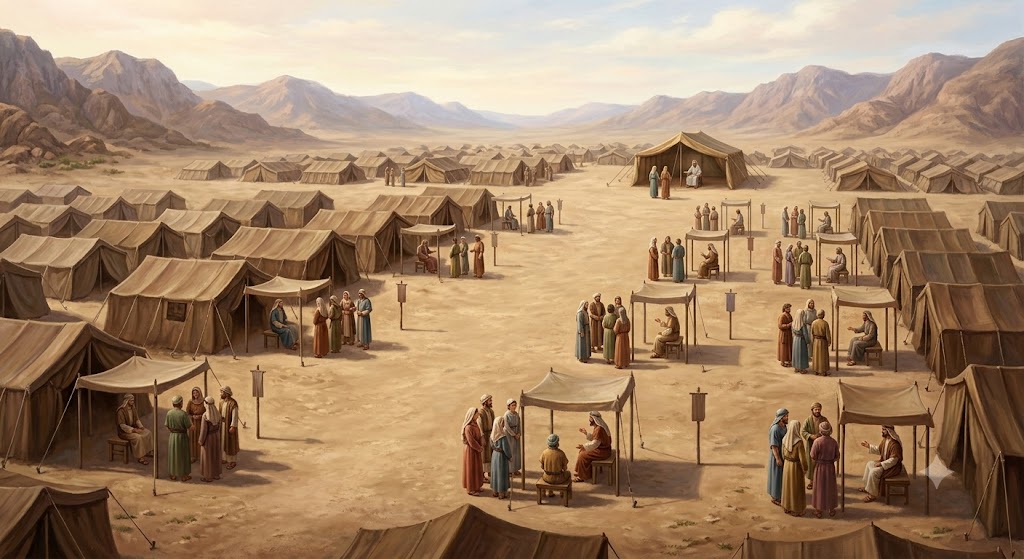
“Listen now to my voice; I will give you counsel, and God will be with you: Stand before God for the people, so that you may bring the difficulties to God… Moreover you shall select from all the people able men, such as fear God, men of truth, hating covetousness; and place such over them to be rulers of thousands, rulers of hundreds, rulers of fifties, and rulers of tens.”
Able men, such as fear God, men of truth, hating covetousness. The qualifications Jethro proposed for leaders were remarkably clear—competence, godliness, integrity, incorruptibility. He insisted that all four were necessary.
A new structure is proposed.
“And let them judge the people at all times. Then it will be that every great matter they shall bring to you, but every small matter they themselves shall judge. So it will be easier for you, for they will bear the burden with you.”
The great matters to you, the small matters to them. Not everything needed to be decided by one person. Delegation was not laziness—it was wisdom. Sharing the burden was, in fact, the way to handle it more fully.
Jethro offers all this counsel conditionally.
“If you do this thing, and God so commands you, then you will be able to endure, and all this people will also go to their place in peace.”
And God so commands you. Jethro did not impose his own wisdom as absolute. The final confirmation belonged to God. And remarkably—
“So Moses heeded the voice of his father-in-law and did all that he had said. And Moses chose able men out of all Israel, and made them heads over the people: rulers of thousands, rulers of hundreds, rulers of fifties, and rulers of tens.”
Moses accepted the counsel exactly as it was given. Even a leader as great as Moses took a posture of humble learning before his father-in-law’s wise words. This was yet another testimony to his leadership—the humility to acknowledge his own limits and receive good counsel.
The chapter closes with a brief farewell.
“Then Moses let his father-in-law depart, and he went his way to his own land.”
🕊️ Reflection — The Instinct to Carry It Alone, and the Wisdom to Share the Load The most practical lesson in Exodus 18 is this: conviction that one is doing something good does not necessarily mean one is doing it the right way. Moses was sincerely serving the people. But his method was wearing out both himself and the people.
We often mistake carrying something alone for devotion. But true devotion sometimes begins with sharing the burden. As Jethro advised, distinguishing between great matters and small ones, and entrusting responsibility to those who can be trusted, is not laziness—it is wisdom.
And the qualifications Jethro proposed for leaders—competence, godliness, integrity, incorruptibility—remain valid criteria for any organization today. Competence without godliness is dangerous; godliness without competence is powerless.
Finally, let us remember that this counsel came from Jethro, a foreign priest. God’s wisdom sometimes arrives through unexpected channels. Moses did not question the source of the counsel—he accepted the truth of its content.
“Is there a burden you are carrying alone right now? Sharing it may not be failure—it may be wisdom.”
📣 Coming Up Next Exodus Chapter 19 — Arrival at Mount Sinai Israel finally arrives at Mount Sinai. God descends upon the mountain, and Israel is called to be a kingdom of priests and a holy nation. The magnificent moment when the covenant between God and His people is established unfolds in the next episode.
#Exodus18 #JethrosVisit #WisdomOfAFatherInLaw #RulersOfThousandsAndHundreds #DelegationOfLeadership #DontCarryItAlone #FamilyReunion #TheExodus #BibleStudy #ChristianBlog #Exodus #OldTestament #Scripture #Church #DailyDevotional #BiblicalFaith #GodsPower