Exodus Series — Episode 16
🔥 Prologue — A Heart Shaken Again by Hunger They had left the oasis at Elim.
The people who had rested beneath twelve springs and seventy palm trees now moved on into the wilderness once more. And before long, this time it was not water but food that became the problem.
Exodus 16 is the chapter that first reveals the rhythm of the entire forty years in the wilderness. God rains bread down from heaven every day, and the people must gather it every day. Within this repeating, ordinary routine, God begins to teach them—and us—what trust actually means.
The heart of this chapter is not the miracle itself, but the fact that the miracle had to be repeated every single day.
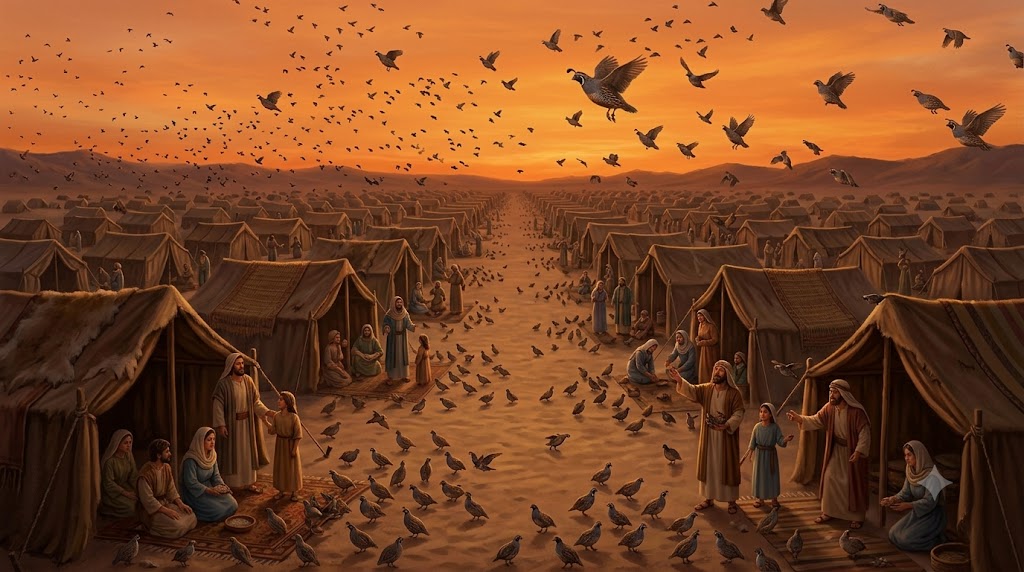
😤 Act One — The People’s Complaint and God’s Response (Verses 1–12) “And they journeyed from Elim, and all the congregation of the children of Israel came to the Wilderness of Sin, which is between Elim and Sinai, on the fifteenth day of the second month after they departed from the land of Egypt.”
The fifteenth day of the second month. An exact date is recorded. It had been just over a month since they left Egypt. By now, the provisions they had carried out of Egypt were running out.
“Then the whole congregation of the children of Israel complained against Moses and Aaron in the wilderness. And the children of Israel said to them, ‘Oh, that we had died by the hand of the LORD in the land of Egypt, when we sat by the pots of meat and when we ate bread to the full! For you have brought us out into this wilderness to kill this whole assembly with hunger.'”
When we sat by the pots of meat. A striking distortion of memory. They had suffered brutal slave labor in Egypt. Yet, faced with hunger, even that bondage was now remembered as abundance. Deprivation romanticizes the past.
But God responds not with rebuke, but with grace.
“Then the LORD said to Moses, ‘Behold, I will rain bread from heaven for you. And the people shall go out and gather a certain quota every day, that I may test them, whether they will walk in My law or not.'”
Gather a certain quota every day. Here God’s method is revealed. Rather than giving several months’ worth of food at once, He would give only what was needed for that single day. This was not merely a method of provision—it was a method of training trust.
Moses and Aaron announce to the people that God’s glory would soon appear.
“At evening you shall know that the LORD has brought you out of the land of Egypt; and in the morning you shall see the glory of the LORD; for He hears your complaints against the LORD.”
And Moses reminds the people of an important truth.
“Also Moses said, ‘This shall be seen when the LORD gives you meat to eat in the evening, and in the morning bread to the full; for the LORD hears your complaints which you make against Him. And what are we? Your complaints are not against us but against the LORD.'”
And what are we? The people had complained against Moses and Aaron, but the real object of their complaint was God. Complaints directed at leaders are often, in reality, distrust directed at God. Moses names this truth precisely.
That evening, quail covered the camp.
“So it was that quails came up at evening and covered the camp, and in the morning the dew lay all around the camp. And when the layer of dew lifted, there, on the surface of the wilderness, was a small round substance, as fine as frost on the ground.”
Quail, and the fine substance upon the dew. Evening meat and morning mystery together completed God’s provision.
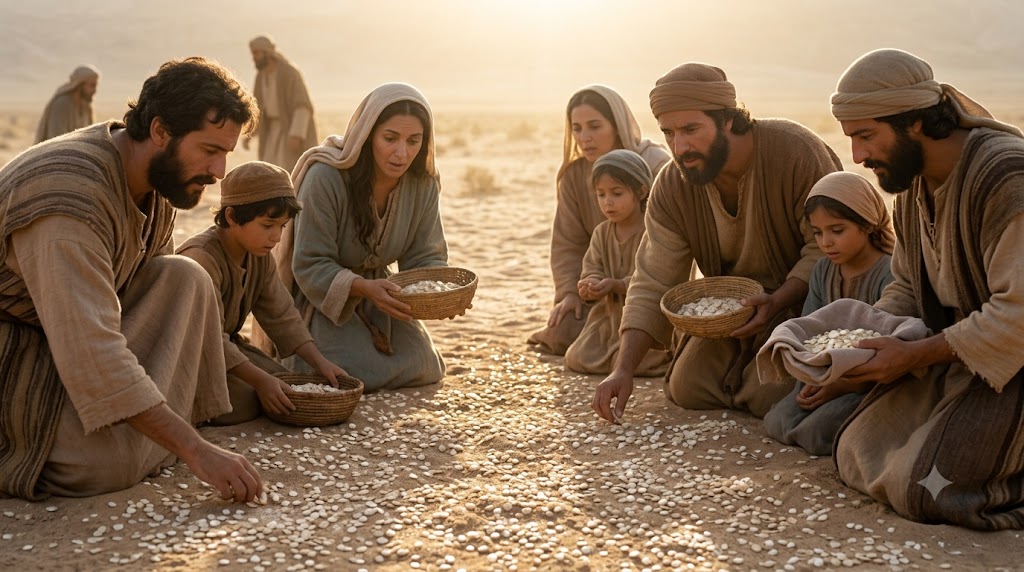
🍚 Act Two — The Ordinances of Manna (Verses 13–30) The people saw this strange substance and asked one another about it.
“So when the children of Israel saw it, they said to one another, ‘What is it?’ For they did not know what it was. And Moses said to them, ‘This is the bread which the LORD has given you to eat.'”
What is it? The Hebrew question “man hu” became the origin of the name given to this bread—”manna.” They would eat and live on something whose very name they did not know at first.
Ordinances for gathering were given.
“This is the thing which the LORD has commanded: ‘Let every man gather it according to each one’s need, one omer for each person, according to the number of persons; let every man take for those who are in his tent.'”
According to each one’s need. Gathering more than necessary was not permitted.
“Notwithstanding they did not heed Moses. But some of them left part of it until morning, and it bred worms and stank. And Moses was angry with them.”
It bred worms and stank. Those who could not trust God’s daily provision and tried to hoard it found their stockpile rotting. This was not merely a material failure but a spiritual lesson. The attempt to secure today’s grace against tomorrow’s anxiety ends, in the end, in decay.
But the sixth day was an exception.
“And so it was, on the sixth day, that they gathered twice as much bread, two omers for each one… Then Moses said to them, ‘This is what the LORD has said: “Tomorrow is a Sabbath rest, a holy Sabbath to the LORD. Bake what you will bake today, and boil what you will boil; and lay up for yourselves all that remains, to be kept until morning.”‘”
A holy Sabbath. Here the concept of Sabbath appears explicitly for the first time. Even before the Ten Commandments were given at Sinai, God was already teaching the people the rhythm of rest through manna.
“So they laid it up till morning, as Moses commanded; and it did not stink, nor were there any worms in it. Then Moses said, ‘Eat that today, for today is a Sabbath to the LORD; today you will not find it in the field.'”
It did not stink. The double portion gathered on the sixth day, unlike other days, did not decay. Within the rhythm of rest God had appointed, even the ordinary principles of nature operated differently.
But not everyone obeyed.
“Now it happened that some of the people went out on the seventh day to gather, but they found none. And the LORD said to Moses, ‘How long do you refuse to keep My commandments and My laws? See! For the LORD has given you the Sabbath; therefore He gives you on the sixth day bread for two days. Let every man remain in his place; let no man go out of his place on the seventh day.'”
This new rhythm was not immediately and fully embraced. Obedience does not become habit overnight. But through repetition, God was training the people into this new way of life.
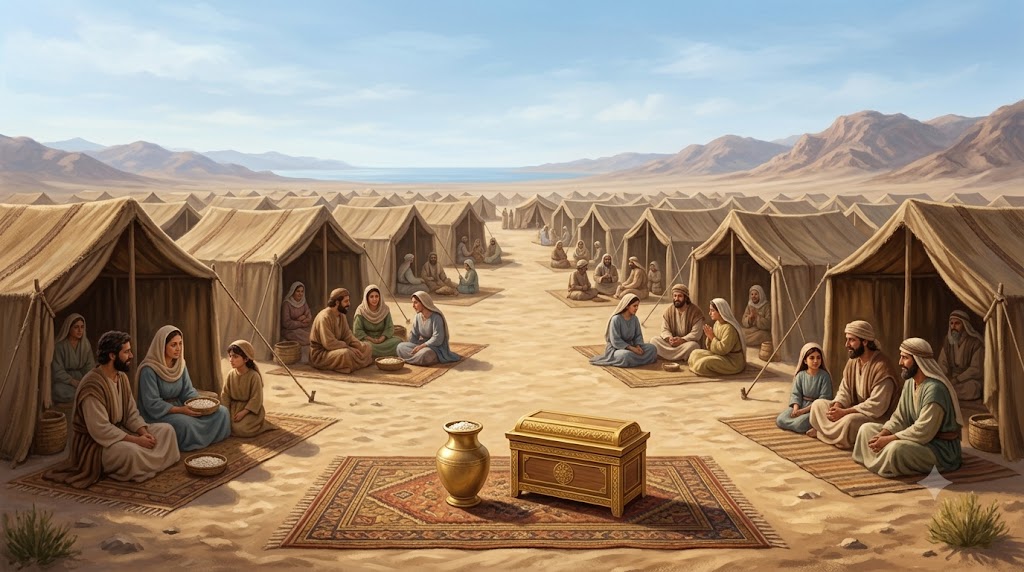
📜 Act Three — Manna Kept for Remembrance (Verses 31–36) “And the house of Israel called its name Manna. And it was like white coriander seed, and the taste of it was like wafers made with honey.”
This mysterious food soon became an established ordinance.
“Then Moses said, ‘This is the thing which the LORD has commanded: “Fill an omer with it, to be kept for your generations, that they may see the bread with which I fed you in the wilderness, when I brought you out of the land of Egypt.”‘”
To be kept for your generations. An omer of manna was commanded to be preserved permanently inside the Ark of the Testimony. This was evidence for future generations—so that they would never forget how God fed their ancestors in the wilderness.
“And the children of Israel ate manna forty years, until they came to an inhabited land; they ate manna until they came to the border of the land of Canaan.”
Forty years. This single sentence foreshadows the length of the entire wilderness journey ahead. The daily provision would not last a mere few days—it would continue for forty years.
🕊️ Reflection — Today’s Bread, Today’s Trust The most important truth God teaches in Exodus 16 is this: why did God not give several months’ worth of food at once, but instead sent it down a little at a time, every day? The answer is simple—trust does not grow from accumulated wealth. Trust grows from looking to God again, every day, in the midst of daily need.
The manna of those who tried to hoard it rotted. This asks something of us. How often do we, worrying about tomorrow, fail to fully enjoy what God has given today? When Jesus later taught His disciples to pray, “Give us this day our daily bread,” it connected precisely with this lesson from the wilderness.
And then, the Sabbath. Even before the Ten Commandments were given, God was already teaching the rhythm of rest through food. Six days of labor and one day of rest—this was grace before it was ever a rule. God did not design His people to labor without rest.
Finally, the manna preserved in the jar. Memory does not preserve itself. It must be deliberately kept. In our own lives too, we need our own “jar”—something that helps us remember the moments God provided.
“Are you, today, missing today’s grace because you are worried about tomorrow?”
📣 Coming Up Next Exodus Chapter 17 — Water from the Rock, War with Amalek The people complain again, this time for lack of water, and God brings forth water from the rock. Soon after, the first battle with Amalek breaks out, and as long as Moses’ hands remain lifted, Israel prevails. This dramatic scene unfolds in the next episode.
#Exodus16 #Manna #Quail #BreadFromHeaven #FirstSabbath #DailyBread #WildernessTraining #TrainingInTrust #TheExodus #BibleStudy #ChristianBlog #Exodus #OldTestament #Scripture #Church #DailyDevotional #BiblicalFaith #GodsPower