Exodus Series — Episode 39
🔥 Prologue — The Weight of a Repeated Sentence In chapter 28, God had commanded that the garments Aaron and his sons would wear—the ephod, the breastplate, the robe, the turban, the sash—be made for glory and for beauty.
Now, in Exodus 39, those intricate garments are actually completed. But what stands out most in this chapter is not the splendor of the garments themselves, but a single short sentence repeated throughout—”just as the LORD had commanded Moses.” This phrase appears more than seven times in this chapter. This repetition is not accidental—it is the central message this entire chapter seeks to convey.
🎽 Act One — The Ephod and the Breastplate Completed (Verses 1–21) “Of the blue, purple, and scarlet thread they made garments of ministry, for ministering in the holy place, and made the holy garments for Aaron, as the LORD had commanded Moses.”
Just as the LORD had commanded Moses. This phrase appears already in the first paragraph of this chapter. It was the beginning of a refrain that would continue to recur.
The process of making the ephod is described in detail.
“He made the ephod of gold, blue, purple, and scarlet thread, and of fine woven linen. And they beat the gold into thin sheets and cut it into threads, to work it in with the blue, purple, and scarlet thread, and the fine linen, into artistic designs.”
Beat the gold into thin sheets and cut it into threads. This detailed description is deeply striking. Gold was hammered into sheets as thin as paper, then cut into thread-like strands and woven together with the other colored threads. This must have been an extraordinarily intricate and time-consuming technique.
The instructions concerning the gemstones on the ephod’s shoulders are also realized precisely.
“And they set onyx stones, enclosed in settings of gold; they were engraved, as signets are engraved, with the names of the sons of Israel… as memorial stones for the sons of Israel, as the LORD had commanded Moses.”
Once again, that refrain appears.
The making of the breastplate follows with equal intricacy.
“He made the breastplate, artistically woven like the workmanship of the ephod, of gold, blue, purple, and scarlet thread, and of fine woven linen.”
Twelve gemstones were each set in place, and the names of the twelve tribes were engraved upon each.
“There were twelve stones according to the names of the sons of Israel, engraved like a signet, each one with its own name according to the twelve tribes.”
The Urim and the Thummim were placed within it as well.
“They put in the breastplate the Urim and the Thummim, as the LORD had commanded Moses.”
The third repetition. Each time this phrase reappears, the reader is once again confirmed in the perfect correspondence between plan and execution.
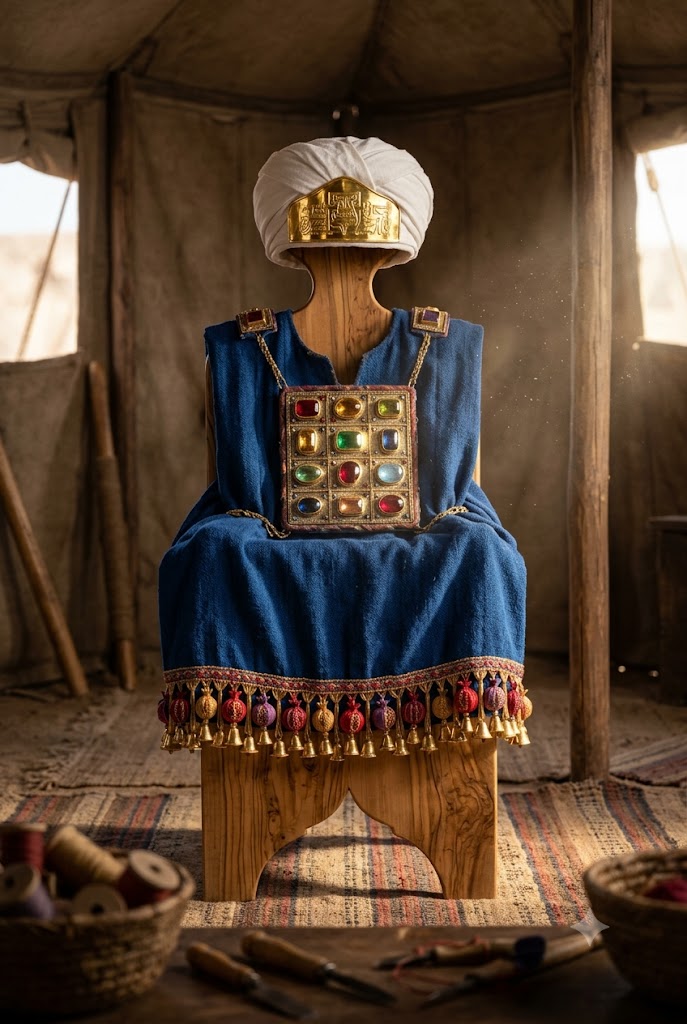
🔔 Act Two — The Robe and the Remaining Garments (Verses 22–31) The robe to be worn beneath the ephod is completed as well.
“He made the robe of the ephod of woven work, all of blue… and they made pomegranates of blue, purple, and scarlet thread, and of fine woven linen, on the hem of the robe.”
And that famous golden bell is made.
“They also made bells of pure gold, and put the bells between the pomegranates on the hem of the robe, all around between the pomegranates… as the LORD had commanded Moses.”
Once again, this refrain. Even down to the intricate arrangement of bells and pomegranates, it was realized without the slightest deviation.
The pure gold plate to be attached to the turban is completed as well.
“Then they made the plate of the holy crown of pure gold, and wrote on it an inscription like the engraving of a signet: HOLINESS TO THE LORD… as the LORD had commanded Moses.”
Even this short but powerful phrase to be inscribed on the forehead—”HOLINESS TO THE LORD”—was engraved exactly as revealed.
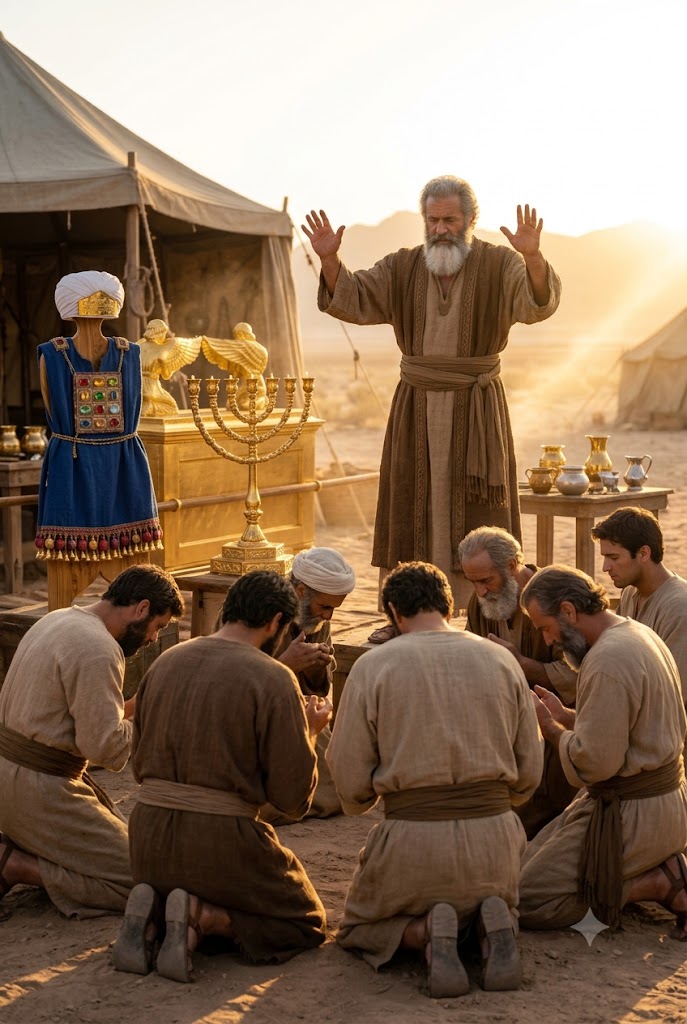
📦 Act Three — The Finished Work Is Brought to Moses (Verses 32–43) The final section of this chapter captures the majestic scene of everything completed being brought to Moses.
“Thus all the work of the tabernacle of the tent of meeting was finished. And the children of Israel did according to all that the LORD had commanded Moses; so they did.”
Here this refrain reaches its climax. It was not a single object, but the summary declaration that “all the work” had been accomplished exactly as commanded.
And every completed item is enumerated one by one and brought to Moses.
“And they brought the tabernacle to Moses: the tent and all its furnishings, its clasps, its boards, its bars, its pillars, and its sockets… the ark of the Testimony with its poles, and the mercy seat; the table, all its utensils, and the showbread; the pure gold lampstand with its lamps set in order, all its utensils, and the oil for light; the gold altar, the anointing oil, and the sweet incense; the screen for the tabernacle door; the bronze altar, its bronze grating, its poles, and all its utensils; the laver with its base; the hangings of the court, its pillars, its sockets, and the screen for the court gate, its cords, and its pegs; all the utensils for the service of the tabernacle, for the tent of meeting; and the garments of ministry, to minister in the holy place—the holy garments for Aaron the priest, and his sons’ garments.”
This vast list proves that everything revealed from chapter 25 onward was actually completed, without a single omission.
And this chapter closes with its most moving sentence.
“Then Moses looked over all the work, and indeed they had done it; as the LORD had commanded, just so they had done it. And Moses blessed them.”
Moses blessed them. This was the climax of this chapter. Moses reviewed everything, confirmed that it had been made exactly as God commanded, and blessed the people for their faithful obedience. Within this short sentence lies the moment when the obedience and faithfulness this entire chapter had emphasized was finally recognized.
🕊️ Reflection — The Language of Repeated Obedience The truth to be most deeply engraved from Exodus 39 is this: the phrase “just as the LORD had commanded Moses” was repeated more than seven times. Scripture never repeats a sentence by accident. This repetition was a literary device emphasizing to us just how thorough and complete this obedience truly was.
We often live in a culture that values creativity and originality more highly than obedience. But this chapter presents a different value. Following exactly what God had revealed—that, in itself, was a mark of deep spiritual maturity.
And it is significant that, after the incident of the golden calf, this kind of complete obedience appears precisely at this point. The failure of chapter 32—the people making a god in their own way—and the faithfulness of chapter 39—making the sacred objects exactly as God commanded—stand in stark contrast. Restoration, in the end, bore fruit in obedience.
Finally, Moses’ blessing. Faithful obedience is always worthy of blessing.
“Is there an area of your own life where you could say, ‘just as the LORD commanded’?”
📣 Coming Up Next Exodus Chapter 40 — The Tabernacle Is Raised At last, the Tabernacle is completed and set up, and the glory of the LORD fills it entirely. The magnificent moment that brings the entire journey of Exodus to its close unfolds in the next episode.
#Exodus39 #JustAsTheLordCommanded #TheEphodAndBreastplateCompleted #GoldenBellsAndPomegranates #HolinessToTheLord #MosesBlessing #FaithfulObedience #TheExodus #BibleStudy #ChristianBlog #Exodus #OldTestament #Scripture #Church #DailyDevotional #BiblicalFaith #GodsPower