Exodus Series — Episode 38
🔥 Prologue — Holiness and Transparency Standing Together The Ark of the Covenant, the table, the lampstand, the altar of incense—the holy furnishings within the Tabernacle had been completed.
Now Exodus 38 turns its attention once again to the outside of the Tabernacle. The bronze altar, the bronze basin, and the courtyard surrounding the entire structure. These outer structures, revealed back in chapter 27, are now actually built.
But this chapter contains something distinct from previous chapters—a detailed record of the exact weight and quantity of every material used in the construction. Following this holy work came a remarkably transparent financial report.
🔥 Act One — The Bronze Altar and the Bronze Basin (Verses 1–8) “He made the altar of burnt offering of acacia wood; five cubits was its length and five cubits its width—it was square—and its height was three cubits.”
The precise dimensions revealed in chapter 27 are now realized in an actual structure.
“He made its horns on its four corners; the horns were of one piece with it. And he overlaid it with bronze.”
And the accompanying implements of the altar are completed as well.
“He made all the utensils for the altar: the pans, the shovels, the basins, the forks, and the firepans; all its utensils he made of bronze.”
An interesting detail is also mentioned concerning the bronze basin.
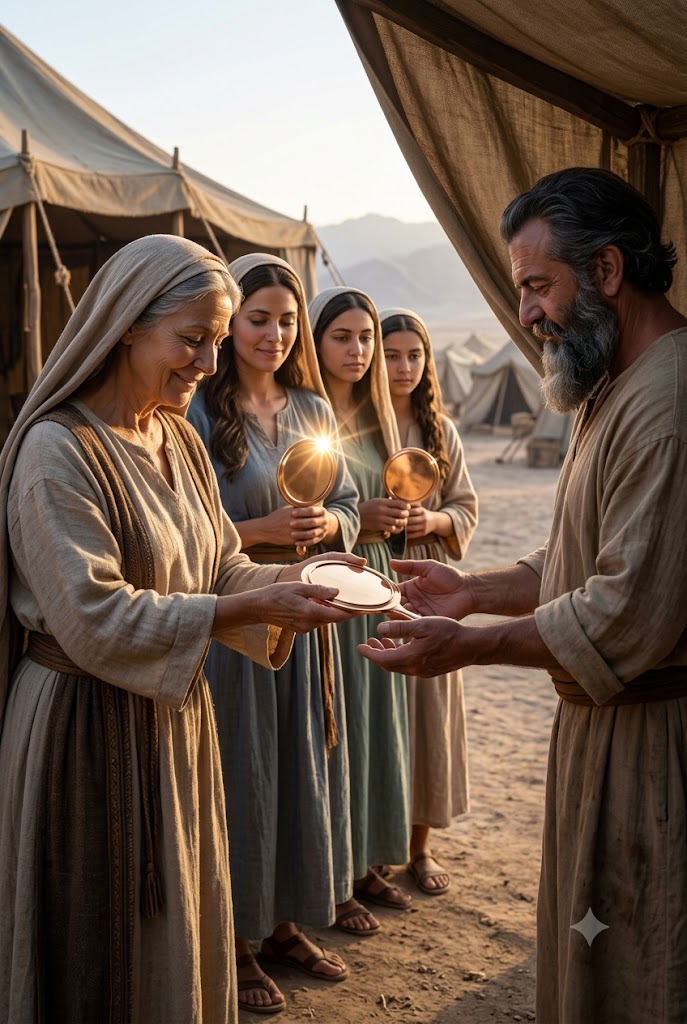
“He made the laver of bronze and its base of bronze, from the bronze mirrors of the serving women who assembled at the door of the tabernacle of meeting.”
From the bronze mirrors. This verse is remarkably distinctive and moving. This basin was made from the bronze mirrors brought by the women who served at the door of the tabernacle. Their personal possessions—mirrors that were likely precious to them—were reborn as an instrument for the priest’s purification. This was evidence of a deeply personal and sacrificial devotion: what once reflected their own image now became a tool for the purity of others.
🏕️ Act Two — The Courtyard Is Erected (Verses 9–20) Now the construction of the courtyard surrounding the entire Tabernacle follows.
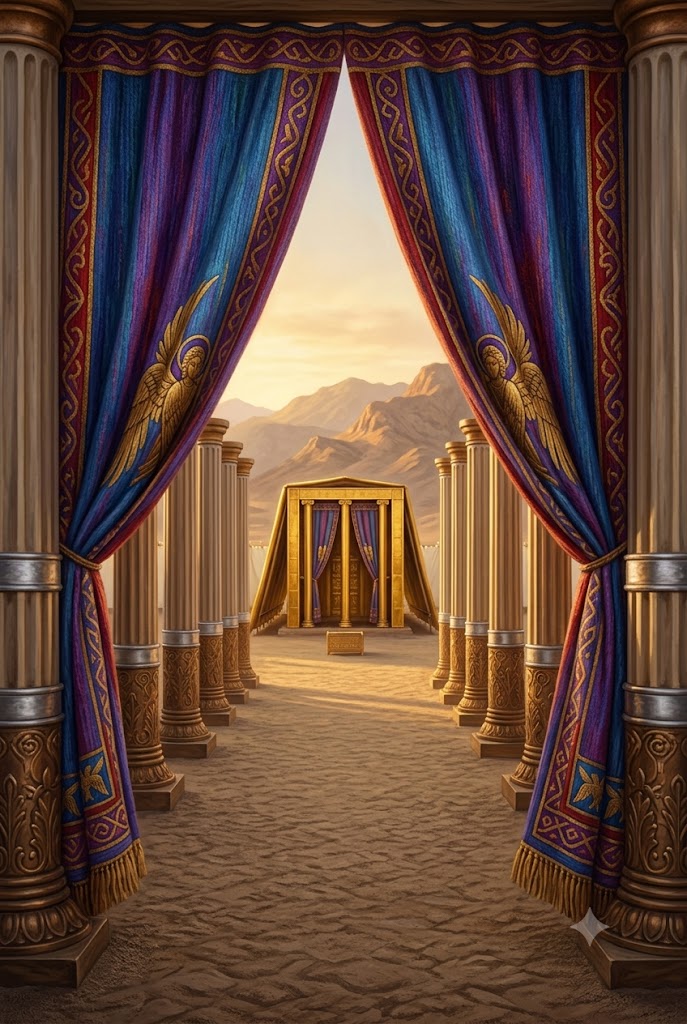
“He made the court on the south side; the hangings of the court were of fine woven linen, one hundred cubits long.”
That vast scale revealed in chapter 27 is now actually erected. The number of pillars, the material of the sockets, even the material of the hooks—every detail matches precisely.
“There were twenty pillars for them, with twenty bronze sockets. The hooks of the pillars and their bands were silver.”
The walls on all four sides—north, south, east, and west—are completed in order, and finally the instructions for the gate of the courtyard are realized.
“For the gate of the court there was a screen twenty cubits long, of blue, purple, and scarlet thread, and fine woven linen, made by a weaver.”
This intricately embroidered curtain at the entrance became the first beauty to greet those approaching the Tabernacle.
“All the pegs of the tabernacle, and of the court all around, were bronze.”
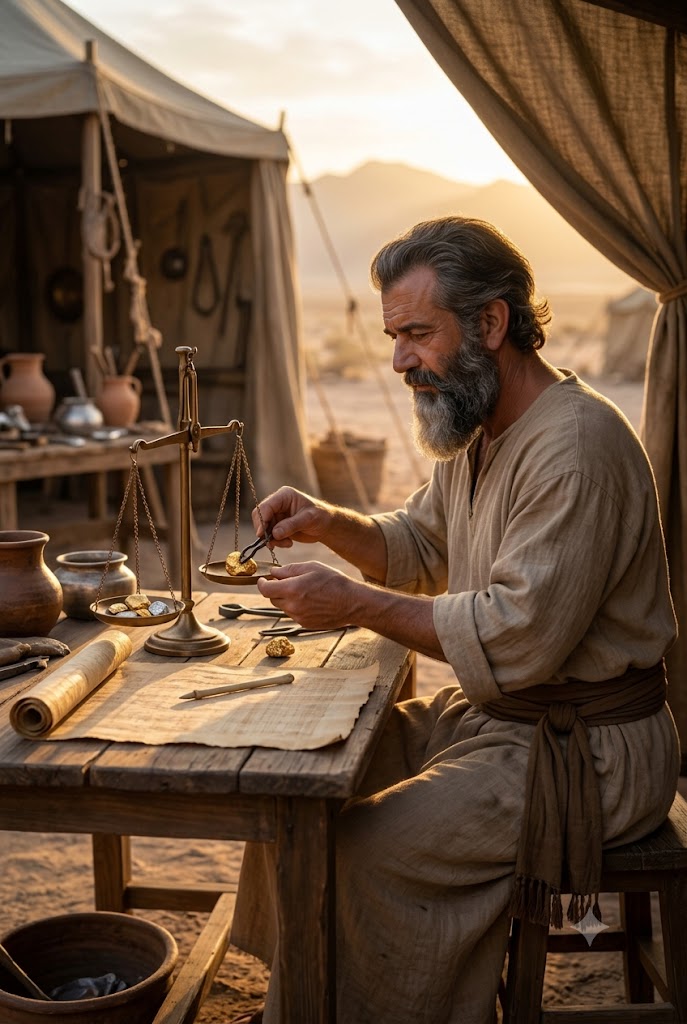
💰 Act Three — The Precise Accounting of Materials Used (Verses 21–31) The most distinctive part of this chapter is that, unlike every previous chapter, an exact statistical accounting of the materials actually used is presented.
“This is the inventory of the tabernacle, the tabernacle of the Testimony, which was counted according to the commandment of Moses, for the service of the Levites, by the hand of Ithamar, son of Aaron the priest.”
By the hand of Ithamar. This financial audit was not accidental. Even the holy offerings given to God had to be recorded and reported accurately and transparently.
The total amount of gold is recorded in detail.
“All the gold that was used in all the work of the holy place, that is, the gold of the offering, was twenty-nine talents and seven hundred and thirty shekels, according to the shekel of the sanctuary.”
The total amounts of silver and bronze are similarly reported in fine detail.
“And the silver from those who were numbered of the congregation was one hundred talents and one thousand seven hundred and seventy-five shekels, according to the shekel of the sanctuary: a bekah for each man, that is, half a shekel, according to the shekel of the sanctuary, for everyone included in the numbering from twenty years old and above, for six hundred and three thousand, five hundred and fifty men.”
The specific use of this silver is stated as well.
“From this the bases of the sanctuary and the bases of the veil were cast: one hundred bases from the hundred talents, a talent for each base… And from the rest of the silver he made the captials of the pillars, overlaid their capitals, and made bands for them.”
This silver came from the ransom for a life revealed in chapter 30—the same half-shekel given equally by rich and poor alike. This detailed accounting proves just how precisely that ordinance was actually kept in practice.
The use of the bronze is recorded as well.
“The bronze of the offering was seventy talents and two thousand four hundred shekels. And with it he made the sockets for the door of the tabernacle of meeting, the bronze altar, the bronze grating for it, and all the utensils for the altar.”
🕊️ Reflection — Holiness and Transparency Go Together The most striking truth in Exodus 38 is this: even the extraordinarily holy project of the Tabernacle was not exempt from financial transparency. The exact weight and quantity of every offering given to God was recorded in detail, verifiable by anyone.
This teaches us an important principle. Religious passion could never substitute for honesty in accounting. True godliness, rather, is revealed precisely in handling what is given to God honestly and transparently. This detailed accounting work Ithamar carried out was a service no less important than building the Tabernacle itself.
And the basin made from women’s mirrors. This small detail shows just how personal and sacrificial devotion can be. Giving up what once reflected one’s own image, for the purity of others—this was one true form of giving.
Finally, the fact that exactly one hundred talents of silver came from the half-shekel ransom. This was proof of just how precisely, and how faithfully, God’s ordinance had actually been kept.
“Is your devotion supported by honesty, as much as by passion?”
📣 Coming Up Next Exodus Chapter 39 — The Priestly Garments Completed The ephod, the breastplate, the turban, and the sash—the magnificent priestly garments revealed in chapter 28—are finally completed. The scene where Moses inspects and blesses all of it unfolds in the next episode.
#Exodus38 #TheBronzeAltarAndBasin #TheWomensMirrors #TheCourtyardCompleted #ThePreciseAccounting #IthamarsRecordKeeping #TransparentDevotion #TheExodus #BibleStudy #ChristianBlog #Exodus #OldTestament #Scripture #Church #DailyDevotional #BiblicalFaith #GodsPower