Ordained Through the Laying On of Hands — Exodus Chapter 29: The Ordination of the Priests Exodus Series — Episode 29
🔥 Prologue — Wearing the Garment Alone Is Not Enough In chapter 28, the priestly garments had been completed.
The ephod, the breastplate, the turban, the bell-hemmed robe—everything had been intricately prepared. But putting on the garments alone did not make a person a priest. Exodus 29 addresses the ceremony by which Aaron and his sons were actually established in that office—the ordination.
Within this chapter, washing, clothing, anointing, and a series of sacrifices are intricately woven together. Through this entire process, an ordinary person was set apart to serve as a holy mediator between God and the people.
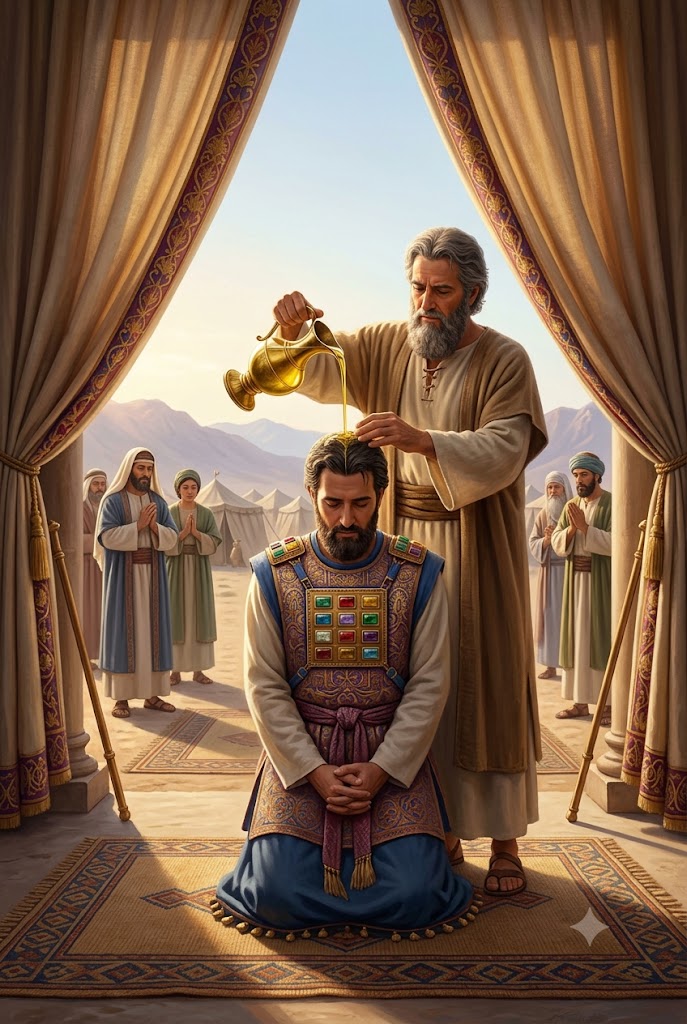
🧼 Act One — Washing and Clothing (Verses 1–9) “And this is what you shall do to them to hallow them for ministering to Me as priests: Take one young bull and two rams without blemish.”
First, the necessary offerings are prepared. Animals without blemish—these formed the foundation of the entire ordination.
“And Aaron and his sons you shall bring to the door of the tabernacle of meeting, and you shall wash them with water.”
Wash them with water. The first step of the ordination was purification. Before the garments could be put on, the body first had to be washed. This shows that the journey toward holiness always begins with purification.
Then, the intricate garments prepared in chapter 28 are placed upon Aaron.
“Then you shall take the garments, put the tunic on Aaron, and the robe of the ephod, the ephod, and the breastplate, and gird him with the intricately woven band of the ephod… You shall put the turban on his head, and put the holy crown on the turban.”
What is striking here is that this clothing was not something Aaron did for himself. Moses dressed him. The priesthood was not something one took upon oneself—it was given and entrusted by another.
Then the anointing oil is used.
“And you shall take the anointing oil, pour it on his head, and anoint him.”
This oil poured upon the head was a visible marker that God had specifically set this person apart and established him.
Aaron’s sons undergo a similar process as well.
“Then you shall bring his sons and put tunics on them. And you shall gird them with sashes, Aaron and his sons, and put the hats on them. The priesthood shall be theirs for a perpetual statute.”
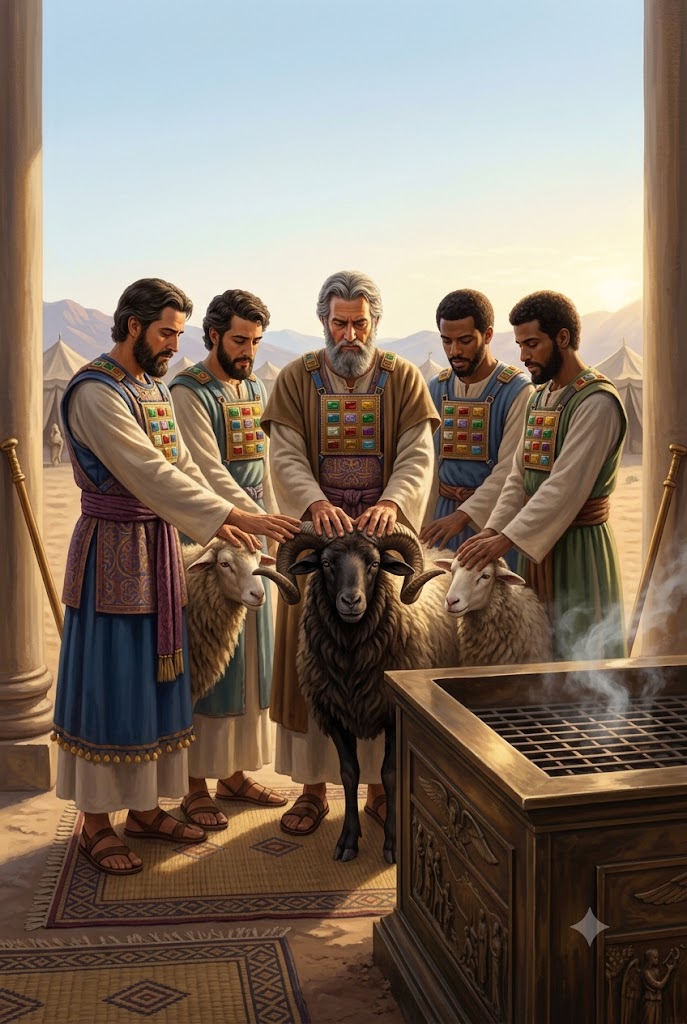
🐂 Act Two — The Sin Offering and the Fellowship Offering (Verses 10–28) Now a series of sacrifices unfolds in intricate detail.
“You shall also have the bull brought before the tabernacle of meeting, and Aaron and his sons shall put their hands on the head of the bull.”
Put their hands on the head. This act was deeply symbolic. Laying hands on an animal meant identifying oneself with it. It was a gesture acknowledging that this animal would die in one’s place.
“Now you shall kill the bull before the LORD, by the door of the tabernacle of meeting… it is a sin offering.”
A sin offering. The priest himself was also a sinner. Before he could intercede for others, his own sin first had to be dealt with. This principle is echoed again in Hebrews 5:3—that the high priest himself had to make atonement not only for the people, but also for himself.
Next follows the burnt offering.
“You shall also take one ram, and Aaron and his sons shall put their hands on the head of the ram… it is a burnt offering to the LORD; it is a sweet aroma, an offering made by fire to the LORD.”
Then follows the most distinctive procedure of the ordination, involving a second ram.
“You shall also take the other ram, and Aaron and his sons shall put their hands on the head of the ram. Then you shall kill the ram, and take some of its blood and put it on the tip of the right ear of Aaron and on the tip of the right ear of his sons, on the thumb of their right hand and on the big toe of their right foot.”
The tip of the ear, the thumb, the big toe. Applying blood to these three specific parts was a highly distinctive symbol. The ear represented hearing; the hand, action; the foot, the path one walked. The priest’s entire being—what he heard, what he did, and the very road he walked—now had to be consecrated with blood.
The subsequent procedure of waving the fat and meat of the fellowship offering is also described in detail.
“Then Moses put all these in Aaron’s hands and in his sons’ hands, and waved them as a wave offering before the LORD.”
All of this procedure was not a mere formality—it was a bodily expression of the priest’s complete devotion to God.
👨👦 Act Three — Seven Days of Ordination and the Continuing Sacrifice (Verses 29–46) The ordination did not end in a single day.
“And you shall offer a bull every day as a sin offering for atonement. You shall cleanse the altar when you make atonement for it, and you shall anoint it to sanctify it. Seven days you shall make atonement for the altar and sanctify it.”
Seven days. Holiness was not accomplished overnight. Through repeated procedures, both the person and the altar were gradually consecrated.
“The altar shall be most holy. Whatever touches the altar must be holy.”
And beyond all these repeated ceremonies, God gives instructions for the daily sacrifice that would continue going forward.
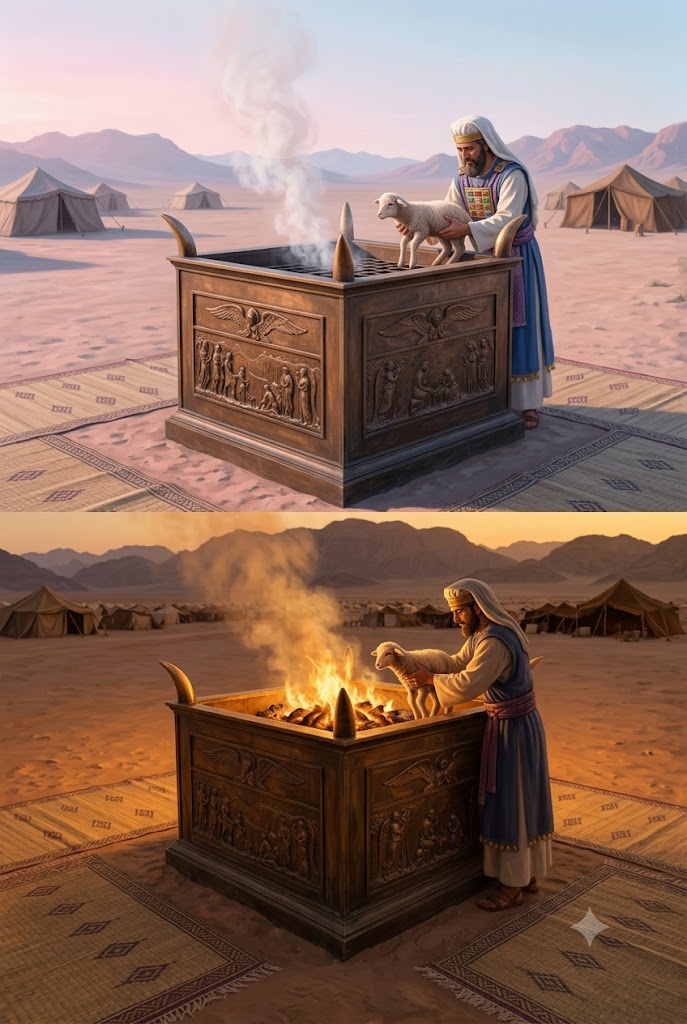
“Now this is what you shall offer on the altar: two lambs of the first year, day by day continually. One lamb you shall offer in the morning, and the other lamb you shall offer at twilight.”
Every morning, every evening. If the ordination had been a single, special event, this continual burnt offering became the very rhythm of Israel’s worship itself. Every morning, every evening, worship upon the altar was never to cease.
And finally, the ultimate purpose behind all of this is declared.
“There I will meet with the children of Israel, and the tabernacle shall be sanctified by My glory… I will dwell among the children of Israel and will be their God. And they shall know that I am the LORD their God, who brought them up out of the land of Egypt, that I may dwell among them. I am the LORD their God.”
That I may dwell among them. This was the ultimate purpose of the Tabernacle, the priesthood, and this entire intricate ordination process. The hope first declared in chapter 25—”let them make Me a sanctuary, that I may dwell among them”—is here confirmed once more, fully and completely.
🕊️ Reflection — A Journey Beginning in Washing, Ending in Dwelling The most important truth discovered in Exodus 29 is this: holiness was never completed all at once, but was accomplished progressively through washing, clothing, anointing, and sacrifice. And behind this entire process lay a single purpose—that God would dwell among His people.
The blood applied to the ear, hand, and foot asks us something important. Is what we hear, what we do, and the path we walk—all of it—devoted to God? Holiness was never devotion of a single part alone—it was the devotion of one’s whole being.
And the fact that the priest himself needed atonement. This teaches us humility. No matter how holy an office someone holds, they too remain a sinner in need of grace. This principle ultimately points to the true High Priest who, though entirely without sin, gave Himself for us—Christ (Hebrews 7:26–27).
Finally, this sentence: “that I may dwell among them.” This is the central thread running through all of Exodus, and through the whole of Scripture. God has always desired to dwell together with His people.
“In your own life, has God found a place to dwell?”
📣 Coming Up Next Exodus Chapter 30 — The Altar of Incense and the Sacred Objects Ordinances follow concerning the altar of incense, the atonement money for the Tabernacle service, the bronze basin, and the holy anointing oil and incense. The final details of worship unfold in the next episode.
#Exodus29 #OrdinationOfPriests #LayingOnOfHands #TheSinOffering #BloodOnEarHandAndFoot #SevenDaysOfConsecration #TheContinualBurntOffering #ThatIMayDwellAmongThem #TheExodus #BibleStudy #ChristianBlog #Exodus #OldTestament #Scripture #Church #DailyDevotional #BiblicalFaith #GodsPower