\PROLOGUE — Three Domains of Authority
Deuteronomy 17 addresses three distinct domains of authority — worship at the altar, difficult legal cases, and the kingship to be established in the future. A single principle runs through all these regulations: no human authority can stand above God’s word.
ACT ONE — Do Not Offer What Is Blemished (verse 1)
“Thou shalt not sacrifice unto the LORD thy God any bullock, or sheep, wherein is blemish, or any evilfavouredness: for that is an abomination unto the LORD thy God.”
The principle already established in Leviticus 22 is recalled once more — only the very best was to be offered to God.
ACT TWO — A Strict Judicial Process for Idolatry (verses 2–7)
“If there be found among you, within any of thy gates which the LORD thy God giveth thee, man or woman, that hath wrought wickedness in the sight of the LORD thy God, in transgressing his covenant, And hath gone and served other gods, and worshipped them… And it be told thee, and thou hast heard of it, and enquired diligently, and, behold, it be true, and the thing certain… then shalt thou bring forth that man or that woman… and shalt stone them with stones, till they die. At the mouth of two witnesses, or three witnesses, shall he that is worthy of death be put to death; but at the mouth of one witness he shall not be put to death.”
At the mouth of two or three witnesses. This principle establishes a fundamental pillar of judicial justice — a death sentence could never be carried out on the testimony of a single witness alone. This was a crucial safeguard against wrongful execution stemming from false accusation or personal grudge.
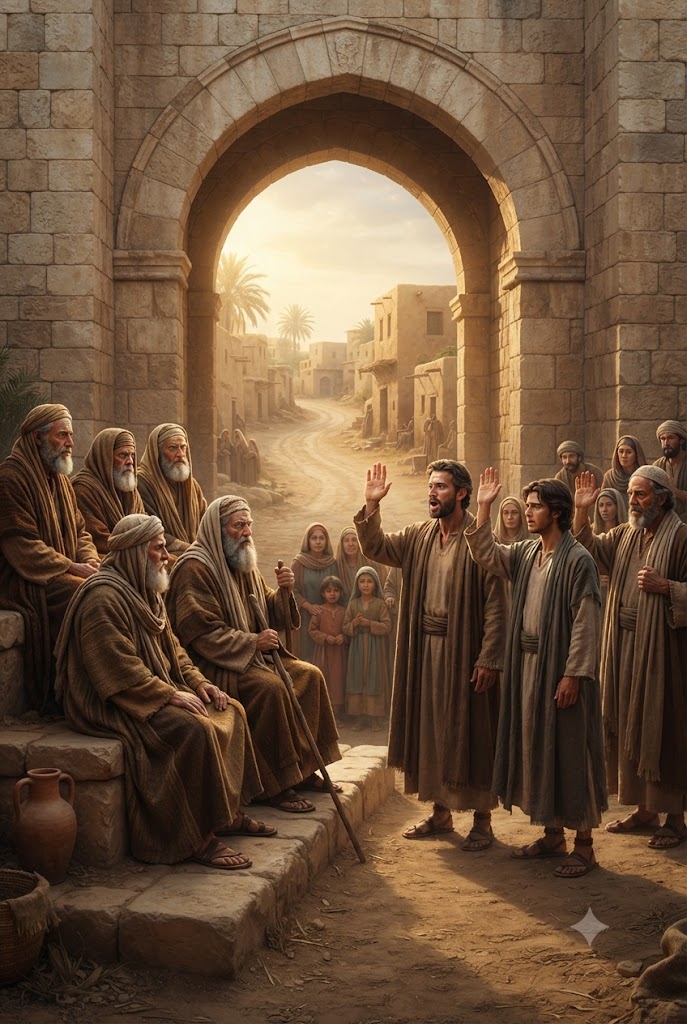
ACT THREE — Difficult Cases Go to the Central Court (verses 8–13)
“If there arise a matter too hard for thee in judgment, between blood and blood, between plea and plea, and between stroke and stroke, being matters of controversy within thy gates: then shalt thou arise, and get thee up into the place which the LORD thy God shall choose… And thou shalt do according to the sentence, which they of that place which the LORD shall choose shall shew thee; and thou shalt observe to do according to all that they inform thee: Thou shalt not decline from the sentence which they shall shew thee, to the right hand, nor to the left.”
To the central court… not turning to the right hand or the left. For complex cases local judges could not resolve, a centralized higher court system was provided. This served as a structural safeguard protecting justice from local bias or pressure.
ACT FOUR — Regulations Concerning the King, From Among the Brethren (verses 14–20)
The most notable portion of this chapter is a regulation given for kingship, at a point when no king yet existed.
“When… thou shalt say, I will set a king over me, like as all the nations that are about me; Thou shalt in any wise set him king over thee, whom the LORD thy God shall choose: one from among thy brethren shalt thou set king over thee: thou mayest not set a stranger over thee, which is not thy brother.”
One from among thy brethren. The king could never be a foreigner — he had to come, without exception, from among the Israelite brethren.
And the limitations imposed on the king are remarkably striking.
“But he shall not multiply horses to himself… Neither shall he multiply wives to himself, that his heart turn not away: neither shall he greatly multiply to himself silver and gold.”
He shall not multiply horses… wives… silver and gold. This was an explicit limitation against the typical form of ancient Near Eastern kingship — military power, political marriage, and accumulated wealth. Israel’s king had to be fundamentally different from the kings of other nations.
And the most remarkable requirement follows.
“And it shall be, when he sitteth upon the throne of his kingdom, that he shall write him a copy of this law in a book out of that which is before the priests the Levites: And it shall be with him, and he shall read therein all the days of his life: that he may learn to fear the LORD his God, to keep all the words of this law and these statutes, to do them: That his heart be not lifted up above his brethren, and that he turn not aside from the commandment, to the right hand, or to the left.”
A copy of this law… he shall read all the days of his life. The only genuine “power” required of Israel’s king was to personally copy the law and read it his entire life. Even the king was never above the law — he stood, like every other person, under God’s word.
REFLECTION — A Word That Stands Above Power
The most powerful political-theological insight Deuteronomy 17 gives us is that no human authority — whether judge or king — can ever stand above God’s word. True leadership was never the accumulation of power, but humble obedience before the word.
When you hold a position of influence or authority in your own life, does that power remain humbly under God’s word?
NEXT EPISODE PREVIEW
Deuteronomy Chapter 18 — the portion of the priests and Levites, and the remarkable prophecy of a prophet like Moses, follow.
Tags: #Deuteronomy17 #DoNotOfferWhatIsBlemished #ByTheMouthOfTwoOrThreeWitnesses #ToTheCentralCourt #AKingFromAmongTheBrethren #ReadTheLawAllHisLife #Deuteronomy #BibleDevotional #ChristianBlog #BibleStudy #OldTestament #Bible #Church #Devotion #Christianity #AWordAboveAllPower #AHumbleRuler #DailyDevotional