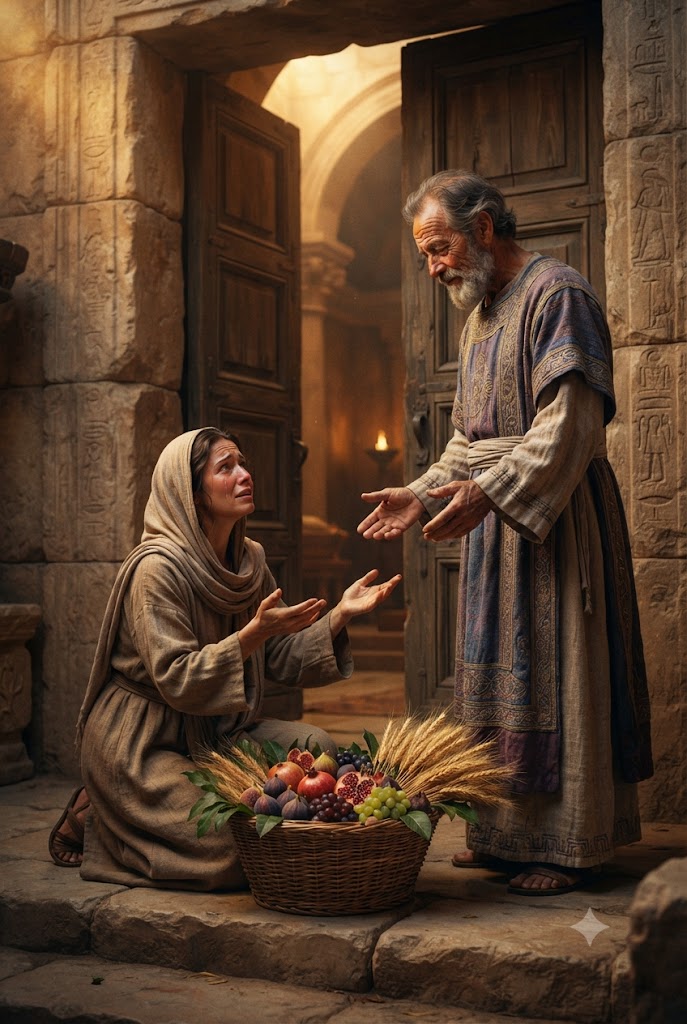
PROLOGUE — A Moment of Worship That Closes the Law Code
Deuteronomy 26 is the chapter that closes the entire detailed law code (chapters 12–26). Its conclusion appears not as an abstract legal summary, but as a remarkably concrete and moving moment of worship — a confession of faith to be recited while offering the firstfruits.
ACT ONE — A Historical Confession Offered With the Firstfruits (verses 1–11)
“And it shall be, when thou art come in unto the land which the LORD thy God giveth thee for an inheritance, and possessest it, and dwellest therein; That thou shalt take of the first of all the fruit of the earth, which thou shalt bring of thy land that the LORD thy God giveth thee, and shalt put it in a basket… and shalt go unto the place which the LORD thy God shall choose… And thou shalt speak and say before the LORD thy God.”
The confession that follows is one of the most compressed and beautiful summaries of redemptive history in all of Scripture.
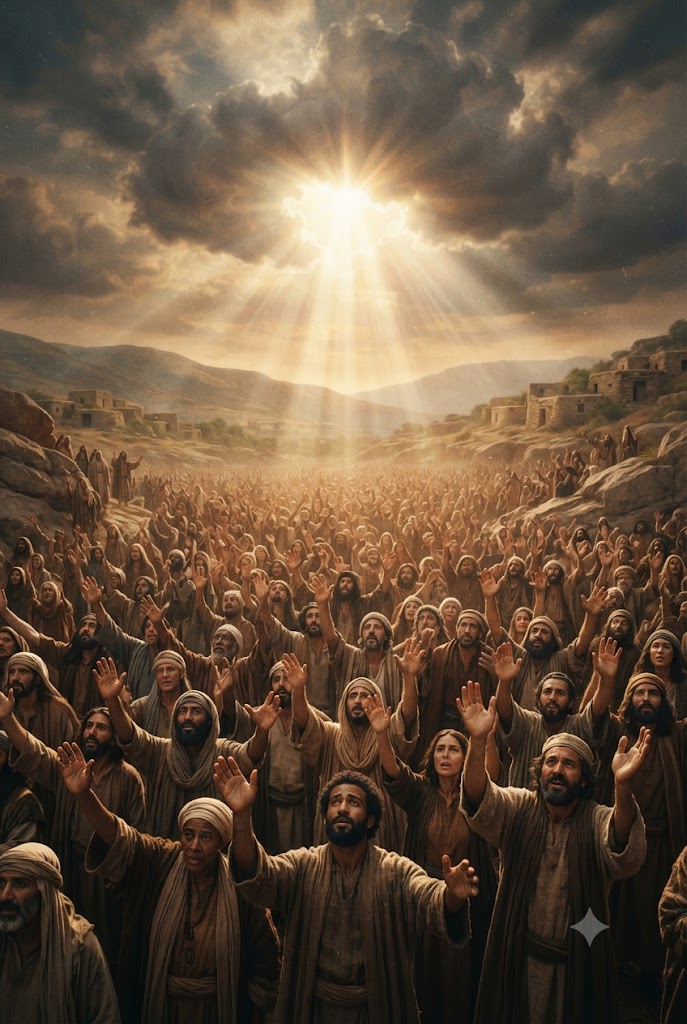
“A Syrian ready to perish was my father, and he went down into Egypt, and sojourned there with a few, and became there a nation, great, mighty, and populous: And the Egyptians evil entreated us, and afflicted us, and laid upon us hard bondage: And when we cried unto the LORD God of our fathers, the LORD heard our voice, and looked on our affliction, and our labour, and our oppression: And the LORD brought us forth out of Egypt with a mighty hand, and with an outstretched arm, and with great terribleness, and with signs, and with wonders: And he hath brought us into this place, and hath given us this land, even a land that floweth with milk and honey.”
A wandering Aramean was my father. This brief passage compresses the entirety of Israel’s redemptive history — beginning with Jacob (closely connected to the Aram region), through slavery in Egypt, the cry for help, God hearing, deliverance, and the promised land — into just a few sentences. This confession remains, to this day, the central text of the Jewish Passover Haggadah (the Passover liturgy).
And this confession closes with a concrete act of worship.
“And now, behold, I have brought the firstfruits of the land, which thou, O LORD, hast given me… and thou shalt worship before the LORD thy God: And thou shalt rejoice in every good thing which the LORD thy God hath given unto thee, and unto thine house, thou, and the Levite, and the stranger that is among you.”
ACT TWO — The Declaration for the Third-Year Tithe (verses 12–15)
Regarding the third-year tithe already addressed in chapter 14, a specific declaration to be spoken after distributing it is given here.
“I have brought away the hallowed things out of mine house, and also have given them unto the Levite, and unto the stranger, to the fatherless, and to the widow, according to all thy commandments which thou hast commanded me… Look down from thy holy habitation, from heaven, and bless thy people Israel, and the land which thou hast given us… a land that floweth with milk and honey.”
I have done according to all thy commandments. This declaration was an honest verification of obedience — not merely claiming to have kept the regulation, but an act of worship formally confessing that obedience before God.
ACT THREE — Mutual Affirmation of the Covenant (verses 16–19)
This chapter, and the entire detailed law code, closes with a remarkably powerful mutual covenant affirmation.
“This day the LORD thy God hath commanded thee to do these statutes and judgments: thou shalt therefore keep and do them with all thine heart, and with all thy soul. Thou hast avouched the LORD this day to be thy God, and to walk in his ways, and to keep his statutes, and his commandments, and his judgments, and to hearken unto his voice: And the LORD hath avouched thee this day to be his peculiar people, as he hath promised thee… and to make thee high above all nations which he hath made, in praise, and in name, and in honour; and that thou mayest be an holy people unto the LORD thy God, as he hath spoken.”
Thou hast avouched… the LORD hath avouched. This bidirectional affirmation — the people declaring the LORD to be their God, and God declaring them to be His people — compresses the very essence of covenant relationship. It was never a one-sided command, but a relationship of mutual devotion.
REFLECTION — Worship That Remembers History
The deepest insight Deuteronomy 26 gives us is that genuine worship is always offered while remembering concrete history — where we came from, and what God has done. A wandering ancestor, an enslaved people, a God who heard their cry — repeatedly confessing this story was the very essence of worship.
When you worship, do you confess the concrete history of salvation God has worked in your own life?
NEXT EPISODE PREVIEW
Deuteronomy Chapter 27 — the ceremony of proclaiming blessing and curse at Mount Gerizim and Mount Ebal begins, opening the covenant renewal section (chapters 27–30).
Tags: #Deuteronomy26 #AWanderingArameanWasMyFather #ConfessionWithFirstfruits #ThirdYearTitheDeclaration #MutualAffirmationOfTheCovenant #APeculiarPeople #Deuteronomy #BibleDevotional #ChristianBlog #BibleStudy #OldTestament #Bible #Church #Devotion #Christianity #PassoverHaggadah #WorshipThatRemembersHistory #DailyDevotional