PROLOGUE — Consistent Generosity Woven Through Scattered Regulations
Deuteronomy 24 addresses divorce, a special exemption for newlyweds, the handling of pledges, and gleaning regulations. Though varied on the surface, running through all these regulations is careful concern for society’s vulnerable — a divorced woman, a poor debtor, the orphan, the widow, the stranger.

ACT ONE — A Certificate of Divorce, and Limits on Remarriage (verses 1–4)
“When a man hath taken a wife, and married her, and it come to pass that she find no favour in his eyes, because he hath found some uncleanness in her: then let him write her a bill of divorcement, and give it in her hand, and send her out of his house… And her latter husband… her former husband, which sent her away, may not take her again to be his wife, after that she is defiled; for that is abomination before the LORD.”
Let him write her a bill of divorcement. The core purpose of this regulation was never to encourage divorce, but to provide a divorced woman with an official document — legal proof guaranteeing her freedom to remarry. Jesus, in Matthew 19, pointed out that this regulation was a concession given “because of the hardness of your hearts,” teaching that the original ideal of marriage stood far higher.
ACT TWO — Exemption for the Newly Married (verse 5)
“When a man hath taken a new wife, he shall not go out to war, neither shall he be charged with any business: but he shall be free at home one year, and shall cheer up his wife which he hath taken.”
Free at home one year… shall cheer up his wife. This extends the principle already mentioned in chapter 20 — the beginning of a new marital relationship was precious enough to take priority even over national duty.
ACT THREE — Prohibiting the Taking of Millstones as Pledges, and Kidnapping (verses 6–9)
“No man shall take the nether or the upper millstone to pledge: for he taketh a man’s life to pledge… If a man be found stealing any of his brethren of the children of Israel, and maketh merchandise of him, or selleth him; then that thief shall die.”
He taketh a man’s life to pledge, for the millstone. The millstone was an essential tool for daily survival — taking it as collateral was, in effect, seizing the very means of that person’s survival. This careful principle shows that a creditor’s rights could never be absolute in the face of a debtor’s survival.
ACT FOUR — What Remains of the Field, for the Poor (verses 10–22)
The latter half of this chapter moves through restraint in handling pledges, prompt payment of wages, and fair justice, leading to the most beautiful regulation of this chapter.
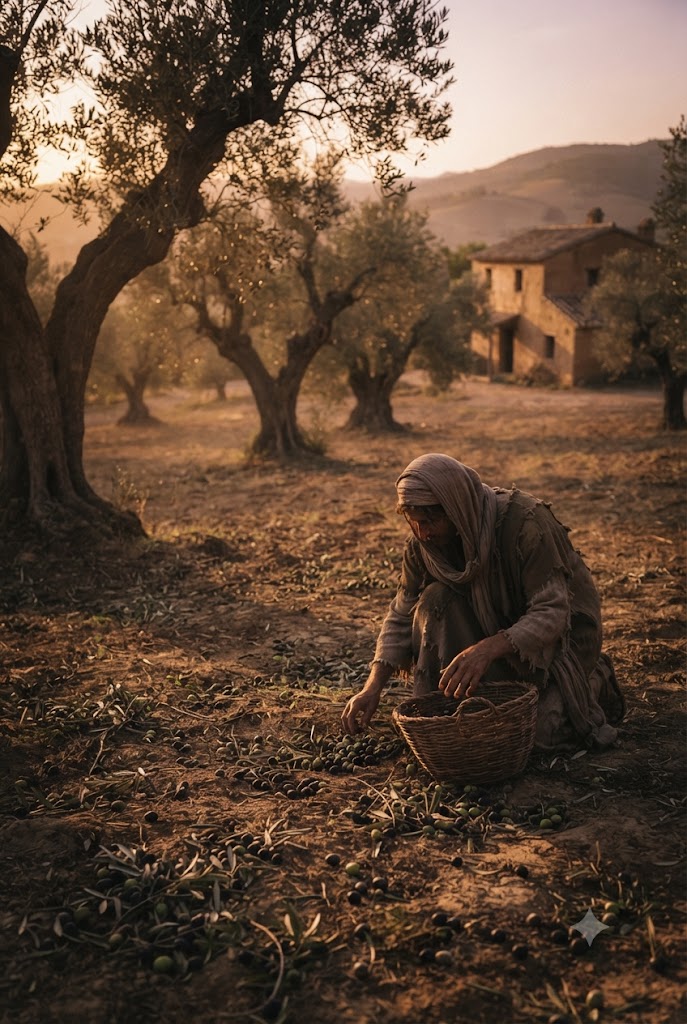
“When thou cuttest down thine harvest in thy field, and hast forgot a sheaf in the field, thou shalt not go again to fetch it: it shall be for the stranger, for the fatherless, and for the widow… When thou beatest thine olive tree, thou shalt not go over the boughs again: it shall be for the stranger, for the fatherless, and for the widow… When thou gatherest the grapes of thy vineyard, thou shalt not glean it afterward: it shall be for the stranger, for the fatherless, and for the widow.”
Thou shalt not go back for it… it shall be for them. This regulation extends the gleaning principle of Leviticus 19 to grain, olives, and the entire vineyard. And the reason is stated explicitly.
“And thou shalt remember that thou wast a bondman in the land of Egypt: therefore I command thee to do this thing.”
Remember that thou wast a bondman. This refrain, repeated throughout Deuteronomy — that Israel’s own painful past must become the basis for generosity toward other vulnerable people now — is reaffirmed once more in this chapter.
REFLECTION — God’s Heart Found Even in a Scattered Sheaf
What Deuteronomy 24 teaches us is that God’s heart attends not only to great principles, but even to a single sheaf scattered in a field. A divorced woman, a newlywed, a poor debtor, the stranger, the orphan, and the widow — care for all of them was woven tightly into God’s law.
When you gather your own harvest and possessions, do you practice the generosity of deliberately leaving something for those who need it most?
NEXT EPISODE PREVIEW
Deuteronomy Chapter 25 — the regulation of levirate marriage, and the final principles concerning honest weights and measures, follow.
Tags: #Deuteronomy24 #CertificateOfDivorce #ExemptionForTheNewlyMarried #DoNotTakeTheMillstoneAsPledge #LeaveItForTheStrangerOrphanWidow #RememberThatThouWastABondman #Deuteronomy #BibleDevotional #ChristianBlog #BibleStudy #OldTestament #Bible #Church #Devotion #Christianity #Matthew19 #GodsHeartInAScatteredSheaf #DailyDevotional