Exodus Series — Episode 19
🔥 Prologue — Arriving Not at a Destination, But at a Threshold Jethro had returned to his own land.
Now Israel enters a new phase of the wilderness journey. Three months after leaving Egypt, they finally arrive at Mount Sinai. But this was not the end of the journey. It was, instead, the threshold where the real story would begin.
At this mountain, Israel is reborn—not merely as a freed multitude of former slaves, but as God’s covenant people. Exodus 19 captures the moment that transformation begins: God descending upon the mountain, and declaring to the people their true identity.
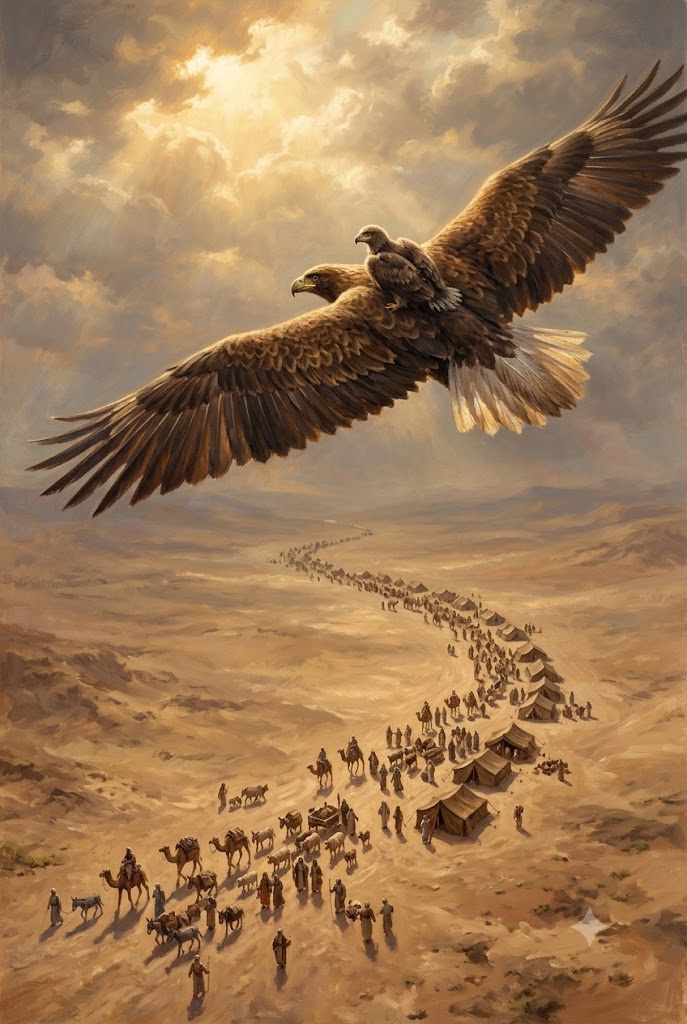
🏔️ Act One — A People Carried on Eagles’ Wings (Verses 1–9) “In the third month after the children of Israel had gone out of the land of Egypt, on the same day, they came to the Wilderness of Sinai.”
The third month. This precise notation of time underscores the significance of this moment. The journey from Egypt to Sinai was the overture to a new chapter in Israel’s history.
“And Moses went up to God, and the LORD called to him from the mountain, saying, ‘Thus you shall say to the house of Jacob, and tell the children of Israel.'”
Here God summarizes the entire journey so far in a single image.
“You have seen what I did to the Egyptians, and how I bore you on eagles’ wings and brought you to Myself.”
I bore you on eagles’ wings. Is there a more intimate expression than this? Not the language of plague and judgment, not the language of military victory—but the image of a mother eagle carrying her young upon her wings. This had not been a journey of being dragged along by force, but one of being carried, held close.
And the purpose of this journey is proclaimed.
“Now therefore, if you will indeed obey My voice and keep My covenant, then you shall be a special treasure to Me above all people; for all the earth is Mine. And you shall be to Me a kingdom of priests and a holy nation.”
A kingdom of priests, a holy nation. These two expressions define Israel’s identity. A kingdom of priests meant a people who would serve as mediators between God and the nations. A holy nation meant a people set apart from the world, belonging to God. Israel was not saved merely for its own sake—it was called for a mission toward the world.
Moses conveyed this word to the people.
“So Moses came and called for the elders of the people, and laid before them all these words which the LORD commanded him. Then all the people answered together and said, ‘All that the LORD has spoken we will do.'”
All that the LORD has spoken we will do. The people answered as one. But they did not yet know how often this confident answer would soon waver.
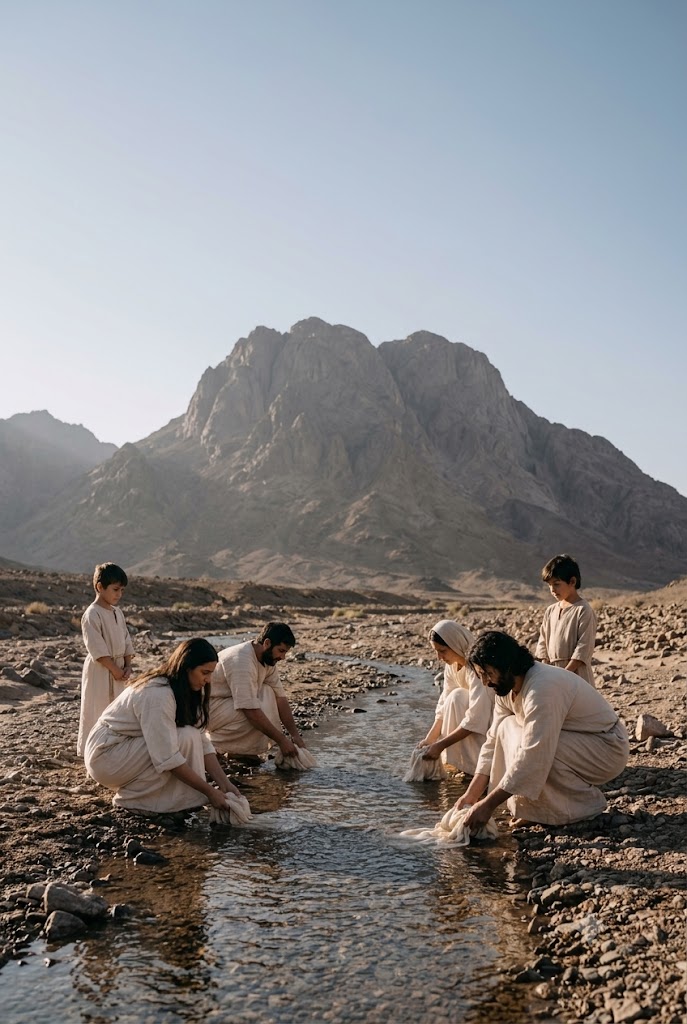
🔥 Act Two — Preparation and Boundaries (Verses 10–15) Before His descent, God commands the people to prepare.
“Then the LORD said to Moses, ‘Go to the people and consecrate them today and tomorrow, and let them wash their clothes. And let them be ready for the third day. For on the third day the LORD will come down upon Mount Sinai in the sight of all the people.'”
Consecrate them, let them wash their clothes. Coming before God’s presence could not happen without preparation. The symbolic act of physical purification marked a preparation of the heart.
And a boundary is set.
“You shall set bounds for the people all around, saying, ‘Take heed to yourselves that you do not go up to the mountain or touch its base. Whoever touches the mountain shall surely be put to death.'”
Whoever touches the mountain shall surely be put to death. This grave warning reveals how overwhelming God’s holiness truly was. It was not that the mountain itself was sacred, but that the presence of God who would descend upon it was so utterly holy. No one could approach it carelessly, without preparation.
“Not a hand shall touch him, but he shall surely be stoned or shot with an arrow; whether man or beast, he shall not live. When the trumpet sounds long, they shall come near the mountain.”
Within this regulation lay not only fear, but also God’s own care. Being exposed to the presence of a holy God without preparation could itself prove fatal to the people. The boundary was not punishment—it was protection.
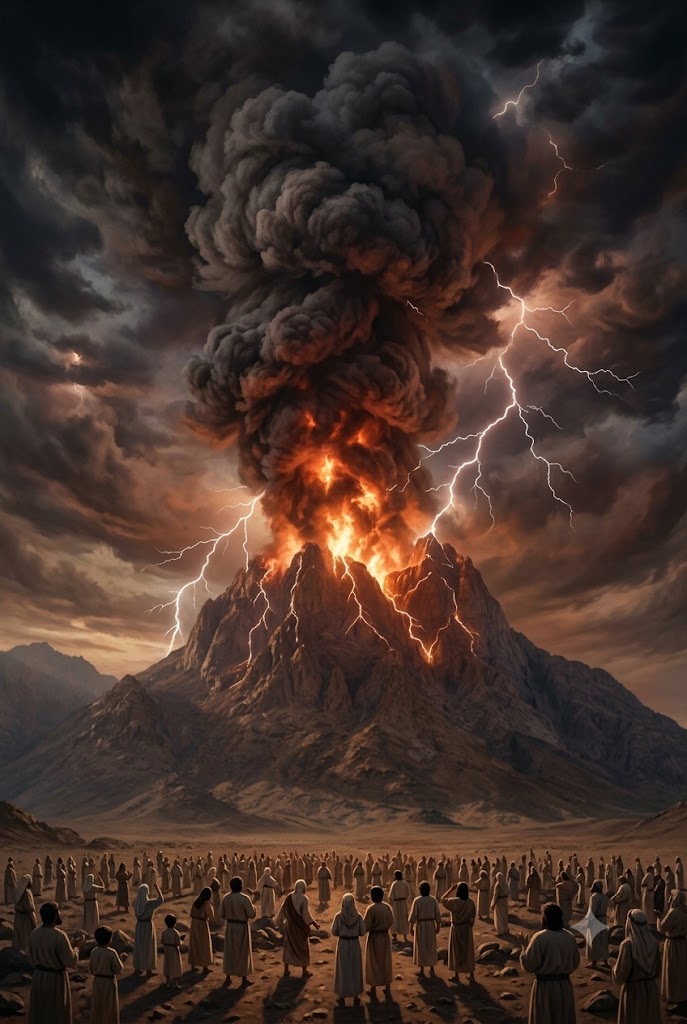
⚡ Act Three — The Descent of God (Verses 16–25) And on the morning of the third day, that moment arrived.
“Then it came to pass on the third day, in the morning, that there were thunderings and lightnings, and a thick cloud on the mountain; and the sound of the trumpet was very loud, so that all the people who were in the camp trembled.”
Thunderings and lightnings, a thick cloud, a very loud trumpet. This was no quiet, gentle presence. It was a descent that overwhelmed the senses, one that provoked fear. The description that all the people trembled gives a sense of just how intense it was.
“And Moses brought the people out of the camp to meet with God, and they stood at the foot of the mountain. Now Mount Sinai was completely in smoke, because the LORD descended upon it in fire. Its smoke ascended like the smoke of a furnace, and the whole mountain quaked greatly.”
The whole mountain quaked greatly. All of nature was responding to God’s presence. Could any scene more overwhelmingly display God’s majesty than this?
“And when the blast of the trumpet sounded long and became louder and louder, Moses spoke, and God answered him by voice.”
And God calls Moses up the mountain, once again reaffirming the boundary.
“And the LORD said to Moses, ‘Go down and warn the people, lest they break through to gaze at the LORD, and many of them perish. Also let the priests who come near the LORD consecrate themselves, lest the LORD break out against them.'”
This warning is repeated twice, even three times. Before God’s holiness, human curiosity or impatience could prove fatal. Even Moses himself had to reconfirm this warning once more.
“So Moses went down to the people and spoke to them.”
The chapter closes quietly, yet in a scene charged with tension and obedience. The stage was now fully set for the giving of the Ten Commandments, soon to follow in the next chapter.
🕊️ Reflection — Grace on the Wing, Awe at the Foot of the Mountain Two contrasting images stand side by side in Exodus 19. One is the intimate image of an eagle carrying its young on its wings. The other is the overwhelming image of holiness—touch the mountain, and you die. These seem contradictory, but together they form the full, whole way of knowing God.
We often try to reduce God to only one image—either only a gentle Father, or only a fearsome judge. But Scripture demands we hold both truths at once. God is near enough to carry us on His wings, and holy enough to make a whole mountain quake.
And the three days the people had to spend consecrating themselves—coming before God’s presence cannot be done on impulse. When we come before God in worship and prayer today, the preparation of our hearts is never a trivial matter.
Let us remember the people’s confident answer: “All that the LORD has spoken we will do.” That answer was sincere, but their lives ahead would repeatedly fail to keep it. Our own resolutions are much the same. What we need is not merely the resolution itself, but the grace that sustains it.
“Do you know God only as the gentleness of the wing—or also as the holiness that shakes the mountain?”
📣 Coming Up Next Exodus Chapter 20 — The Ten Commandments At last, God Himself proclaims the Ten Words from Mount Sinai. The core provisions of the covenant that would shape the whole of Israel’s life unfold in the next episode.
#Exodus19 #MountSinai #EaglesWings #KingdomOfPriests #HolyNation #TheDescentOfGod #WhoeverTouchesTheMountain #PreparingForCovenant #TheExodus #BibleStudy #ChristianBlog #Exodus #OldTestament #Scripture #Church #DailyDevotional #BiblicalFaith #GodsPower