In our video on 1 Samuel, we met the three main characters of the book: Samuel, Saul, and David. The literary structure of 1 Samuel first introduced us to Samuel, followed by the rise and fall of King Saul, contrasted with the rise of David.
2 Samuel focuses on the life of David as the king of Israel, dividing it into two parts: first, a period of success and blessing, followed by a time of major moral failure and its tragic consequences. The book then concludes with a well-crafted ending that reflects on the good and bad in David’s life, leaving us with a hope for a future king from his lineage.
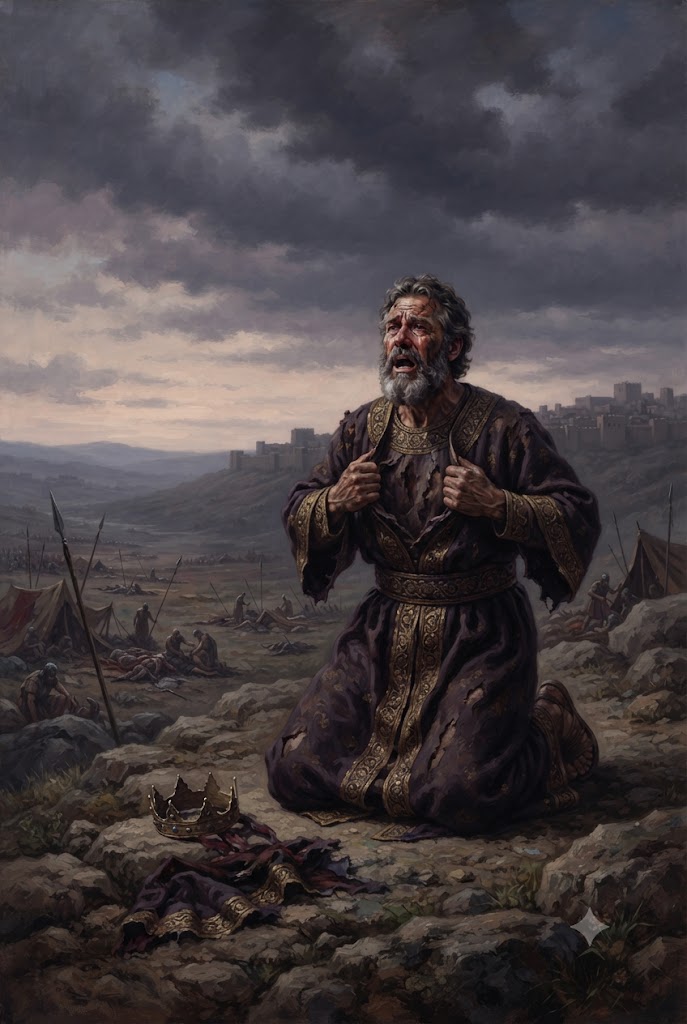
2 Samuel begins with the death of Saul. David shocks everyone by composing a long lament mourning the death of the very person who tried to kill him. Once again, the author highlights David’s humility and compassion, portraying him as a man who even weeps over the death of his enemy.
Following this, David experiences a season of success and divine blessing. All the tribes of Israel come to David, unify, and plead with him to be their king. The very first thing David does as king is conquer Jerusalem, making it the capital of Israel and renaming it Zion. From then on, he wins numerous battles and expands Israel’s territory.
Desiring to make Jerusalem not only the political capital but also the spiritual capital, David brings the Ark of the Covenant to Jerusalem. In 2 Samuel chapter 7, he tells God, “Here we live in a house of cedar, but the ark of God remains in a tent. I want to build a house for God.” But God replies, “Your intention is good, but instead, I will build a house—a dynasty—for you.”
2 Samuel 7 is a pivotal chapter for understanding the storyline of the whole Bible. God promises David that a future king will come from his lineage, who will build a house for God’s name and establish an eternal kingdom. This messianic promise given to David is further developed later in the Psalms and the Prophets. This future king is also connected to God’s promise to Abraham, through whose future messianic kingdom all nations will be blessed.
Just as God promises these blessings, things take a severely wrong turn. A precious soldier named Uriah is sacrificed due to a critical sin committed by David. From his rooftop, David sees Uriah’s wife, Bathsheba, bathing, brings her to the palace, and she becomes pregnant. To cover this up, David has Uriah killed and then marries her. It is horrific.
When the prophet Nathan points out his sin, David immediately acknowledges his wrong. He falls into deep grief, repents, and asks for forgiveness, and God forgives him. However, God does not erase the consequences of David’s choices. As a result of this terrible choice, David’s household and kingdom are torn apart.
This tragic story bears a striking resemblance to the downfall of Saul. David’s sons repeat his mistakes in even more tragic ways. Amnon sexually assaults his half-sister Tamar, and Tamar’s full brother Absalom finds out and murders Amnon. Absalom then secretly plots to overthrow his father David from the throne and launches a massive rebellion.
For the second time in his life, David becomes a fugitive, fleeing into the wilderness, but this time not with a clear conscience. Eventually, the rebellion ends when Absalom is killed, leaving David’s heart broken. Once again, he mourns the death of someone who tried to kill him. In his later years, David regains the throne, but he remains grief-stricken and scarred by the tragic consequences of his sin.
The book closes with a well-arranged conclusion. While the stories are not strictly in chronological order, they form a brilliant symmetrical literary structure. The outer two stories describe the early part of David’s reign, comparing the failures of Saul and David and showing how their poor decisions harmed others. The inner two stories focus on David and his mighty warriors fighting the Philistines. Interestingly, both highlight David’s vulnerabilities in battle; unlike the triumphant David of chapters 1 through 9, we now see a weakened David dependent on the help of others.
At the very center are two poems that serve as a memoir of David reflecting on his life. He remembers how the gracious God rescued him from danger and praises the God who remains faithful to His covenant promises to him and his household. Both poems conclude by looking forward in hope to the future king who will establish an eternal kingdom, linking back to God’s promises and the song of Hannah at the beginning of the work.
These key themes placed at the beginning, middle, and end weave together the core message of 1 and 2 Samuel: despite the flaws and sins of both Saul and God’s anointed kings, God continues to advance His redemptive plan. God humbled the pride of Saul and David, yet lifted David up when he was humble. The ultimate hope of this book points far beyond David, looking forward to the future coming of the Messiah King who will establish God’s kingdom and bring blessing to all nations.
Tags: #2Samuel #BookOf2Samuel #KingDavid #Bathsheba #Uriah #AbsalomsRebellion #NathanTheProphet #ArkOfTheCovenant #EternalKingdom #BibleOverview #BibleStudy #KJVBible #Christian #Christianity #BibleStory #OldTestament #GodsFaithfulness #SinAndRepentance #BibleSummary #MessianicPromise