PROLOGUE — From Sinai, Toward the Wilderness
Numbers begins at Sinai. After the tabernacle was raised in Exodus and the regulations of worship and holiness surrounding it were given in Leviticus, Israel now had to prepare to actually move toward the promised land. Their first step was, surprisingly — a census.
The Hebrew title, Bemidbar — “in the wilderness.” The book’s true title points not to numbers, but to a place. Yet the wilderness journey itself begins with this precise act of counting.
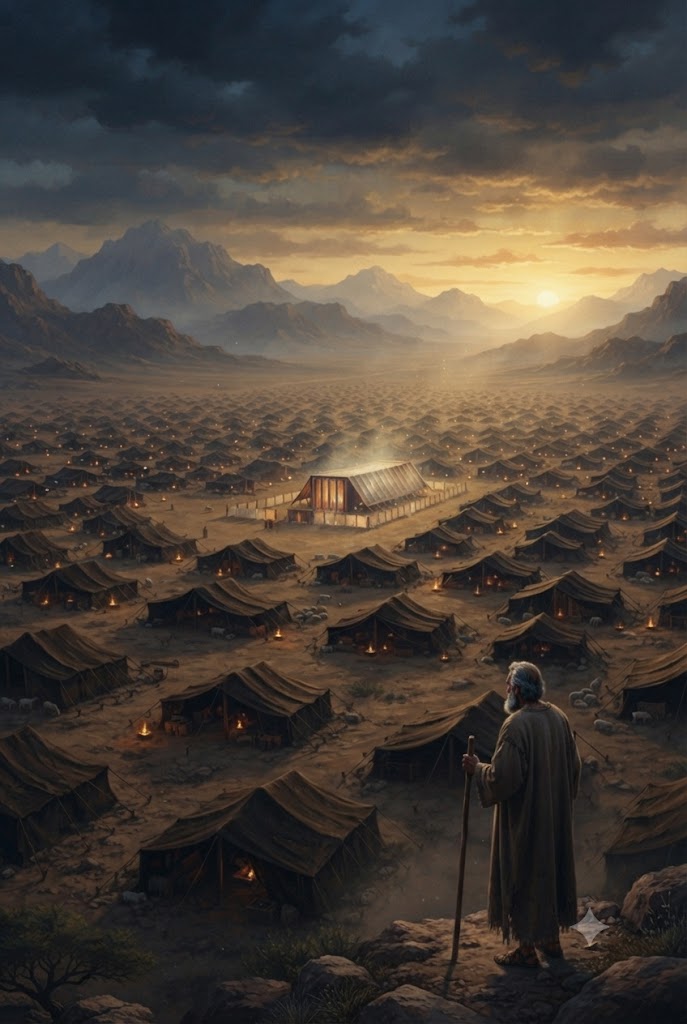
ACT ONE — Number Every Man Able to Go to War (verses 1–19)
“Take ye the sum of all the congregation of the children of Israel, after their families, by the house of their fathers, with the number of their names, every male by their polls; From twenty years old and upward, all that are able to go forth to war in Israel: thou and Aaron shall number them by their armies.”
Able to go forth to war. This census was never mere statistics. Israel was being organized into an army bound for Canaan. God was establishing this people not as a disorganized band of nomads, but as His own carefully ordered army.
A leader was explicitly appointed from each tribe — reflecting a principle of communal responsibility and representation. God’s people were never an anonymous crowd, but tribes and families called by name.
ACT TWO — Counted by Tribe: An Army Over Six Hundred Thousand (verses 20–46)
The text lists the count of each tribe one by one: Reuben, Simeon, Gad, Judah, Issachar, Zebulun, Ephraim, Manasseh, Benjamin, Dan, Asher, Naphtali — totaling 603,550.
603,550. A number that excluded women, children, and the elderly. Israel’s actual total population would have been far larger still. This vast number stood as living proof that the promise given to Abraham in Genesis — “as the stars of heaven, and as the sand which is upon the sea shore” — was being fulfilled quite literally.
ACT THREE — The Tribe of Levi Excluded from the Count (verses 47–54)
“But thou shalt not number the tribe of Levi, neither take the sum of them among the children of Israel: But thou shalt appoint the Levites over the tabernacle of testimony, and over all the vessels thereof, and over all things that belong to it.”
Thou shalt not number. The tribe of Levi alone was excluded from this military census. Their role was not warfare, but the care and transport of the tabernacle. Within the community of Israel, two callings existed side by side — those who fought and those who served. Both were essential; both were callings ordained by God.
REFLECTION — Not Numbers, But Names
Numbers 1 may appear at first glance to be tedious statistics. But in Scripture, a census was never an anonymous act of counting. Each tribe, each family, each leader’s name was specifically recorded. God did not see this people of over six hundred thousand as a single undifferentiated mass — He knew them by tribe, by family, by name.
Do you trust that God knows you by name, even within a vast multitude?
NEXT EPISODE PREVIEW
Numbers Chapter 2 — the orderly structure of Israel’s camp, arranged around the tabernacle, unfolds.
Tags: #Numbers1 #WildernessCensus #AbleToGoToWar #ArmyOverSixHundredThousand #LeviExcludedFromCount #Bemidbar #Numbers #BibleDevotional #ChristianBlog #BibleStudy #OldTestament #Bible #Church #Devotion #Christianity #GodsArmy #PromiseToAbrahamFulfilled #DailyDevotional