This is the end of Samson’s story. The chapter splits into two parts — a short episode in Gaza, and then the much longer Delilah episode that follows.
In Gaza, Samson visits a prostitute, word gets out, and the city gates are shut against him — people figure they’ll just wait for morning and kill him. Instead, at midnight, he gets up, pulls out the gate doors and both posts, hoists them onto his shoulders, and carries them all the way to a hilltop near Hebron. Ripping an entire city gate out of the ground and walking off with it — this brief scene confirms his strength is still fully intact. The problem is that no one, not even Samson, has any idea when that will change.
Then Delilah shows up, from the valley of Sorek.
The Philistines approach her with an offer — eleven hundred pieces of silver each — if she can find out the secret of his strength and how to bind him. From here the chapter falls into an almost game-like rhythm.
First, Samson lies and says fresh, undried bowstrings will do it. Delilah ties him up with them, ambushers shout “The Philistines be upon thee, Samson,” and he snaps the bowstrings like burnt thread.
Second, he lies again — new ropes this time. Same result.
Third, he tells her to weave seven locks of his hair into the loom. Another lie, another failure.
Even at this point, something’s strange. Three times he’s caught lying, and three times he goes right back to her.
Delilah’s line here is the sharpest in the whole chapter: “How canst thou say, I love thee, when thine heart is not with me? thou hast mocked me these three times, and hast not told me wherein thy great strength lieth.” She presses him daily, wears him down with her words, until his soul is vexed unto death.
Vexed unto death is exactly the right phrase. Eventually he tells her the truth.
“There hath not come a razor upon mine head; for I have been a Nazarite unto God from my mother’s womb: if I be shaven, then my strength will go from me, and I shall become weak, and be like any other man.”
The text tells us right away that she could see he had told her all his heart. She calls the Philistine lords back, lulls him to sleep on her knees, and has someone shave off the seven locks of his hair.
The next sentence is, I think, one of the saddest in the whole book.
“And he wist not that the LORD was departed from him.”
That line is chilling. Samson himself didn’t know his strength was already gone. He still believed he was the same man he’d always been.
The Philistines seize him, put out his eyes, bind him with brass fetters, and set him to grinding grain in the prison — blind, and made into a spectacle.
But then one tiny sentence gets inserted right at the end of this part: “the hair of his head began to grow again after he was shaven.” That’s the setup for everything that follows.
The Philistines gather in the temple of Dagon and bring him out to mock him. He asks the boy guiding him to let him touch the pillars. And he prays.
“O Lord GOD, remember me, I pray thee, and strengthen me, I pray thee, only this once, O God, that I may be at once avenged of the Philistines for my two eyes.”
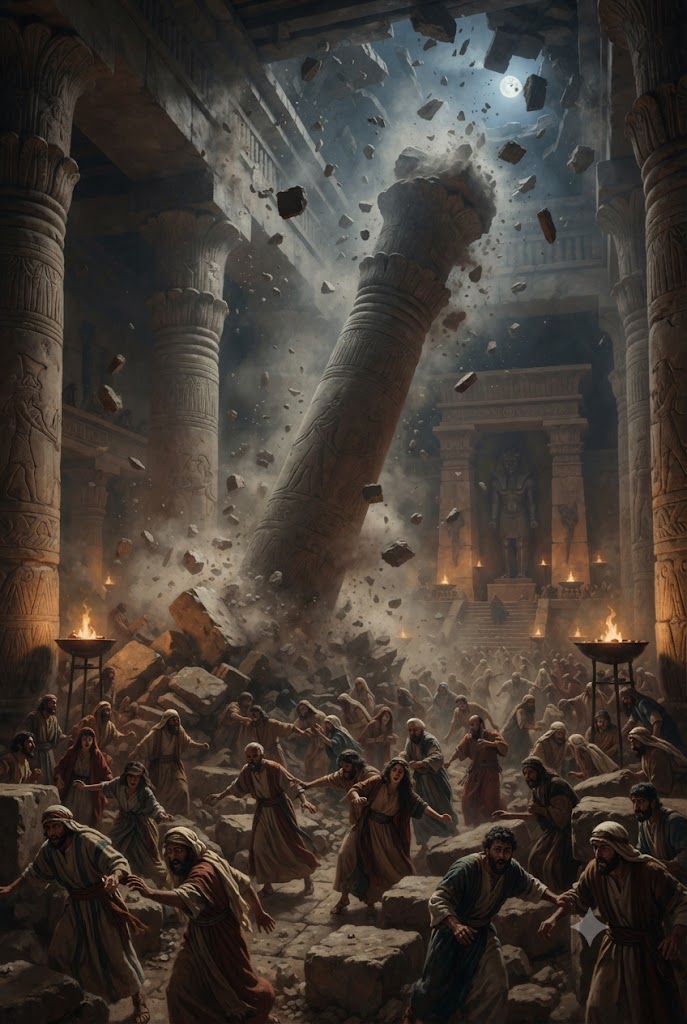
He pushes the two pillars with all his might, and the temple collapses on everyone inside, himself included. “So the dead which he slew at his death were more than they which he slew in his life.”
Going back over Samson’s whole story, it seems like he never fully understood where his own strength came from, right up to the very end. Only at the lowest point — blind, mocked, humiliated — does he finally pray a prayer that admits the strength was never his own. And that prayer is what makes his last act a victory.
Tags: #Judges16 #Delilah #SamsonsHair #HeWistNotThatTheLordWasDeparted #TheTempleOfDagonFalls #TheFinalPrayer #Judges #BibleDevotional #BibleStudy #OldTestament