Genesis Series — Episode 29
🔥 Prologue — The Master Deceiver Outmaneuvered by a Secular Professional
Armed with the unswerving companion treaty issued at Bethel, Jacob finalized his long regional transit, stepping onto the geography of the eastern lands of Haran. At a strategic well inside the frontier, he encountered Rachel, the beautiful daughter of his uncle Laban. Pierced by an immediate, systemic affection, Jacob committed to render seven years of intense physical infrastructure to secure her as his bride—a lease of time that felt like a mere collection of days due to the purity of his focus.
Yet, inside the boundaries of this transition, the sovereign law of reciprocity deployed a massive boomerang into Jacob’s rhythm. The master manipulator who historically weaponized a disguise to slip past his blind father was thoroughly outmaneuvered under the cover of a pitch-black wedding night. The veiled bride was not Rachel, but her older sister Leah. “What is this you have done to me? I served you for Rachel, didn’t I? Why have you deceived me?” Wailing against the cold terms of his uncle, Jacob was forced to sign a secondary 7-year layout of labor. Discover how the gears of divine Providence exploit even domestic frictions to establish the permanent foundations of the twelve tribes of Israel.
🌙 Act One — The Eastern Spring and the Strategic Alignment with Rachel (Verses 1–14)
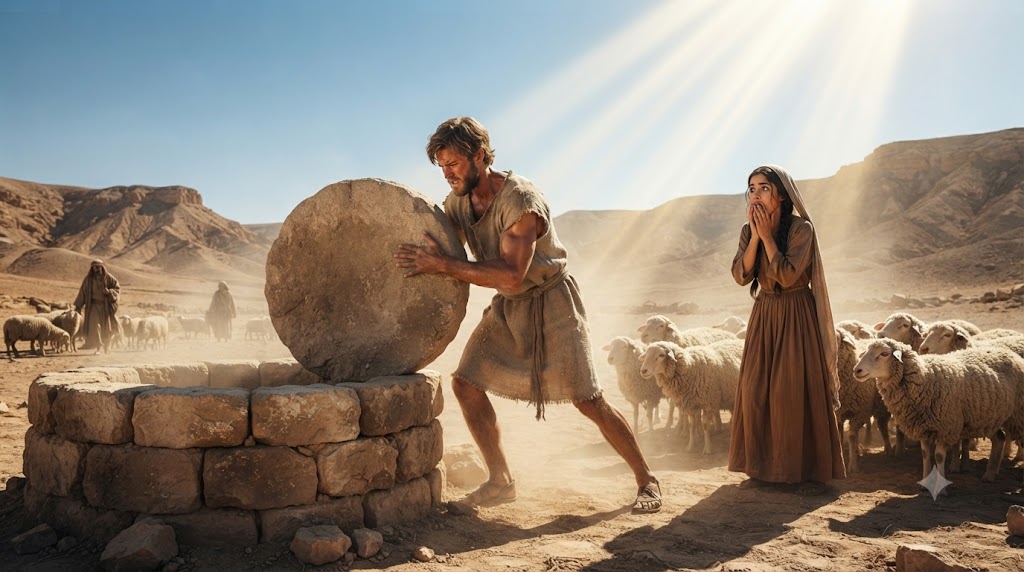
Then Jacob continued on his journey and came to the land of the eastern peoples. There he saw a well in the open country, with three flocks of sheep lying near it because the flocks were watered from that well. He edited his inquiry to the local herders: “Do you know Laban, Nahor’s grandson?” “We know him,” they replied. “He is well, and here comes his daughter Rachel with the sheep.” While he was still talking with them, Rachel came with her father’s sheep, for she was a shepherd.
“When Jacob saw Rachel daughter of his uncle Laban and his uncle’s sheep, he went over and rolled the stone away from the mouth of the well…”
He watered his uncle’s flock, kissed Rachel, and wept aloud, mapping out his domestic pedigree as Rebekah’s son. Rachel executed a sprint to alert her house. When Laban audited the arrival of his sister’s son, he ran to meet him, brought him into his home, and stated: “You are my own flesh and blood.” Jacob remained within his parameters for a month.
💛 Act Two — Seven Years Rendered for Love and the Midnight Contract Deception (Verses 15–25)
Laban said to him, “Just because you are a relative of mine, should you work for me for nothing? Tell me what your wages should be.” Now Laban had two daughters; the name of the older was ‘Leah,’ and the name of the younger was ‘Rachel.’ Leah had weak eyes, but Rachel had a lovely figure and was beautiful. Jacob was in love with Rachel and said, “I’ll work for you seven years in return for your younger daughter Rachel.”
“So Jacob served seven years to get Rachel, but they seemed like only a few days to him because of his love for her…”
When the chronometer hit the 7-year ceiling, Jacob demanded his bride. Laban assembled the regional population, initiating a major feast. Yet under the dark canopy of evening, he substituted Leah into the marriage chamber. Laban also gave his servant Silpah to his daughter Leah as her attendant.
“When morning came, there was Leah! So Jacob said to Laban, ‘What is this you have done to me? I served you for Rachel, didn’t I? Why have you deceived me?’…”
👐 Act Three — The Secondary Seven-Year Lease and Leah’s Weeping Birthrate Architecture (Verses 26–35)
Laban replied, “It is not our custom here to give the younger daughter in marriage before the older one. Finish this daughter’s bridal week; then we will give you the younger one also, in return for another seven years of work.” Jacob complied, finalizing the week, and Laban delivered Rachel as well, assigning Bilhah to her as an attendant. Jacob cohabited with Rachel also, loving her far more than Leah, and he worked for Laban another seven years.
When the LORD audited that Leah was unloved, He threw open her barren ceiling, while Rachel remained childless. Leah conceived, delivering a son named ‘Reuben (See, a son),’ whispering: “It is because the LORD has seen my misery. Surely my husband will love me now.” She conceived again, declaring, “Because the LORD heard that I am not loved, he gave me this one too,” labeling him ‘Simeon (Hearing).’
“Again she conceived, and when she gave birth to a son she said, ‘Now at last my husband will become attached to me, because I have borne him three sons.’ So he was named ‘Levi (Attached)’…”
She conceived yet again, and when she gave birth to a son she stated: “This time I will praise the LORD.” Therefore she named him ‘Judah (Praise).’ Then she stopped having children. Though Leah navigated an environment of domestic exclusion, weeping bitter tears onto her altar, the Sovereign Lord engineered her womb to materialize the strategic priestly axis (Levi) and the global Messianic scepter (Judah).
🕊️ Reflection — Navigating the Crucible of Laban to Behold the Mirrors of Sovereignty
Genesis Chapter 29 serves as a powerful demonstration of the structural law of spiritual compensation, documenting the painful phase where Jacob encounters a secular mirror—his uncle Laban—to systematically dismantle his reliance on deceptive shortcuts. Jacob historically exploited his father’s blindness under the cover of a domestic ruse. In Haran, he encounters a master technician who weaponizes the blindness of the night to execute an identical fraud. The jarring morning realization—”there was Leah!”—profoundly mirrored the exact shock and betrayal Esau experienced when returning from the plains. The Lord permitted Jacob to sweat for 14 years under the manipulative baseline of Laban to break his automated reliance on human schemes.
Yet, inside this fractured domestic architecture, the mercy of El Shaddai tracks the weeping outsider. Jacob locked his preference exclusively onto Rachel, but the Lord redirected the critical weight of redemptive history through Leah. When Leah graduated from begging for her husband’s appreciation to anchoring her focus entirely on the Creator—declaring at Judah’s birth, “This time I will praise the LORD”—she unlocked the line through which Jesus Christ would step onto the planet. “Today, are you trapped inside a frustrating environment of manipulation, or reaping the bitter harvest of old systemic errors? Rather than raging against the boundaries of your current ‘Laban,’ realize that this furnace is designed to clean your internal codes. Will you shift your gaze past human validation, offer your unhindered praise to the Sovereign Lord, and permit Him to anchor your destiny?”
📣 Coming Up Next
Genesis Chapter 30 — Rachel and Leah’s Rivalry: Mandrakes, Striped Goats, and the Strategic Accumulation of Assets As the birthrate war accelerates inside the tents, watch as Rachel and Leah engage in high-stakes proxy conflicts utilizing their handmaids. Discover how Jacob outmaneuvers Laban’s constantly shifting wage metrics by deploying brilliant husbandry strategies with poplar and almond branches, initiating a massive wealth migration in our next episode.
#Genesis29 #WellOfHaran #EncounteringRachel #LabansDeception #SevenYearsLabor #LeahAndRachel #SpiritualReciprocity #LeviAndJudah #ThisTimeIWillPraiseTheLord #Christian #Bible #Meditation #Genesis #TheWord #BibleStudy #Church #ChristianBlog #BibleMeditation