Genesis Series — Episode 26
🔥 Prologue — Defying a Global Drought and Overcoming Environmental Temptation
Following the passing of Abraham, a severe economic crisis hit the geography of Canaan, severely testing Isaac’s immediate stewardship. A brutal drought, echoing the historical famine of his father’s youth, swept across the entire landscape. According to the automated survival metrics of the ancient Near East, migrating down into the hydro-rich infrastructure of Egypt was the standard, logical option.
Yet, the Voice of the Almighty directly intercepted Isaac’s trajectory: “Do not go down to Egypt; live in the land where I tell you to live.” Defying rational calculations of security, Isaac chose to anchor his lifestyle within the dry confines of Gerar. This structural compliance unlocked an unprecedented wave of supernatural compensation. Discover the extraordinary chronicle of a hundredfold breakthrough materialized amidst economic devastation, and the peaceful relinquishment of asset after asset until the Lord generated the wide, unhindered space of Rehoboth.
🌙 Act One — Famine in Gerar and the Global Migration Boundary (Verses 1–5)
Now there was a famine in the land—besides the previous famine in Abraham’s time—and Isaac went to Abimelech king of the Philistines in Gerar. The LORD appeared to Isaac and said,
“Do not go down to Egypt; live in the land where I tell you to live. Stay in this land for a while, and I will be with you and will bless you. For to you and your descendants I will give all these lands…”
“I will fulfill the oath I swore to your father Abraham. I will make your descendants as numerous as the stars in the sky and will give them all these lands, and through your offspring all nations on earth will be blessed, because Abraham obeyed me and did everything I required of him, keeping my commands, my decrees and my instructions.” Isaac anchored his family in obedience, remaining in Gerar despite the spreading devastation.
💛 Act Two — The Recycled Deception and the Miraculous Centennial Yield (Verses 6–14)
So Isaac stayed in Gerar. When the men of that place asked about his wife, he said, “She is my sister,” because he was afraid to say, “She is my wife.” He thought, “The men of this place might kill me on account of Rebekah, because she is beautiful.” Isaac defaulted into the exact fear-driven baseline previously tracked in his father’s narrative. However, when Abimelech king of the Philistines looked down from a window and saw Isaac caressing his wife Rebekah, he summoned Isaac, corrected his compromised deception, and issued a royal decree to the populace: “Anyone who harms this man or his wife shall surely be put to death.”
Insulated by divine protection, Isaac initiated agricultural production within the dry environment:
“Isaac planted crops in that land and the same year reaped a hundredfold, because the LORD blessed him. The man became rich, and his wealth continued to grow until he became very wealthy…”
He possessed so many flocks and herds and servants that the Philistines envied him. It was an absolute, mathematically impossible breakthrough engineered strictly by the provision of El Shaddai amidst regional starvation.
👐 Act Three — Sabotaged Wells and the Conquest of Rehoboth (Verses 15–25)
So all the wells that his father’s servants had dug in the time of his father Abraham, the Philistines stopped up, filling them with earth. Abimelech said to Isaac, “Move away from us; you have become too powerful for us.” So Isaac moved away from there and encamped in the Valley of Gerar, where he settled. Isaac reopened the wells that had been dug in the time of his father Abraham, which the Philistines had stopped up after Abraham died. Isaac’s servants dug in the valley and discovered a well of fresh water there. But the herders of Gerar quarreled with those of Isaac and said, “The water is ours!” So he named the well ‘Esek (Dispute),’ because they disputed with him.
Then they dug another well, but they quarreled over that one also; so he named it ‘Sitnah (Opposition).’ Refusing to lock his men in military friction, Isaac continuously uprooted his camp, advancing further into the geography:
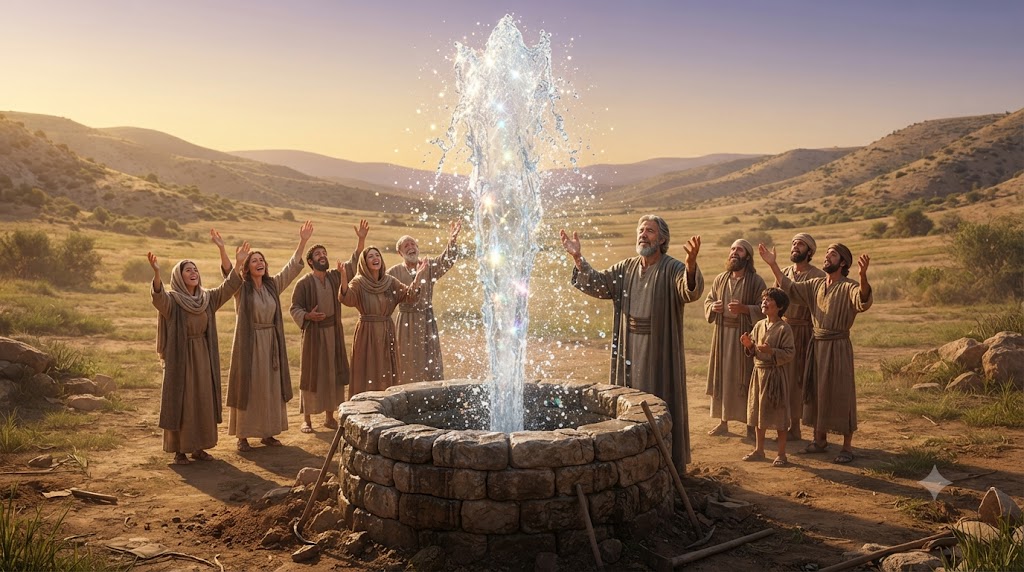
“He moved on from there and dug another well, and no one quarreled over it. He named it ‘Rehoboth,’ saying, ‘Now the LORD has given us room and we will flourish in the land’…”
From there he went up to Beersheba. That night the LORD appeared to him and said, “I am the God of your father Abraham. Do not be afraid, for I am with you; I will bless you and will increase the number of your descendants for the sake of my servant Abraham.” Isaac built an altar there and called on the name of the LORD. There he pitched his tent, and there his servants dug a well.
🙌 Act Four — Secular Oaths of Pacification and Esau’s Structural Compromise (Verses 26–35)
Meanwhile, Abimelech had come to him from Gerar, with Ahuzzath his personal adviser and Phicol the commander of his forces. Isaac asked them, “Why have you come to me, since you were hostile to me and sent me away?” They answered,
“We saw clearly that the LORD was with you; so we said, ‘There ought to be a solemn oath between us’—between us and you. Let us make a treaty with you…”
“That you will do us no harm, just as we did not harm you but always treated you well and sent you away in peace. And now you are blessed by the LORD.” Isaac then made a feast for them, and they ate and drank. Early the next morning the men swore an oath to each other. Then Isaac sent them on their way, and they left him in peace. That day Isaac’s servants came and told him about the well they had dug. They said, “We’ve found water!” He called it ‘Shibah,’ and to this day the name of the town has been ‘Beersheba.’
When Esau was forty years old, he married Judith daughter of Beeri the Hittite, and also Basemath daughter of Elon the Hittite. They were a source of grief to Isaac and Rebekah. Esau’s shallow appetite for immediate worldly assimilation effectively introduced structural, long-standing grief into the emotional ecosystem of the home.
🕊️ Reflection — The Radical Authority of Yielding Born from an Unending Aquifer
Genesis Chapter 26 maps out the immense internal architecture of Isaac, tracing how a man rooted in the character of the covenant transforms regional envy and systemic friction into an absolute spiritual monument by mastering the art of peaceful relinquishment. When Isaac materialized a hundredfold breakthrough amidst global scarcity, the surrounding culture reacted with immediate sabotage, filling his vital assets with dirt. In the ancient Near East, seizing water infrastructure was a direct act of war. Isaac possessed the defensive muscle to easily engage and neutralize these threats, yet he chose to continuously fold his tents and yield the ground. Moving from Esek (Dispute) to Sitnah (Opposition), Isaac’s strategy appeared to secular metrics as absolute weakness and defeat.
Yet, true spiritual authority is never threatened by immediate displacement because its resource is not anchored to a localized puddle; it is plugged into the Sovereign Source who commands the deep springs of the earth. By refusing to pollute his energy with regional friction, Isaac exhausted the hostility of his adversaries until they marched down to Beersheba to confess, “We saw clearly that the LORD was with you.” “Today, are you draining your vital vision by engaging in bitter disputes over the shifting enclaves of Esek and Sitnah? Will you drop your frantic defense of passing parameters, step into the unshakeable confidence of the covenant, and permit the Lord to clear the unhindered space of your Rehoboth?”
📣 Coming Up Next
Genesis Chapter 27 — Jacob Steals Isaac’s Blessing: Savory Meat, Goat Skins, and the High-Stakes Domestic Interception Confronted by Isaac’s failing vision, watch as Rebekah and Jacob engineer a sophisticated, high-stakes tactical deception. Utilizing savory meat and strategic goat skins to falsify his identity, Jacob intercepts the global patriarchal blessing, triggering a volcanic domestic crisis with a weeping Esau in our next episode.
#Genesis26 #FamineInGerar #HundredfoldHarvest #WealthyIsaac #SabotagedWells #EsekAndSitnah #Rehoboth #RoomToFlourish #TreatyWithAbimelech #Beersheba #EsausHittiteWives #Christian #Bible #Meditation #Genesis #TheWord #BibleStudy #Church #ChristianBlog #BibleMeditation