Genesis Series — Episode 25
🔥 Prologue — A Sovereign Stride Into the Eternal Homeland and the Changing of the Guard
Abraham, the monumental patriarch who historically responded to the call from Ur of the Chaldeans to establish a lifetime of tents and altars, finalized his epochal 175-year earthly migration. He was solemnly interred inside the Cave of Machpelah, directly adjacent to his wife Sarah. Although the era of the giant had drawn to a close, the cosmic starry promise did not freeze; it flowed uninterrupted into the immediate tents of Isaac.
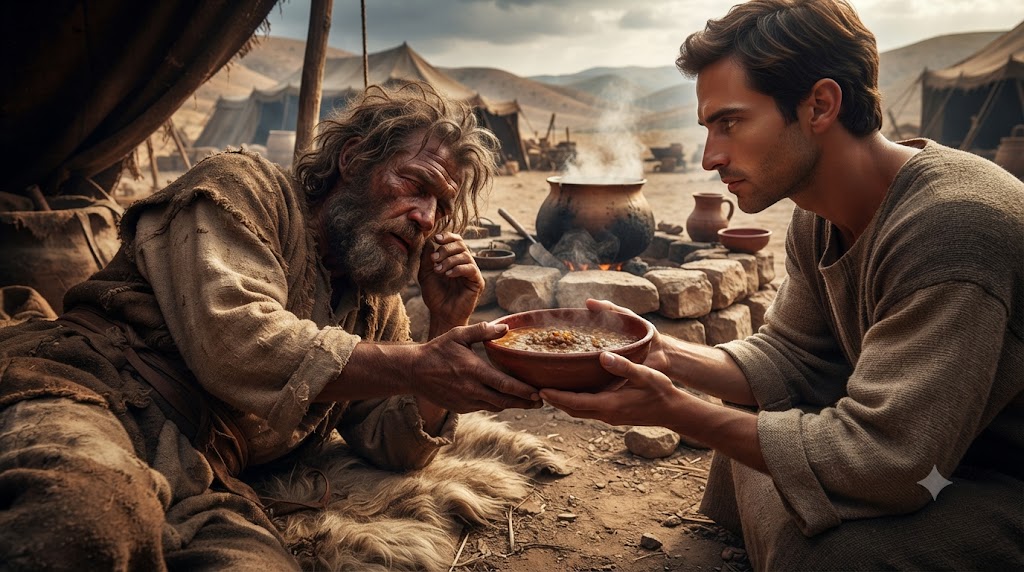
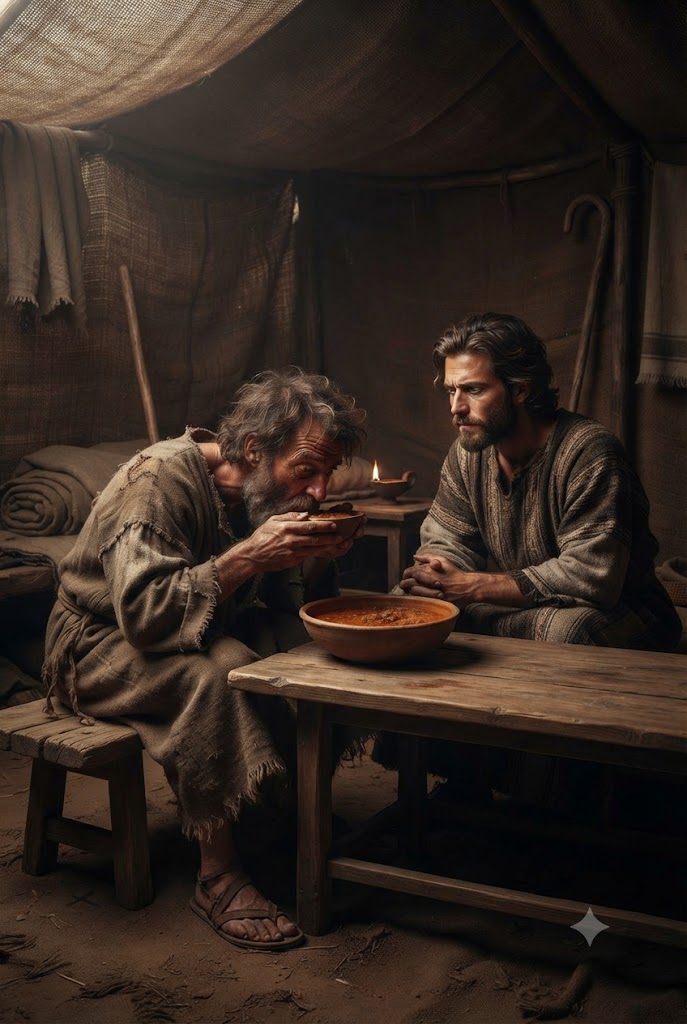
Within Isaac’s estate, a highly dynamic redemptive drama was unfolding. Just as the Creator had historically opened Sarah’s barren ceiling, He intercepted Rebekah’s 20-year season of infertility, permitting an unprecedented biological warfare to break out between twin nations inside her womb. Esau emerged as a rugged, heavily haired hunter of the wild plains, while Jacob was born gripping his brother’s heel, living a quiet existence inside the tents, waiting for strategic optimization. Through the shocking transaction of a legal birthright over a solitary bowl of red lentil stew, the internal metrics of how human hearts audit invisible spiritual blessing were thoroughly exposed.
🌙 Act One — Abraham’s Concubines and the Holy Centennial Passing (Verses 1–11)
Abraham had taken another wife, whose name was Keturah. She bore him Zimran, Jokshan, Medan, Midian, Ishbak and Shuah. Jokshan was the father of Sheba and Dedan… Abraham left everything he owned to Isaac. But while he was still living, he gave gifts to the sons of his concubines and sent them away from his son Isaac to the land of the east. Abraham meticulously insulated the strategic lineage of Isaac.
“Abraham lived a hundred and seventy-five years. Then he breathed his last and died at a good old age, an old man and full of years; and he was gathered to his people…”
His sons Isaac and Ishmael buried him in the cave of Machpelah near Mamre, in the field of Ephron son of Zohar the Hittite, the field Abraham had bought from the Hittites. There Abraham was buried with his wife Sarah. After Abraham’s death, God blessed his son Isaac, who then lived near Beer Lahai Roi.
💛 Act Two — The Lineage of Ishmael and His Passing at 137 (Verses 12–18)
This is the account of the family line of Abraham’s son Ishmael, whom Sarah’s Egyptian slave Hagar bore to Abraham. The names of the sons of Ishmael, listed in the order of their birth, are Nebaioth the firstborn of Ishmael, Kedar, Adbeel, Mibsam, Mishma, Dumah, Massa, Hadad, Tema, Jetur, Naphish and Kedemah. These were the sons of Ishmael, and these are the names of the twelve tribal rulers according to their settlements and camps.
“Ishmael lived a hundred and thirty-seven years. He breathed his last and died, and he was gathered to his people…”
His descendants settled in the area from Havilah to Shur, near the eastern border of Egypt, as you go toward Ashur. And they lived in hostility toward all the tribes related to them. Just as the Lord had promised Hagar in the desolate wilderness (Genesis 17:20, 21:18), Ishmael’s house expanded into twelve powerful chieftains.
👐 Act Three — Rebekah’s Twenty-Year Infertility and the Twin Dynasties (Verses 19–26)
This is the account of the family line of Abraham’s son Isaac. Abraham became the father of Isaac, and Isaac was forty years old when he married Rebekah daughter of Bethuel… Isaac prayed to the LORD on behalf of his wife, because she was childless. The LORD answered his prayer, and his wife Rebekah became pregnant. The babies jostled each other within her, and she said, “Why is this happening to me?” So she went to inquire of the LORD. The LORD said to her,
“Two nations are in your womb, and two peoples from within you will be separated; one people will be stronger than the other, and the older will serve the younger…”
When the time came for her to give birth, there were twin boys in her womb. The first to come out was red, and his whole body was like a hairy garment; so they named him ‘Esau.’ After this, his brother came out, with his hand grasping Esau’s heel; so he was named ‘Jacob.’ Isaac was sixty years old when Rebekah gave birth to them. Isaac navigated a rigorous 20-year tunnel of prayerful persistence before he finally cradled the heirs destined to preserve the legacy.
🙌 Act Four — A Red Bowl of Stew and Esau’s Reckless Disregard for the Birthright (Verses 27–34)
The boys grew up, and Esau became a skillful hunter, a man of the open country, while Jacob was a quiet man, staying among the tents. Isaac, who had a taste for wild game, loved Esau, but Rebekah loved Jacob. Once when Jacob was cooking some stew, Esau came in from the open country, famished. He said to Jacob, “Quick, let me have some of that red stew! I’m famished!” (That is why he was also called ‘Edom.’) Jacob replied, “First sell me your birthright.” “Look, I am about to die,” Esau executed his rationalization.
“What good is the birthright to me?…”
But Jacob said, “Swear to me first.” So he swore an oath to him, selling his birthright to Jacob. Then Jacob gave Esau some bread and some lentil stew. He ate and drank, and then got up and left. “So Esau despised his birthright.”
🕊️ Reflection — Bypassing Eternal Architecture to Satisfy Temporary Hunger
Genesis Chapter 25 marks the changing of a monumental guard, illustrating with stark, sobering transparency how distinct human hearts audit ‘invisible spiritual infrastructure’ when confronted by immediate, primal demands. Isaac’s 20-year layout of domestic dryness—marrying at 40 and fathering at 60—serves as a structural reminder that the covenant inheritance cannot be engineered by physical momentum; it must be extracted through the altar of persistent prayer. From this furnace of prayer, Esau and Jacob emerged, driven by diametrically opposed internal systems.
Confronted by temporary physical exhaustion, Esau blurted out: “What good is the birthright to me?” To satisfy an immediate, 1-dimensional craving, he casually signed away the global spiritual asset of the birthright—the line through which the Messiah would step onto the planet—for a solitary, fleeting bowl of lentil stew. Scripture summarizes this execution with a devastating metric: Esau ‘despised’ his inheritance. Jacob’s methods were heavily calculated and flawed, yet his internal engine possessed a deep, desperate hunger for the invisible validation of God. “Today, are you allowing temporary exhaustion, emotional hunger, or immediate situational pressure to validate signing away your spiritual position and holy callings? Will you refuse to replicate the fatal short-sightedness of Esau, who traded a permanent inheritance for a passing meal, and lock your focus onto the enduring wealth of the Kingdom?”
📣 Coming Up Next
Genesis Chapter 26 — Isaac and Abimelech: The Centennial Hundredfold Harvest and the Springs of Rehoboth When a severe economic drought strikes the geography of Canaan, watch as Isaac obeys the sovereign decree to remain in Gerar rather than retreating into Egypt. Discover the chronicle of an extraordinary hundredfold breakthrough that triggers regional envy, culminating in Isaac’s peaceful relinquishment of wells until he secures the unhindered space of Rehoboth in our next episode.
#Genesis25 #DeathOfAbraham #175YearsOld #LineageOfIshmael #137YearsOld #IsaacAt60 #TwinNations #EsauAndJacob #LentilStew #TheBirthright #EsauDespisedHisBirthright #Christian #Bible #Meditation #Genesis #TheWord #BibleStudy #Church #ChristianBlog #BibleMeditation