Genesis Series — Episode 21
🔥 Prologue — A Cynical Sigh of Disbelief Transformed into the Miracle of Radiant Joy
When human capacity had withered down to absolute zero, hidden behind the suffocating canvas of a hundred-year-old patriarch and a ninety-year-old barren ceiling, humanity had internally let out a cynical laugh: ‘Will a child really be born to those past their prime?’ It was the rational, automated response engineered by the cold calculations of sight.
Yet, precisely inside that environment of human skepticism, God Almighty stepped onto the canvas, generating a thunderous realization that redefined historical boundaries. The LORD was gracious to Sarah as he had said, and the LORD did for Sarah what he had promised. Discover the magnificent chronicle of an infant’s crying filling the estate, the defensive grace shielding Hagar and Ishmael in the desert, and the permanent anchor of ownership established at Beersheba.
🌙 Act One — Realization of the Promised Decree and Sarah’s Transformed Laughter (Verses 1–7)
Now the LORD was gracious to Sarah as he had said, and the LORD did for Sarah what he had promised. Sarah became pregnant and bore a son to Abraham in his old age, at the very time God had promised him. Abraham gave the name Isaac to the son Sarah bore him. When his son Isaac was eight days old, Abraham circumcised him, as God commanded him.
“Sarah said, ‘God has brought me laughter, and everyone who hears about this will laugh with me’…”
And she added, “Who would have said to Abraham that Sarah would nurse children? Yet I have borne him a son in his old age.” Abraham was a hundred years old when his son Isaac was born to him. The internal, cynical laughter fueled by physical limitation was systematically re-engineered by the fidelity of the Creator into an everlasting shout of sovereign victory and joy.
💛 Act Two — The Expulsion of Hagar and Ishmael, and the Spring Interception (Verses 8–21)
The child grew and was weaned, and on the day Isaac was weaned Abraham held a great feast. But Sarah saw that the son whom Hagar the Egyptian had borne to Abraham was mocking, and she said to Abraham, “Get rid of that slave woman and her son, for that woman’s son will never share in the inheritance with my son Isaac.” The matter distressed Abraham greatly because it concerned his son.
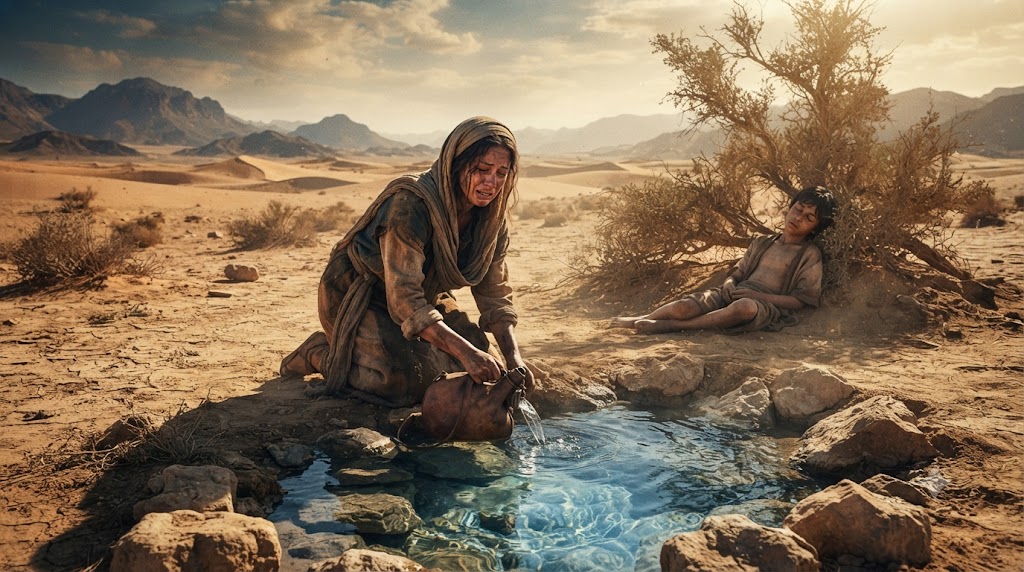
But God said to him, “Do not be so distressed about the boy and your slave woman. Listen to whatever Sarah tells you, because it is through Isaac that your offspring will be reckoned. I will make the son of the slave into a nation also, because he is your offspring.” Early the next morning Abraham took some food and a skin of water and gave them to Hagar. He set them on her shoulders and sent her off with the boy. She went on her way and wandered in the Desert of Beersheba. When the water in the skin was gone, she began to weep loudly in despair.
“God heard the boy crying, and the angel of God called to Hagar from heaven and said to her…”
“What is the matter, Hagar? Do not be afraid; God has heard the boy crying as he lies there. Lift the boy up and take him by the hand, for I will make him into a great nation.” Then God opened her eyes and she saw a well of water. So she went and filled the skin with water and gave the boy a drink. God was with the boy as he grew up. He lived in the desert and became an archer. While he was living in the Desert of Paran, his mother got a wife for him from Egypt.
👐 Act Three — The Covenant Treaty at Beersheba and Worship Beneath the Tamarisk (Verses 22–34)
At that time Abimelech and Phicol the commander of his army said to Abraham, “God is with you in everything you do. Now swear to me here before God that you will not deal falsely with me or my children or my descendants.” Abraham, however, complained to Abimelech about a well of water that Abimelech’s servants had seized, standing firmly to outline legal ownership.
Then Abraham took sheep and cattle and gave them to Abimelech, and the two men made a covenant. Abraham set apart seven ewe lambs from the flock, and Abimelech asked Abraham, “What is the meaning of these seven ewe lambs you have set apart by themselves?” He replied, “Accept these seven lambs from my hand as a witness that I dug this well.”
“So that place was called Beersheba, because the two men swore an oath there…”
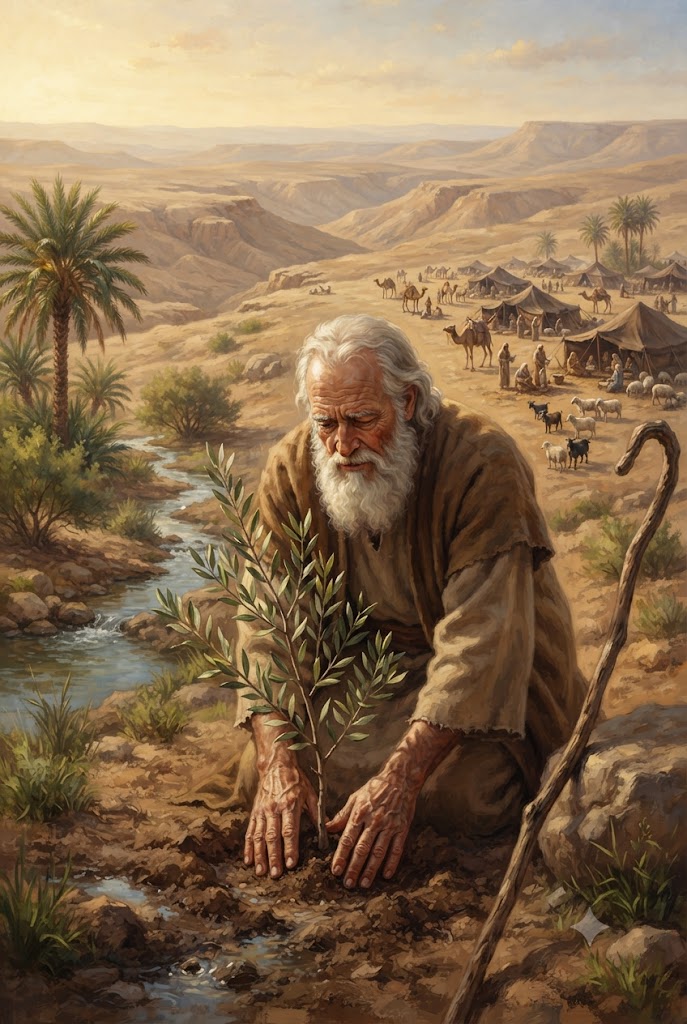
After the covenant had been made at Beersheba, Abimelech and Phicol returned to the land of the Philistines. Abraham planted a tamarisk tree in Beersheba, and there he called on the name of the LORD, the Eternal God. And Abraham stayed in the land of the Philistines for a long time. The nomenclature Beersheba signifies ‘The Well of the Oath,’ representing a permanent legal marking where even a secular king had to audit and validate that the blessing of the Almighty was anchored to the patriarch.
🕊️ Reflection — Rooting Our Confessions Within the Character of El Olam
Genesis Chapter 21 stands as a powerful demonstration of how the structural phrase “as He had promised” systematically obliterates human limitations to materialize physical breakthroughs upon the earth. When navigating an extended season of dryness, we easily succumb to the physical reality reports, whispering, ‘My opportunities have withered, and my options are entirely locked.’ Yet, the velocity of divine execution is never insulated or regulated by biological frameworks or economic droughts. When the designated alignment of God’s ‘appointed time’ intersects our geography, our cynical sigh is transformed into ‘Isaac’—the laughter of radical, contagious joy.
Furthermore, this narrative traces the cosmic scope of a mercy that tracks not only the covenant child inside the tent, but also hears the weeping of the discarded Ishmael out in the wild terrain. Following this immense manifestation of grace, Abraham planted a ‘tamarisk tree’ at Beersheba, vocalizing his worship to “The Eternal God (El Olam).” The tamarisk is an evergreen that drives its roots exceptionally deep into subterranean aquifers to survive harsh desert parameters. It signifies that Abraham’s faith had graduated from chasing temporary circumstances to anchoring its roots within the unchanging eternity of God’s character. “Today, are you allowing immediate blockages to justify an internal laugh of disbelief behind the canvas of your anxieties? Will you trust the Lord who manufactures realizations precisely where human momentum expires, planting an evergreen of gratitude in your Beersheba to call upon His eternal name?”
📣 Coming Up Next
Genesis Chapter 22 — The Binding of Isaac: The Altar at Moriah and Jehovah Jireh On the heels of experiencing ultimate parental fulfillment, watch as Abraham encounters the most agonizing crucible of his life: the divine mandate to offer his unique son Isaac as a burnt sacrifice. Discover the gripping narrative of radical surrender and the provision of the hidden ram in our next episode.
#Genesis21 #TheBirthOfIsaac #AsHeHadPromised #GodBroughtLaughter #HagarAndIshmael #Beersheba #WellOfTheOath #TamariskTree #TheEternalGod #Christian #Bible #Meditation #Genesis #TheWord #BibleStudy #Church #ChristianBlog #BibleMeditation