Exodus Series — Episode
🔥 Prologue — The Truth That Accumulating Plagues Reveal
The first plague had passed.
The Nile had run with blood for seven days. But Pharaoh had not turned. He had walked back into his palace and given the catastrophe no further thought. He had dismissed God’s first answer.
So God’s second answer came. His third answer came. His fourth answer came.
The plagues were not random. They were not arbitrary. Each one was precisely targeted at a specific Egyptian deity. Frogs—Heqet, the frog goddess of fertility. Gnats—Geb, the god of the earth. Flies—Khepri, the fly-headed god. One by one—the gods of Egypt were being dismantled before the power of the living God.
And then Pharaoh’s own magicians finally said it out loud. “This is the finger of God.”
A confession extracted from the enemy’s own mouth. That was the climax of this chapter.
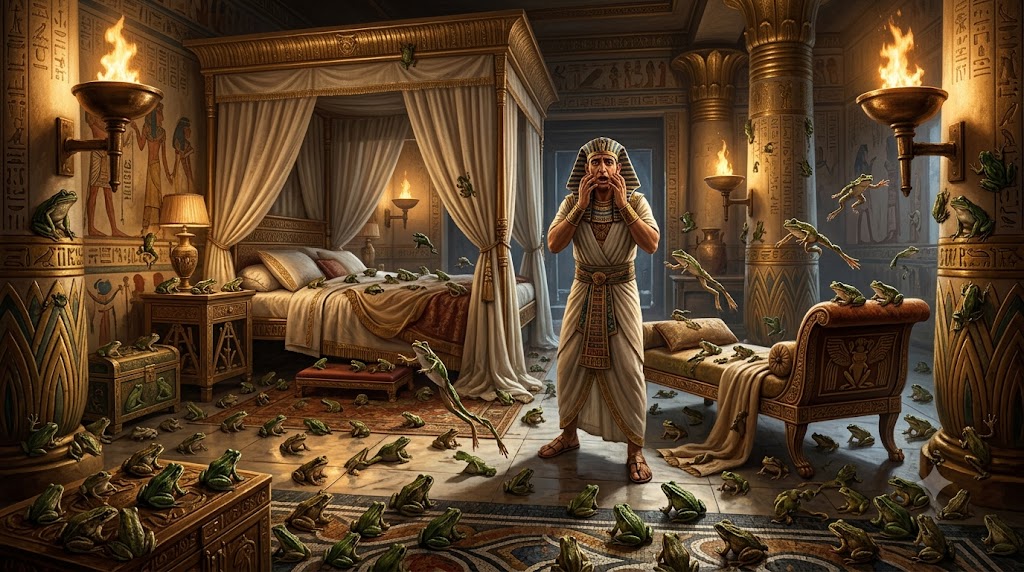
🐸 Act One — The Second Plague: Frogs (Verses 1–15)
“And the LORD spoke to Moses, ‘Go to Pharaoh and say to him, “Thus says the LORD: Let My people go, that they may serve Me.”‘”
The same demand. Let My people go. Pharaoh refused again. The second plague was decreed.
“But if you refuse to let them go, behold, I will smite all your territory with frogs.”
Frogs.
In ancient Egypt, the frog was the sacred symbol of Heqet—the goddess of fertility, childbirth and life. Revered. Worshipped. Protected. Now the revered creature would become the instrument of judgment—the thing they worshipped becoming the vehicle of their suffering.
“So the river shall bring forth frogs abundantly, which shall go up and come into your house, into your bedroom, on your bed, into the houses of your servants, on your people, into your ovens, and into your kneading bowls.”
Everywhere. The bedroom. The bed. The cooking oven. The bread bowl. What Egypt had consecrated as sacred swarmed into every corner of their lives. This is the nature of idolatry—what you worship eventually suffocates you.
“So Aaron stretched out his hand over the waters of Egypt, and the frogs came up and covered the land of Egypt.”
The magicians replicated the sign—adding more frogs to a land already overrun with frogs. Multiplying the catastrophe rather than resolving it. But this time, Pharaoh responded differently.
“Then Pharaoh called for Moses and Aaron, and said, ‘Entreat the LORD that He may take away the frogs from me and from my people; and I will let the people go, that they may sacrifice to the LORD.'”
For the first time—Pharaoh negotiated. For the first time—he used the name of the LORD and asked for intercession. The frogs had penetrated what the blood could not.
Moses asked Pharaoh when he wanted the frogs removed.
“And he said, ‘Tomorrow.'”
Tomorrow. Not immediately. Not right now. Tomorrow. Why not this moment? Perhaps he wanted one more night to see if the frogs would leave on their own. Perhaps he was still testing whether this was genuinely supernatural. Perhaps pride would not allow him to admit urgency.
Moses prayed. The frogs died.
“They gathered them together in heaps, and the land stank.”
Dead frog heaps. The stench of judgment’s aftermath. Every passing plague left evidence in the land.
But Pharaoh—
“But when Pharaoh saw that there was relief, he hardened his heart and did not heed them.”
When he saw that there was relief. The pressure released—and immediately the hardness returned. The crisis passed and the promise evaporated. This is one of the oldest patterns in human nature—crying out to God in the pressure and turning away when the pressure lifts.
🦟 Act Two — The Third Plague: Gnats (Verses 16–19)
The third plague came without warning.
“So the LORD said to Moses, ‘Say to Aaron, “Stretch out your rod, and strike the dust of the land, so that it may become lice throughout all the land of Egypt.”‘”
No advance notice to Pharaoh. No opportunity to negotiate before the plague arrived. The first two plagues had come with prior warning—an invitation to repent before the judgment fell. The third came simply.
God does not issue unlimited warnings. When warnings are consistently disregarded, there comes a moment when judgment arrives without prior announcement.
“And they did so. For Aaron stretched out his hand with his rod and struck the dust of the earth, and it became lice on man and beast.”
Dust transformed into gnats—or lice—covering every person and every animal throughout Egypt. The very ground beneath their feet became the source of torment.
Then came the decisive moment.
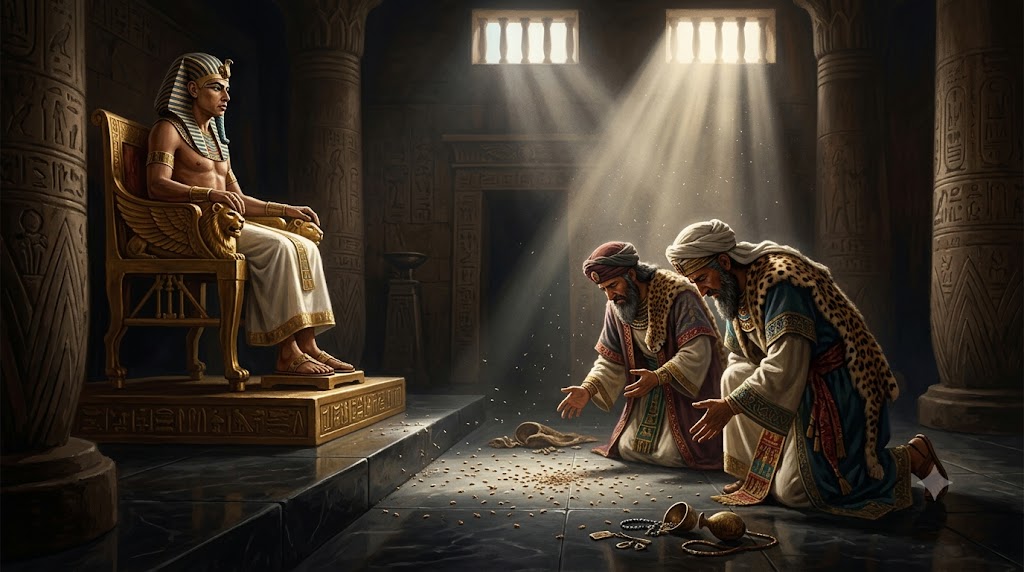
“Now the magicians so worked with their enchantments to bring forth lice, but they could not.”
Could not. For the first time—the magicians failed. Twice they had managed imitation. On the third attempt—they were stopped.
And they said it.
“Then the magicians said to Pharaoh, ‘This is the finger of God.'”
The finger of God. The most honest confession in the chapter—delivered by the enemies of Moses. The magicians recognized what Pharaoh refused to recognize: this is beyond human capability. This is God.
But Pharaoh?
“But Pharaoh’s heart grew hard, and he did not heed them, just as the LORD had said.”
His own magicians had confessed the truth. His own officials stood before him acknowledging the divine origin of what they had witnessed. And Pharaoh remained unmoved. The evidence his own court accepted—he refused.
The one who refuses to see will not see regardless of what stands before him. That is the definition of hardness.
🪰 Act Three — The Fourth Plague: Flies (Verses 20–32)
The fourth plague introduced a critical new development.
“And the LORD said to Moses, ‘Rise early in the morning and stand before Pharaoh as he comes out to the water.'”
Again morning. Again the Nile. God returned Moses to the same location at the same time. The repeated setting was itself a message—I have not moved from what I said. The demand remains unchanged.
“Or else, if you will not let My people go, behold, I will send swarms of flies on you and your servants, on your people and into your houses.”
Swarms—the Hebrew arov, denoting a dense mixture of insects, likely including flies, beetles and other crawling creatures.
But in the fourth plague, a decisive distinction emerged.
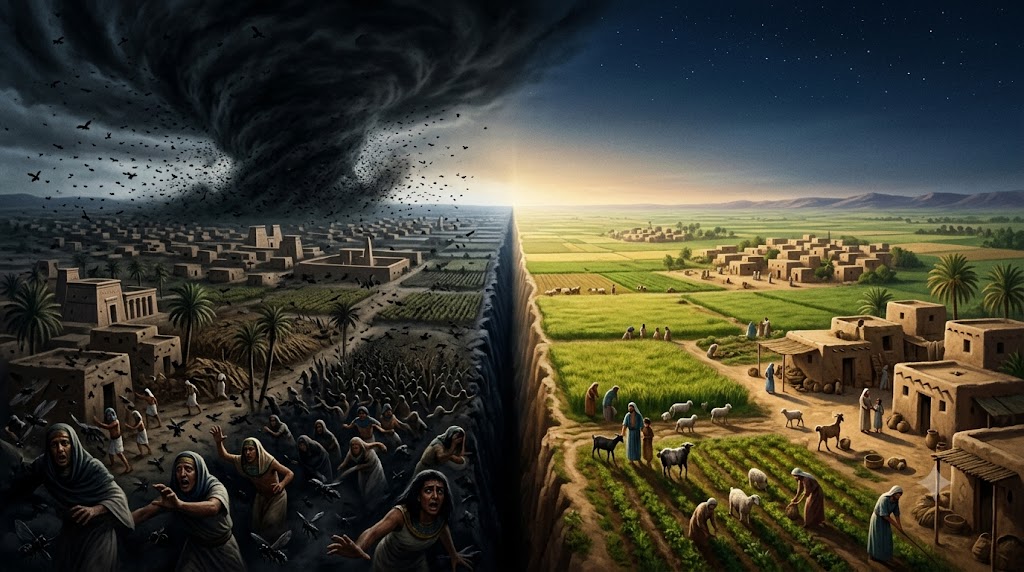
“And in that day I will set apart the land of Goshen, in which My people dwell, that no swarms of flies shall be there, in order that you may know that I am the LORD in the midst of the land.”
Goshen shall be set apart. Where Israel lived—no flies. The same land. The same Egypt. Yet a clear, visible, verifiable boundary between the afflicted territory and the protected territory.
This was the theological core of the fourth plague. God distinguishes between His people and others. When judgment moves through the earth—it does not operate identically toward those who belong to the Covenant God. This distinction was proclaimed publicly before all of Egypt. I am the LORD—and I know My own.
The flies came. Egypt was consumed by them. Goshen had none.
Pharaoh initiated negotiation.
“Then Pharaoh called for Moses and Aaron, and said, ‘Go, sacrifice to your God in the land.'”
In the land. The first attempt at compromise—worship your God, but do it here. In Egypt. Don’t actually leave. A partial concession designed to grant the appearance of compliance while retaining control.
Moses refused.
“And Moses said, ‘It is not right to do so, for we would be sacrificing the abomination of the Egyptians to the LORD our God.'”
Worship conducted within Egypt’s territorial and spiritual jurisdiction would be compromised worship. Not separated unto God—but contained within the system that opposed Him. The call was not for negotiated religion within the world’s structure. It was for worship genuinely set apart from it.
Pharaoh countered.
“I will let you go, that you may sacrifice to the LORD your God in the wilderness; only you shall not go very far away.”
Not very far away. The second negotiating position. You can go—but stay within reach. You can worship—but don’t go too deep into it. The instinct to retain partial control over the people’s relationship with God. To allow enough freedom to silence the demand while preventing genuine liberation.
This is the strategic pattern of the adversary in every generation. Not total prohibition—but limitation. Not complete denial of God—but managed distance. One foot in the world, one foot before God. Near enough to silence the demand. Far enough from God to prevent full surrender.
Moses prayed. The flies departed. But Pharaoh—
“But Pharaoh hardened his heart at this time also, and he did not let the people go.”
At this time also. The rhythm of this chapter. Plague arrives—partial concession. Plague departs—hardness returns. Crisis religion. Convenience faith.
🕊️ Reflection — When the Pressure Is Released
The sharpest verse in Exodus Chapter 8 is this:
“But when Pharaoh saw that there was relief, he hardened his heart.”
When the pressure released—he forgot. When the crisis passed—he turned away. When the pain that had driven his prayer subsided—the prayer subsided with it.
This is not only Pharaoh’s story. It is the story of the human heart in every generation. We cry out to God with intensity in the crisis. The crisis resolves. And quietly, almost imperceptibly—we drift back to where we were before the crisis found us.
But this chapter also carries hope.
The magicians confessed: “This is the finger of God.” Even within the court of the hardened Pharaoh—there were those whose eyes could see. Even in the most resistant environment, truth has the capacity to be recognized.
And Goshen was distinguished. In a land overrun with flies—the territory of God’s people was untouched. The same geography. The same Egypt. A different experience for those who belonged to the LORD.
Whatever plague surrounds you today—the promise of Goshen is still operative. God distinguishes between His people and the environment around them. The world may be consumed by what does not touch you.
“When the pressure releases in your life, what do you do? Does relief produce gratitude that deepens your surrender—or does it produce the hardness that returns you to where you were?”
📣 Coming Up Next
Exodus Chapter 9 — Livestock, Boils and Hail: The Plagues Intensify
The fifth through seventh plagues arrive. Egypt’s livestock die in the fields. Boils break out on the skin of every person and animal in Egypt. Then the most devastating hailstorm in Egyptian history falls from the sky. And for the first time, Pharaoh makes an astonishing confession: “I have sinned this time.” The drama reaches a new register in the next episode.
#Exodus8 #FroguePlague #GnatPlague #FlyPlague #FingerOfGod #PharaohsHardHeart #GosenDistinguished #MagiciansConfess #CrisisReligion #ConvenienceFaith #TenPlagues #BibleStudy #ChristianBlog #Exodus #OldTestament #Scripture #Church #DailyDevotional #BiblicalFaith #GodsPower