Exodus Series — Episode 36
🔥 Prologue — A Moment So Abundant It Had to Be Stopped In chapter 35, the people had begun bringing offerings from a willing heart.
Exodus 36 shows just how far that devotion reached. And this chapter contains a truly unique scene in all of Scripture—a moment when people had to be told to stop bringing offerings. Not scarcity, but abundance, was the problem—a remarkably rare situation.
This chapter also captures the process by which Bezalel and Oholiab actually begin building the Tabernacle. It is the scene where the blueprint finally becomes an actual structure.
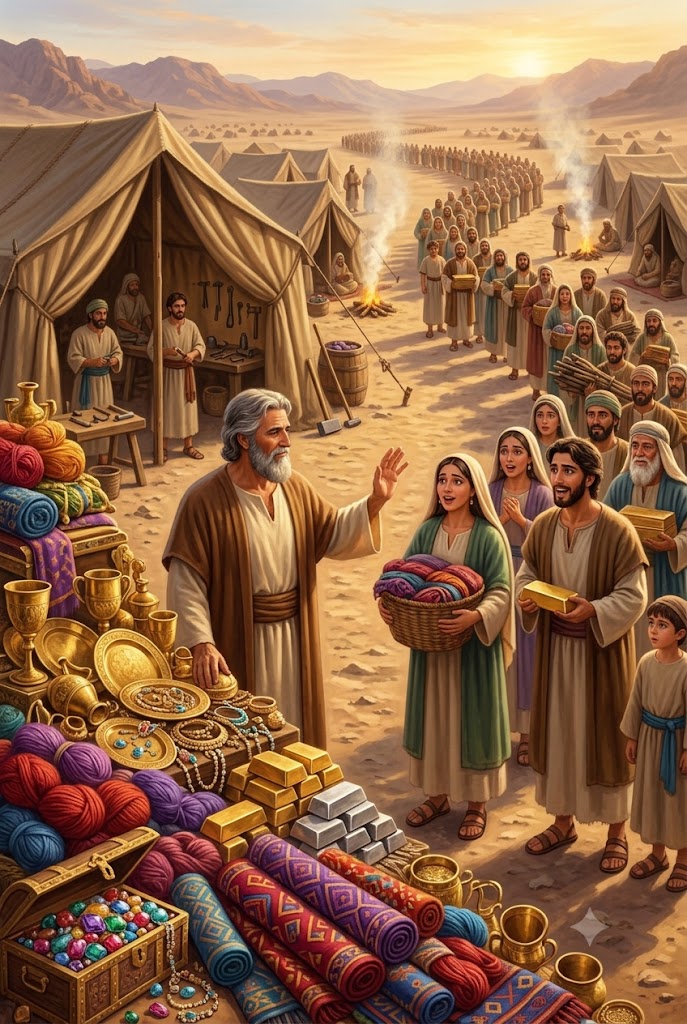
🙌 Act One — The Skilled Craftsmen Begin Their Work (Verses 1–7) “And Bezalel and Aholiab, and every gifted artisan in whom the LORD has put wisdom and understanding, to know how to do all manner of work for the service of the sanctuary, shall do according to all that the LORD has commanded.”
The LORD has put wisdom and understanding. This repeated expression continually reminds us that this work was not accomplished by human talent alone, but by ability specially poured out by God.
And the offerings begin to pour in.
“For the children of Israel had brought enough material for all the work to be done—indeed too much.”
Enough material—indeed too much. This brief sentence foreshadows the remarkable scene about to unfold.
The craftsmen actually received offerings every morning.
“And all the gifted artisans who were doing all the work of the sanctuary came, each from the work he was doing… For they had received from Moses all the offering which the children of Israel had brought for the work of the service of making the sanctuary. And they still were bringing to him freewill offerings every morning.”
Every morning. This expression shows that the people’s zeal was never a fleeting excitement. It was not something that lasted a day or two—it was a devotion that continued, unceasingly.
And finally, the craftsmen bring an unusual report to Moses.
“So the skilled workmen said to Moses, ‘The people bring much more than enough for the service of the work which the LORD commanded us to do.'”
Much more than enough. This was a remarkably rare problem in Scripture—the problem of having received too much.
Moses takes immediate action.
“So Moses gave a commandment, and they caused it to be proclaimed throughout the camp, saying, ‘Let neither man nor woman do any more work for the offering of the sanctuary.’ And the people were restrained from bringing, for the material they had was sufficient for all the work to be done—indeed too much.”
The people were restrained from bringing. This scene is both highly unusual and beautiful. This was not a situation where offerings had to be forcibly extracted—rather, the people’s zeal had to be calmed. This was a remarkable testimony to just how spontaneous and overflowing devotion can be, when true restoration has actually taken place.
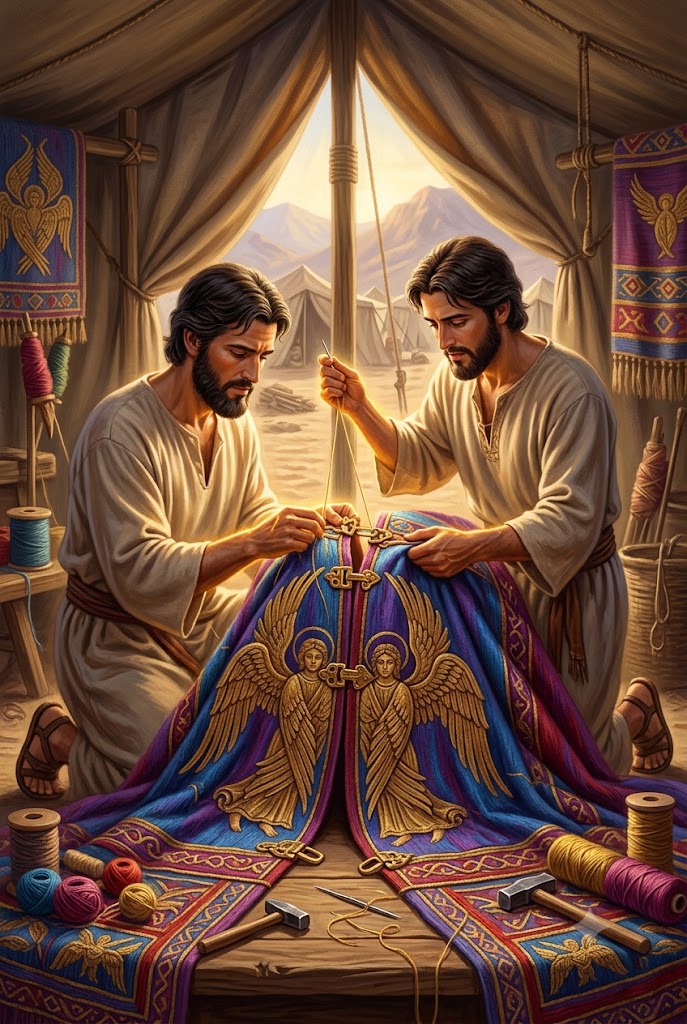
🧵 Act Two — Weaving the Ten Curtains (Verses 8–19) Now the text moves into the actual process of construction. This section shows the instructions revealed in chapter 26 being carried out precisely as given.
“Then all the gifted artisans among them who worked on the tabernacle made ten curtains woven of fine linen, and of blue, purple, and scarlet thread; with artistic designs of cherubim they made them.”
The verses that follow repeat, in almost identical language, the instructions from chapter 26. This repetition may seem monotonous, but it in fact carries a very important theological message—that what God had planned, and what human beings actually accomplished, matched precisely.
“He made loops of blue yarn on the edge of the curtain, on the selvedge of one set, and likewise he did on the outer edge of the other curtain of the second set… he also made fifty clasps of gold, and coupled the curtains together with the clasps, so that it formed one tabernacle.”
Formed one tabernacle. That very unity planned in chapter 26 was now actually being accomplished.
The making of the goats’ hair curtain, the ram skins dyed red covering, and the badger skin covering follow in the same order.
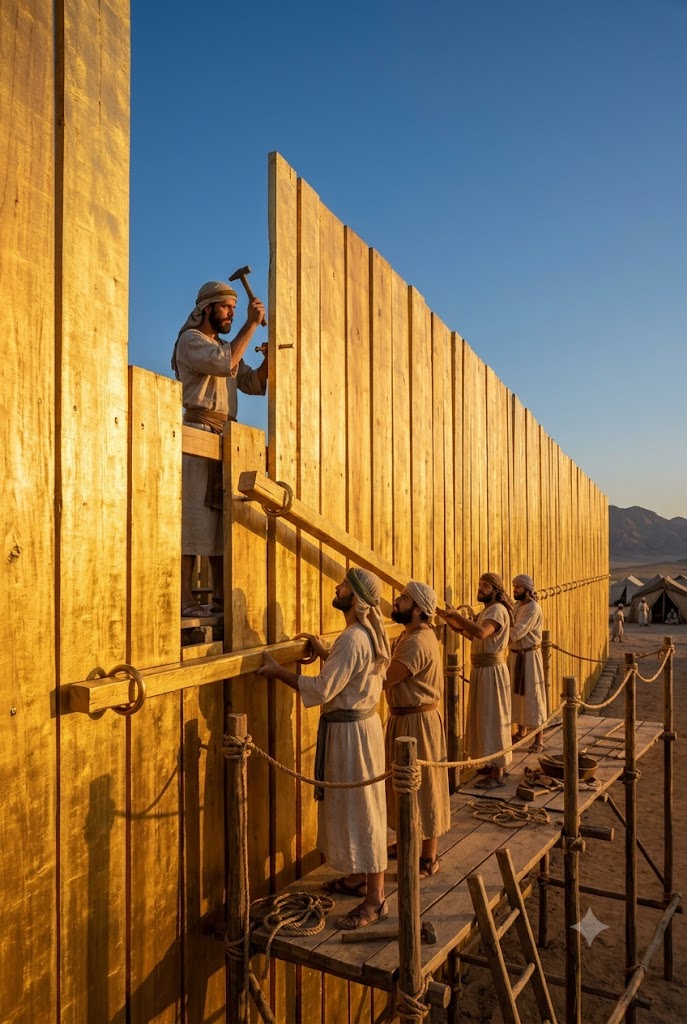
🏗️ Act Three — Setting Up the Frames and the Veil (Verses 20–38) Now the process of making the frame of the Tabernacle, the acacia wood boards, follows.
“And for the tabernacle he made boards of acacia wood, standing upright. The length of each board was ten cubits, and the width of each board a cubit and a half.”
This section, too, follows exactly the dimensions and arrangement given in chapter 26. Twenty boards on the south, twenty on the north, six on the west—every measurement was carried out exactly as revealed.
“And he made bars of acacia wood: five for the boards on one side of the tabernacle, five bars for the boards on the other side of the tabernacle, and five bars for the boards of the tabernacle on the far side westward.”
And the veil to conceal the Most Holy Place is made.
“And he made a veil of blue, purple, and scarlet thread, and fine woven linen; it was worked with an artistic design of cherubim.”
This veil was completed exactly with the same materials and craftsmanship revealed in chapter 26. And the screen for the door of the Tabernacle is completed alongside it.
“He also made a screen for the tabernacle door, of blue, purple, and scarlet thread, and fine woven linen, made by a weaver.”
The chapter closes with all of this intricate work completed. What had begun as a plan was now being finished as a tangible reality one could hold in one’s hands.
🕊️ Reflection — Evidence of Grace So Great It Had to Be Stopped The most striking truth in Exodus 36 is this: the people brought so many offerings that they had to be restrained from bringing more. This is a truly rare scene in all of Scripture—in most cases, the problem is scarcity, not abundance.
This scene shows what true restoration looked like after repentance. Not devotion offered under compulsion, but a heart wanting, of its own accord, to give overflowingly. This was the true mark of a genuine response to grace.
And the fact that the plan given in chapter 26 was carried out in chapter 36 precisely as given. This reveals another face of faithfulness. The exact correspondence between the original plan and its final execution symbolically shows complete obedience to God’s word.
We often regard devotion as something done out of obligation or guilt. But this chapter shows another possibility—that devotion flowing from a truly restored heart overflows naturally, abundantly.
“Is your giving something forced out of you, or something so natural it overflows and must be restrained?”
📣 Coming Up Next Exodus Chapter 37 — The Ark and the Sacred Furnishings Completed Bezalel personally continues the process of making the Ark of the Covenant, the table, the lampstand, and the altar of incense. The story of the holy furnishings revealed in chapter 25 actually taking physical form unfolds in the next episode.
#Exodus36 #OverflowingOffering #ThePeopleWereRestrained #TheWorkOfBezalelAndOholiab #CurtainsAndFrames #PlanAndExecutionAligned #TheExodus #BibleStudy #ChristianBlog #Exodus #OldTestament #Scripture #Church #DailyDevotional #BiblicalFaith #GodsPower