\Exodus Series — Episode 33
🔥 Prologue — The Question Left Behind After Forgiveness The incident of the golden calf had passed.
The tablets had been broken, judgment had fallen, and through Moses’ desperate intercession, God had turned back His wrath. But the end of chapter 32 did not mean everything simply returned to how it had been before. Exodus 33 addresses a far deeper question left behind after that event: would God still go with this people?
This chapter holds one of the most intimate and mysterious conversations in all of Scripture. Moses longs not merely for forgiveness, but for God’s actual presence. And at the very edge of that longing, he dares to ask: “Show me Your glory.”
🚶 Act One — I Will Not Go Up With You (Verses 1–6) “Then the LORD said to Moses, ‘Depart and go up from here, you and the people whom you have brought out of the land of Egypt, to the land of which I swore to Abraham, Isaac, and Jacob, saying, “To your descendants I will give it.”‘”
The command to go up remained in force. The promised land still lay ahead of them. But what followed was shocking.
“And I will send My Angel before you… but I will not go up in your midst, lest I consume you on the way, for you are a stiff-necked people.”
I will not go up in your midst. This sentence was, in some ways, more terrifying than the wrath of chapter 32. Total destruction had been averted, but going to Canaan without God’s direct presence—this was a new form of judgment. An angel would be sent, but God Himself would not go with them.
The people’s response was immediate and deep.
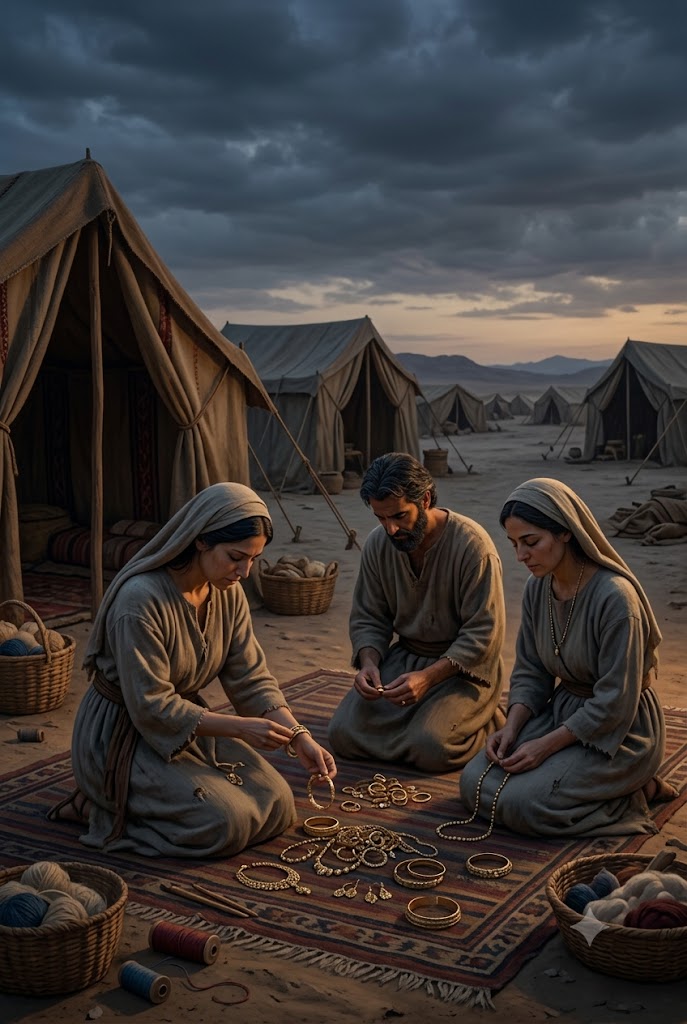
“And when the people heard this bad news, they mourned, and no one put on his ornaments.”
Mourned, and put on no ornaments. This expression shows they truly felt the weight of this word. God commanded them to remove their jewelry, and they obeyed. It was a gesture of repentance—confronting their own sin mattered more than adorning their appearance.
⛺ Act Two — Meeting at the Tabernacle (Verses 7–11) After this event, Moses sets up a special tent outside the camp.
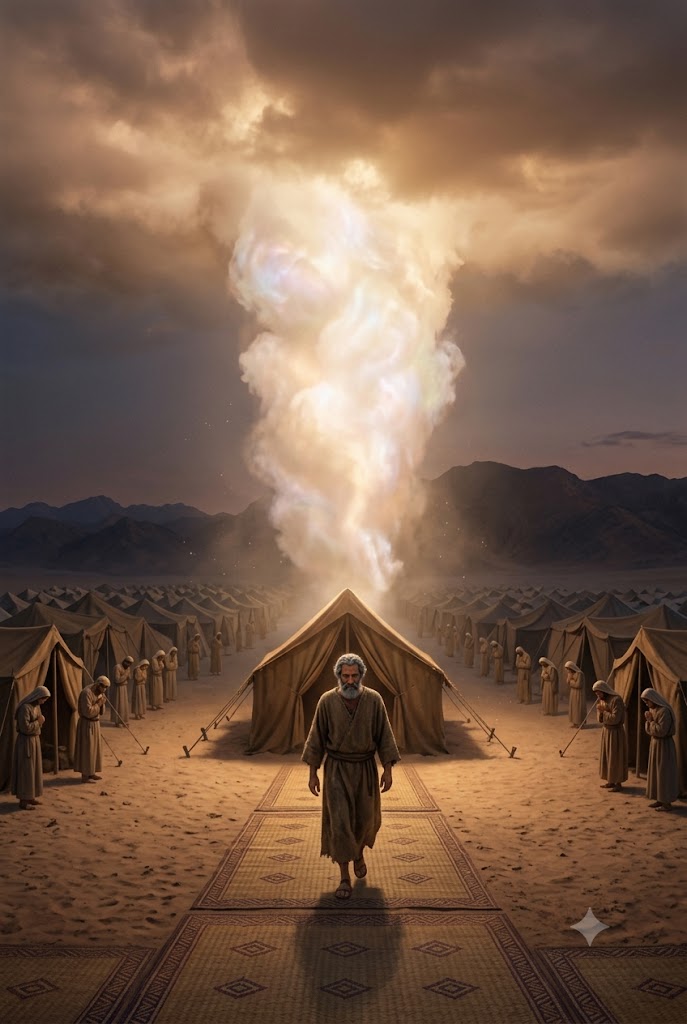
“Moses took his tent and pitched it outside the camp, far from the camp, and called it the tabernacle of meeting. And it came to pass that everyone who sought the LORD went out to the tabernacle of meeting which was outside the camp.”
Outside the camp, far off. This choice of location was itself symbolic. At this point, before the Tabernacle proper had been completed, this makeshift tent was the only place where encounter with God was possible. And that place was not at the center of the camp, but outside it.
But what happened there was remarkable.
“So it was, whenever Moses went out to the tabernacle, that all the people rose, and each man stood at his tent door and watched Moses until he had gone into the tabernacle. And it came to pass, when Moses entered the tabernacle, that the pillar of cloud descended and stood at the door of the tabernacle, and the LORD talked with Moses.”
And the entire people watched this scene.
“All the people saw the pillary cloud standing at the tabernacle door, and all the people rose and worshiped, each man in his tent door.”
The most striking sentence follows.
“So the LORD spoke to Moses face to face, as a man speaks to his friend.”
As a man speaks to his friend. This expression is extremely rare throughout all of Scripture. It is uncommon for communication between God and a human being to be described in such intimate, informal language. This friendship-like conversation stands in remarkable contrast to the distance at which the entire people had once stood, trembling in fear, at Mount Sinai.
🙏 Act Three — Moses’ Plea (Verses 12–17) Based precisely on this intimate relationship, Moses boldly asks God for more.
“Then Moses said to the LORD, ‘See, You say to me, “Bring up this people.” But You have not let me know whom You will send with me.'”
Moses did not simply accept the situation. He demanded a clear answer.
“Now therefore, I pray, if I have found grace in Your sight, show me now Your way, that I may know You and that I may find grace in Your sight. And consider that this nation is Your people.”
Show me now Your way, that I may know You. What Moses sought was not merely safe passage. He wanted to know God more deeply.
God’s response goes beyond what Moses had asked.
“And He said, ‘My Presence will go with you, and I will give you rest.'”
My Presence will go with you. This was a remarkable reversal. The initial declaration—”I will not go up in your midst”—was now being completely overturned through Moses’ intercession.
But Moses does not stop here.
“Then he said to Him, ‘If Your Presence does not go with us, do not bring us up from here. For how then will it be known that Your people and I have found grace in Your sight, except You go with us? So we shall be separate, Your people and I, from all the people who are upon the face of the earth.'”
Do not bring us up from here. For Moses, the promised land held no meaning without God’s presence. Reaching the destination mattered less to him than God’s companionship along the journey.
God responds once more.
“So the LORD said to Moses, ‘I will also do this thing that you have spoken; for you have found grace in My sight, and I know you by name.'”
I know you by name. This expression shows that the relationship between Moses and God was not merely functional cooperation, but personal knowledge.
✨ Act Four — Show Me Your Glory (Verses 18–23) And then comes the boldest request in this entire chapter.
“And he said, ‘Please, show me Your glory.'”
This request was the most extreme thing a human being could ask of God. To see God had previously been considered so dangerous as to mean death (though in 24:10–11 the elders saw God and lived, this was an even more direct request).
God’s response was both cautious and gracious.
“Then He said, ‘I will make all My goodness pass before you, and I will proclaim the name of the LORD before you. I will be gracious to whom I will be gracious, and I will have compassion on whom I will have compassion.'”
But a clear limit is given as well.
“But He said, ‘You cannot see My face; for no man shall see Me, and live.'”
For no man shall see Me, and live. This limit reminds us once more just how overwhelming God’s holiness truly was. No matter how intimate the relationship, there remained a limit human beings could not surpass.
But instead of a complete refusal, God offers a remarkable accommodation.
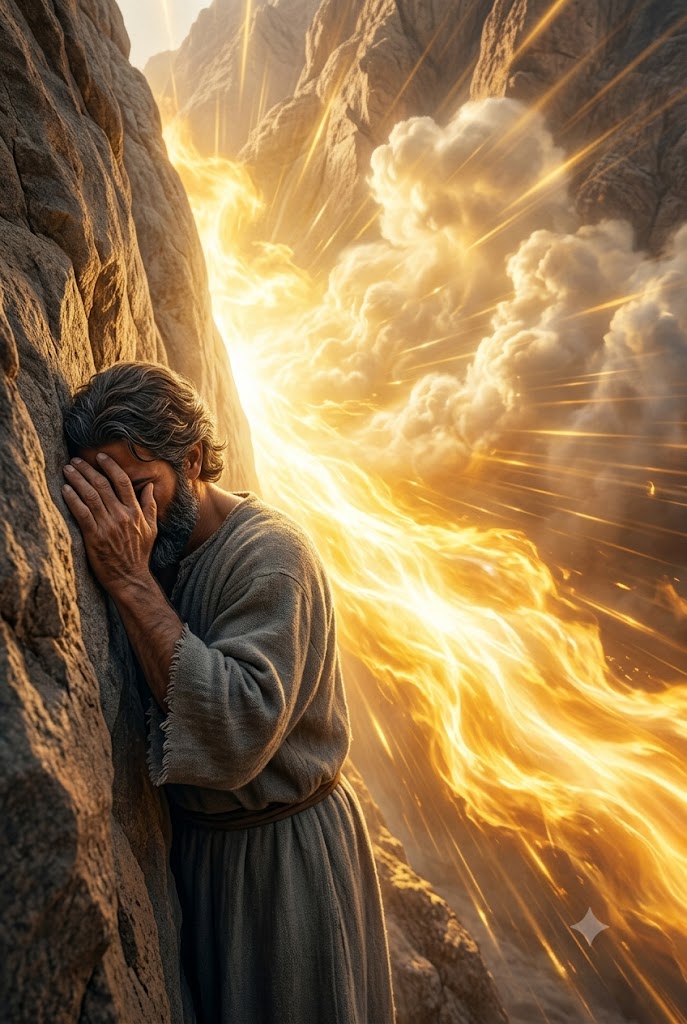
“And the LORD said, ‘Here is a place by Me, and you shall stand on the rock. So it shall be, while My glory passes by, that I will put you in the cleft of the rock, and will cover you with My hand while I pass by. Then I will take away My hand, and you shall see My back; but My face shall not be seen.'”
You shall see My back. This image is remarkably human, and yet mysterious. Moses could not face God directly, but he could see the trace of His passing—His back. This is also a profound metaphor for how we come to know God. We often understand God’s presence not in real time, but only afterward, realizing He had been with us all along.
🕊️ Reflection — A God Who Speaks as a Friend, Yet Remains Utterly Holy The truth to be most deeply engraved from Exodus 33 is this: God spoke face to face with Moses, as a friend. But at the same time, the grave limit—”no man shall see Me, and live”—remained equally clear. These two truths do not contradict each other. Together, they paint the full picture of what it means to know God.
We are tempted to reduce our relationship with God to intimacy alone, or to distance alone. But Scripture demands we hold both truths together. God is near enough to speak with us as a friend, and yet holy enough to be beyond what we could ever bear.
And Moses’ plea—”If Your Presence does not go with us, do not bring us up from here.” This prayer asks us an important question. Do we value simply arriving at our destination more than having God’s presence along the way?
Finally, that mysterious image—”you shall see My back.” We too often recognize God’s hand only after it has already passed. But even that, in itself, is one true way of coming to know God.
“Do you look back to see the trace of where God has passed, and recognize that He was with you?”
📣 Coming Up Next Exodus Chapter 34 — The Tablets Re-Inscribed In place of the broken tablets, God commands two new tablets to be prepared. And upon that mountain, God proclaims His own name and character to Moses. The moment the covenant is renewed unfolds in the next episode.
#Exodus33 #IWillNotGoUpWithYou #MeetingAtTheTabernacle #AsAManSpeaksToHisFriend #ShowMeYourGlory #IntheCleftOfTheRock #YouShallSeeMyBack #TheExodus #BibleStudy #ChristianBlog #Exodus #OldTestament #Scripture #Church #DailyDevotional #BiblicalFaith #GodsPower