Exodus Series — Episode 3
🔥 Prologue — The Fire That Shattered Forty Years of Silence
Forty years.
That was the duration of Moses’ concealment within the Midian wilderness—tending the flocks of his father-in-law Jethro, walking the dust of the desert, reduced from the marble corridors of imperial power to the barren anonymity of a wilderness shepherd. The man once educated in all the wisdom of Egypt, fluent in the languages of power and palace, had been systematically stripped of every external credential.
From the world’s perspective, this was a wasted life. An abandoned calling. A forgotten existence.
But from the perspective of the Sovereign Architect—this was the completion of the most precise preparation in redemptive history.
Forty years of wilderness had not broken Moses. Forty years of wilderness had been sculpting him—chiseling away the imperial pride, dismantling the architecture of self-reliance, fashioning a vessel capable of carrying not his own agenda but the weight of divine commission. And then the day of completion arrived.
On the slopes of Horeb, an ordinary desert shrub ignited. And did not burn.
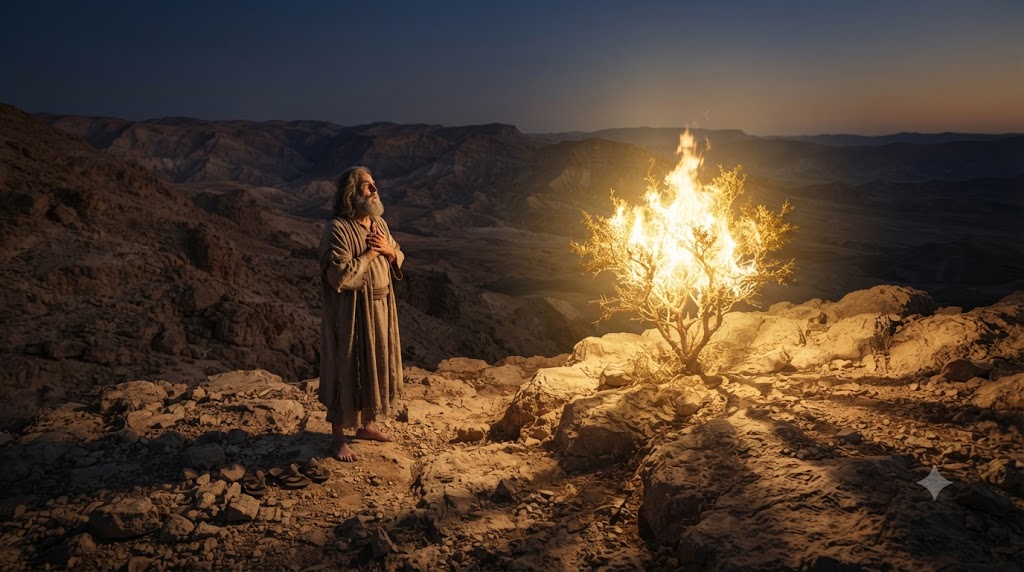
🌿 Act One — The Mountain of God and the Unconsumed Fire (Verses 1–3)
“Now Moses was tending the flock of Jethro his father-in-law, the priest of Midian. And he led the flock to the back of the desert, and came to Horeb, the mountain of God.”
An ordinary day. Moses guided the flock westward into the wilderness, toward the slopes of Horeb. No divine appointment was circled on any calendar. No prophetic impression had stirred within him that morning. Simply another day of following sheep toward water and pasture.
This is frequently how the commission of God arrives—without fanfare, without dramatic forewarning, directly into the unguarded middle of an ordinary sequence.
“And the Angel of the LORD appeared to him in a flame of fire from the midst of a bush. So he looked, and behold, the bush was burning with fire, but the bush was not consumed.”
A flame materialized. A desert shrub ignited. And yet—it was not being consumed. The fire blazed with intensity, yet the organic matter refused to be reduced to ash. In a wilderness environment where fire spreads rapidly and burns itself out, this flame neither spread nor extinguished.
“Then Moses said, ‘I will now turn aside and see this great sight, why the bush does not burn.'”
Moses turned aside. He arrested his momentum, reversed his trajectory, and moved toward the anomaly. This was the first response—curiosity elevated into something greater. To stop one’s ordinary motion, to redirect toward the uncanny flame—this itself constituted the inaugural step of faith.
The unconsumed bush encoded the self-revelation of God. Fire that does not consume—the eternal nature of the Almighty, incapable of diminishment. The divine presence descending upon the most lowly and common desert shrub—the character of a God who consistently selects the humble and overlooked. The flame preserving rather than destroying the bush—the grace of a God whose presence does not annihilate but sustains those who draw near.
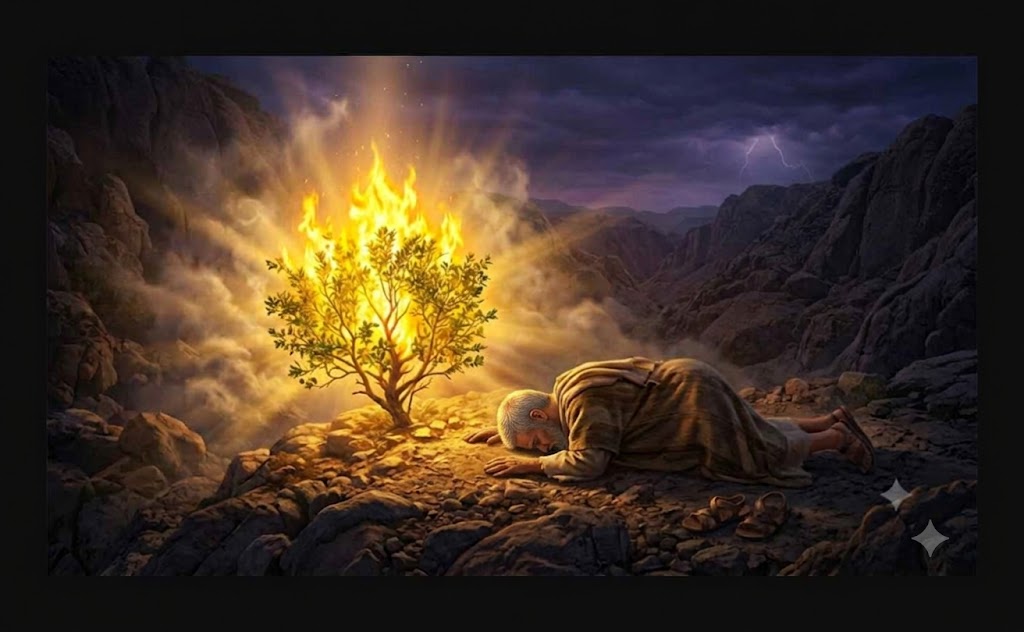
👂 Act Two — The Divine Address: God Calls, Moses Responds (Verses 4–6)
“So when the LORD saw that he turned aside to look, God called to him from the midst of the bush and said, ‘Moses, Moses!’ And he said, ‘Here I am.'”
God was watching. He observed Moses turning aside, approaching the flame. He had been waiting—for the stopping, the turning, the drawing near.
And then He spoke the name. “Moses, Moses.” The double vocative. In Hebrew literary tradition, the repetition of a name signals both profound intimacy and urgent commission. Abraham received it. Samuel received it. Martha received it from the lips of Jesus Himself. Moses now entered that sacred company.
Moses answered: “Here I am.” The Hebrew Hineini—the full-body declaration of covenantal availability. Not merely a positional report but a declaration of total consecration. Abraham had said it. Isaiah had said it. Moses now joined the lineage of those who met God’s call with unreserved presence.
“Then He said, ‘Do not draw near this place. Take your sandals off your feet, for the place where you stand is holy ground.'”
Remove your sandals. Bare soles on sacred soil. The posture required before the holiness of God—the stripping away of every self-constructed barrier, every layer of worldly insulation. Sandals connected a person to the terrain of their ordinary world. To remove them was to step out of the ordinary and stand, unmediated, before the extraordinary.
“Moreover He said, ‘I am the God of your father—the God of Abraham, the God of Isaac, and the God of Jacob.’ And Moses hid his face, for he was afraid to look upon God.”
God identified Himself in historical terms. The God of Abraham, Isaac and Jacob—not an abstract philosophical category but a God with a covenant biography, a God who had acted within specific human narratives across centuries. A God who remembered promises made to dead patriarchs and was now arriving to fulfill them.
Moses covered his face. The instinctive human response to the overwhelming holiness of God—the sacred trembling that marks every authentic encounter with the living Creator.
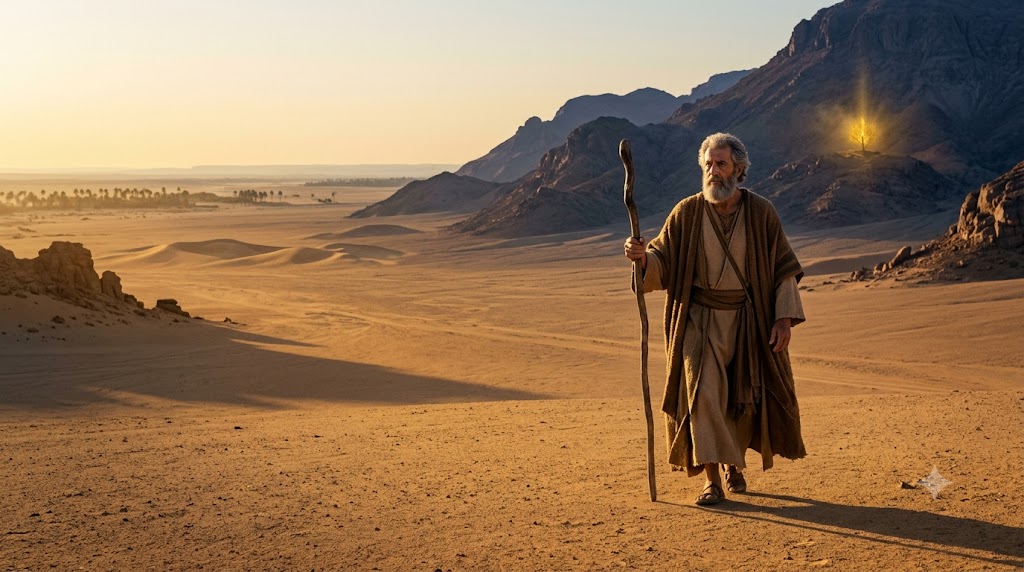
💔 Act Three — God Has Seen, God Has Heard, God Has Come Down (Verses 7–9)
“And the LORD said: ‘I have surely seen the oppression of My people who are in Egypt, and have heard their cry because of their taskmasters, for I know their sorrows.'”
Three verbs cascaded in rapid succession.
Seen. Heard. Know.
God had been watching—the Hebrew slaves collapsing under the weight of production quotas in the brick kilns, the backs lacerated by imperial whips, the pillows saturated with midnight tears.
God had been listening—to the raw cries of anguish, to the inarticulate groaning that precedes formed language, to the sighs that escaped from souls too crushed to assemble coherent prayer.
God knew—the sorrow, the inner texture of the suffering, the cumulative weight of generational bondage on the collective soul of a nation.
“So I have come down to deliver them out of the hand of the Egyptians, and to bring them up from that land to a good and large land, to a land flowing with milk and honey.”
I have come down. God declared His personal descent into the situation. Not a God who issues directives from comfortable celestial distance—but a God who comes down. This was the prefiguring of the Incarnation itself. Just as Jesus Christ would one day descend into the human condition, God consistently reveals Himself as a God who descends toward His people.
And at the end of the descent—a land flowing with milk and honey. Beyond the suffering, abundance. Beyond the oppression, freedom. Beyond the wilderness, Canaan.
😰 Act Four — Five Refusals: The Anatomy of Moses’ Fear Before the Commission (Verses 10–22)
“Come now, therefore, and I will send you to Pharaoh that you may bring My people, the children of Israel, out of Egypt.”
The commission was declared. Moses’ response was not immediate acceptance.
Five waves of objection followed—not unbelief, but the honest articulation of human terror before an overwhelming assignment.
First Refusal — Who Am I? (Verse 11)
“Who am I that I should go to Pharaoh, and that I should bring the children of Israel out of Egypt?”
Forty years ago I was a prince. Today I am an aging wilderness shepherd. I have no standing, no credentials, no platform. God answered: “I will certainly be with you.” The qualification was never resident within Moses. The qualification was the presence of God Himself.
Second Refusal — What Is Your Name? (Verses 13–15)
“Indeed, when I come to the children of Israel and say to them, ‘The God of your fathers has sent me to you,’ and they say to me, ‘What is His name?’ what shall I say to them?”
God answered with the most profound self-disclosure in the entire Hebrew canon.
“I AM WHO I AM… Thus you shall say to the children of Israel, ‘I AM has sent me to you.'”
Ehyeh Asher Ehyeh. The self-existent One. The One whose being requires no external source or substrate. The One who was, and is, and is to come—simultaneously. Past tense, present tense, future tense collapsed into a single eternal declaration. Every other name describes; this name simply is.
“The LORD God of your fathers, the God of Abraham, the God of Isaac, and the God of Jacob, has sent me to you. This is My name forever, and this is My memorial to all generations.”
YHWH. The covenant name. The name Israel would whisper in reverence and shout in deliverance for millennia. Revealed for the first time in the flickering light of an unconsumed desert shrub.
Third Refusal — They Will Not Believe Me (Chapter 4, Verse 1)
What if they do not believe? God answered with three signs—the staff becoming a serpent, the leprous hand restored, the water transformed to blood.
Fourth Refusal — I Am Not Eloquent (Chapter 4, Verse 10)
I am slow of speech and slow of tongue. God answered: “Who has made man’s mouth?… Have not I, the LORD?” The Creator of language does not regard the speaker’s limitations as a disqualifying impediment.
Fifth Refusal — Send Someone Else (Chapter 4, Verse 13)
When every other excuse had been exhausted, Moses made the naked request—send someone else. God’s anger burned. Yet in grace, He appointed Aaron as Moses’ spokesman.
🕊️ Reflection — What the Unconsumed Flame Says to Us
Exodus Chapter 3 is the complete anatomy of divine commission.
The desert shrub was the most ordinary, unremarkable vegetation in the Sinai wilderness. God chose it for His self-revelation. If you currently perceive yourself as nothing more than an unremarkable desert bush—know that the flame of God descends precisely upon the ordinary and overlooked.
The fire blazing without consuming its host is not a paradox to be intellectually resolved—it is a portrait of how God’s presence operates. His commission does not incinerate you. It illuminates you. He does not send you to be burned up by the assignment. He sends you to burn with His presence before a watching world.
Moses’ five objections are our five objections. I am unqualified. I don’t know enough. No one will believe me. I am not capable enough. Find someone else. The answer to every one of them was identical: “I will certainly be with you.” Our inadequacy is not the obstacle to the calling. God’s presence is the power of the calling.
Today, what desert shrub is burning on your Horeb? Stop walking. Turn aside. Draw near. Remove your sandals before that flame. God is calling your name—twice.
“With what fear are you refusing God’s commission today? ‘I will certainly be with you’—that single declaration is the complete answer to every objection you have raised.”
📣 Coming Up Next
Exodus Chapter 4 — The Staff and the Signs: Obedience Beyond Fear
After five refusals, Moses finally accepts the commission and sets out for Egypt. A staff becomes a serpent. A hand becomes leprous and is restored. Water becomes blood. And then—the shocking scene on the road where God moves to kill Moses himself. The cost of delayed obedience and the depth of covenant grace unfold in the next episode.
#Exodus3 #BurningBush #HorebMountain #NameOfGod #IAmWhoIAm #YHWH #CallingOfMoses #WildernessPpreparation #RemoveYourSandals #HolyGround #LandOfMilkAndHoney #DivineCommission #FearOfCalling #GodIsWithYou #BibleStudy #ChristianBlog #Exodus #OldTestament #Scripture #Church