Exodus Series — Episode 25
🔥 Prologue — A Blueprint Beginning Within the Cloud Moses had entered the cloud and was spending forty days on the mountain.
Meanwhile, at the foot of the mountain, the people waited for him. And on the mountain, God begins to reveal to Moses a remarkable plan. The Tabernacle—the blueprint for a dwelling place where God would live among His people.
From Exodus 25 onward, across several chapters, extremely detailed and specific construction instructions follow. For some readers, this level of detail may feel tedious. But one central sentence in this chapter reveals why all these details matter—God desires to dwell together with humanity.
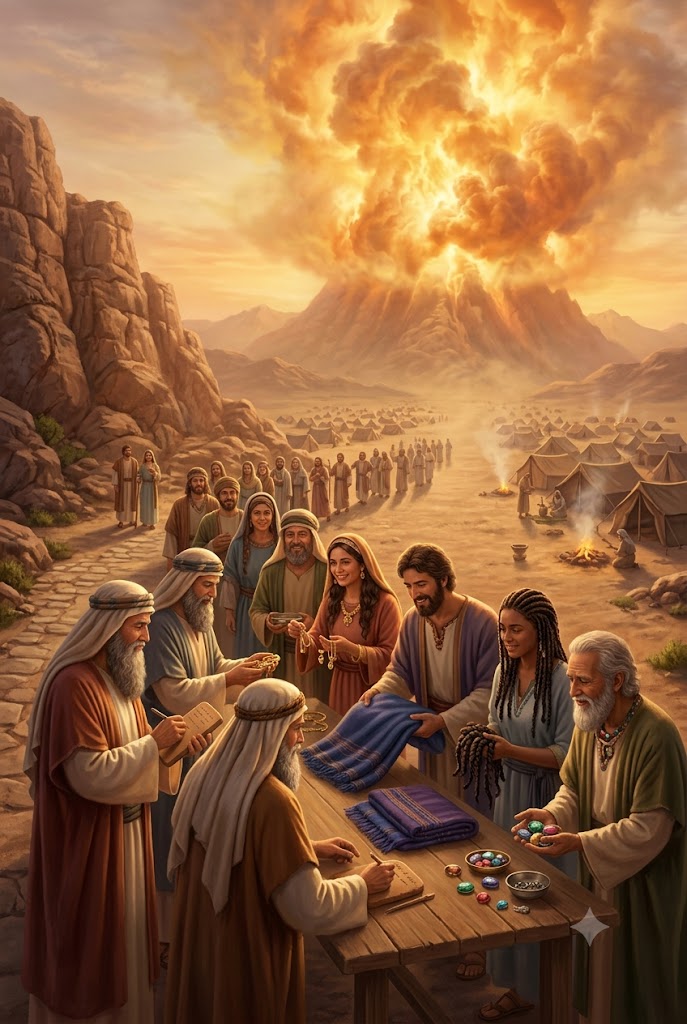
🎁 Act One — Offerings Given from a Willing Heart (Verses 1–9) “Then the LORD spoke to Moses, saying: ‘Speak to the children of Israel, that they bring Me an offering. From everyone who gives it willingly with his heart you shall take My offering.'”
Everyone who gives it willingly with his heart. The funding for the Tabernacle’s construction was not a forced levy. It had to be an offering that flowed from a willing heart. God did not desire what was given reluctantly.
The list of offerings is enumerated in detail.
“And this is the offering which you shall take from them: gold, silver, and bronze; blue, purple, and scarlet thread, fine linen, and goats’ hair; ram skins dyed red, badger skins, and acacia wood; oil for the light, and spices for the anointing oil and for the sweet incense; onyx stones, and stones to be set in the ephod and in the breastplate.”
Gold, silver, bronze, colored threads, hides, wood, oil, spices, gemstones. This astonishingly diverse list of materials shows that building the Tabernacle required the participation of the entire people. The wealthy could bring gold and silver; the ordinary person could bring goats’ hair or hide. It was a devotion in which no one was excluded.
And the ultimate purpose of all these offerings is declared.
“And let them make Me a sanctuary, that I may dwell among them.”
That I may dwell among them. This sentence is the heart of the entire Tabernacle plan. God was not one who remained only in the distant heavens—He was one who desired to actually dwell in the midst of His people. The distance at which the people had stood, trembling in fear at Mount Sinai, was now beginning to be closed through the Tabernacle.
“According to all that I show you—that is, the pattern of the tabernacle and the pattern of all its furnishings—just so you shall make it.”
According to what I show you. This was not human creative design. Moses had to follow the exact pattern God revealed to him. The Tabernacle was not a dwelling place for God imagined by human beings—it was a design directly revealed by God Himself.
📦 Act Two — The Ark of the Covenant (Verses 10–22) Instructions are given first for the holiest object within the Tabernacle, the Ark of the Covenant.
“And they shall make an ark of acacia wood; two and a half cubits shall be its length, a cubit and a half its width, and a cubit and a half its height.”
Precise dimensions. Not a rough guideline, but a meticulously specified size.
“And you shall overlay it with pure gold, inside and out you shall overlay it, and shall make on it a molding of gold all around.”
With pure gold. Upon the humble material of acacia wood, pure gold was applied. This was a symbolic way in which human material and divine glory were joined together.
Instructions follow concerning the mercy seat to be placed atop the ark.
“You shall make a mercy seat of pure gold: two and a half cubits shall be its length and a cubit and a half its width. And you shall make two cherubim of gold; of hammered work you shall make them at the two ends of the mercy seat.”
The cherubim—winged angelic beings—stood at either end of the mercy seat, facing one another with their wings spread.
“The cherubim shall stretch out their wings above, covering the mercy seat with their wings, and they shall face one another; the faces of the cherubim shall be toward the mercy seat.”
And the most important purpose of this object is proclaimed.
“And there I will meet with you, and I will speak with you from above the mercy seat, from between the two cherubim which are on the ark of the Testimony, about everything which I will give you in commandment to the children of Israel.”
There I will meet with you. This verse summarizes the very essence of the Ark of the Covenant. It was not merely a container—it was the exact point where God and humanity would meet. The intense encounter the entire people had experienced at Mount Sinai was now being concentrated into this one specific place.
🍞 Act Three — The Table of Showbread and the Lampstand (Verses 23–40) Following the Ark, instructions are given concerning the table on which the showbread would be placed.
“You shall also make a table of acacia wood; two cubits shall be its length, a cubit its width, and a cubit and a half its height. And you shall overlay it with pure gold, and make a molding of gold all around.”
Bread was to be arranged on this table at all times.
“And you shall set the showbread on the table before Me always.”
Before Me always. This bread simultaneously symbolized God’s continual provision and the people’s continual worship. The God who had fed His people manna every day now had bread placed as a symbol of continual presence within the Tabernacle as well.
Then detailed instructions concerning the lampstand follow.
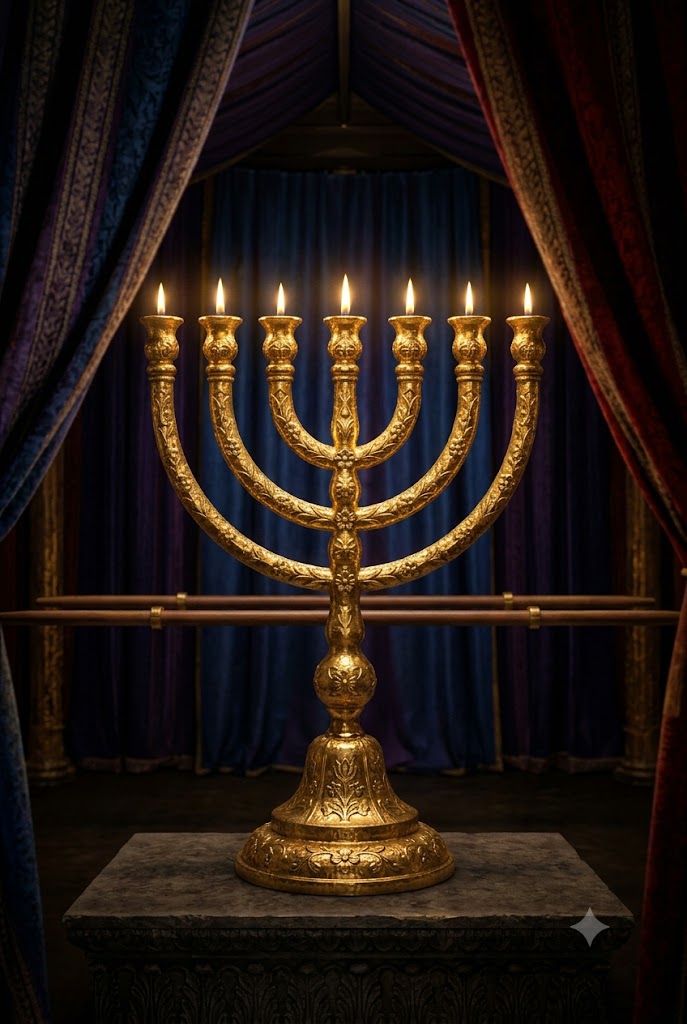
“You shall also make a lampstand of pure gold; the lampstand shall be of hammered work. Its shaft, its branches, its bowls, its ornamental knobs, and flowers shall be of one piece.”
Of one piece. The lampstand was not to be assembled from separate parts—it had to be hammered out of a single mass of pure gold. This required an extraordinary level of skill and care.
“And six branches shall come out of its sides: three branches of the lampstand out of one side, and three branches of the lampstand out of the other side.”
This lampstand became the archetype of the menorah, which would later become one of the most iconic symbols of Judaism. Seven lamps were designed to continuously illuminate the interior of the Tabernacle.
The chapter closes with a short but forceful sentence.
“And see to it that you make them according to the pattern which was shown you on the mountain.”
According to the pattern shown to you. This repeated emphasis reaffirms, once more, that the building of the Tabernacle was, from beginning to end, not a work of human creativity but a work following God’s revelation.
🕊️ Reflection — The God Who Closes the Distance The truth to be most deeply engraved from Exodus 25 is this: at Mount Sinai, the people had stood trembling and far off before God’s holiness. But now, God Himself begins to close that very distance. “Let them make Me a sanctuary, that I may dwell among them.”
This is the heart of God running through all of Scripture. Before humanity finds a way to approach God, God Himself prepares the way to come near to humanity. The Tabernacle was the beginning of that journey—leading later to the Temple, and ultimately to Christ incarnate (John 1:14—the Word became flesh and dwelt among us).
And the offerings given from a willing heart. God did not desire what was given under compulsion. Our own devotion today is much the same. It must flow not from obligation or pressure, but from a heart that gives joyfully.
Finally, the repeated command—”according to the pattern shown to you.” We often want to invent our own way of serving God. But true worship is not about displaying our own creativity—it is about faithfully following the way God Himself has revealed.
“Are you preparing a place in your own life where God may dwell?”
📣 Coming Up Next Exodus Chapters 26–27 — The Structure of the Tabernacle and the Courtyard Detailed instructions follow concerning the curtains and frames that form the Tabernacle, as well as the bronze altar and the courtyard. The story of God’s dwelling place taking physical shape unfolds in the next episode.
#Exodus25 #OfferingsForTheTabernacle #AWillingHeart #ArkOfTheCovenant #TheMercySeat #Cherubim #TableOfShowbread #PureGoldLampstand #AccordingToThePatternShown #TheExodus #BibleStudy #ChristianBlog #Exodus #OldTestament #Scripture #Church #DailyDevotional #BiblicalFaith #GodsPower