Exodus Series — Episode 13
🔥 Prologue — Freedom Is Not a Destination, But a Beginning They had left Egypt.
Four hundred and thirty years of bondage had ended, and six hundred thousand men and their families were finally free. But Exodus 13 is not a chapter of celebration. Instead, it quietly asks a question: what must a people do once freedom has been given to them?
This chapter deals with two things at once. One is remembrance—consecrating the firstborn and keeping the Feast of Unleavened Bread so that this night would never be forgotten. The other is guidance—since a people freshly liberated could not find their own way, God Himself would go before them.
Freedom was not an arrival, but the beginning of a journey. And that journey required a guide.
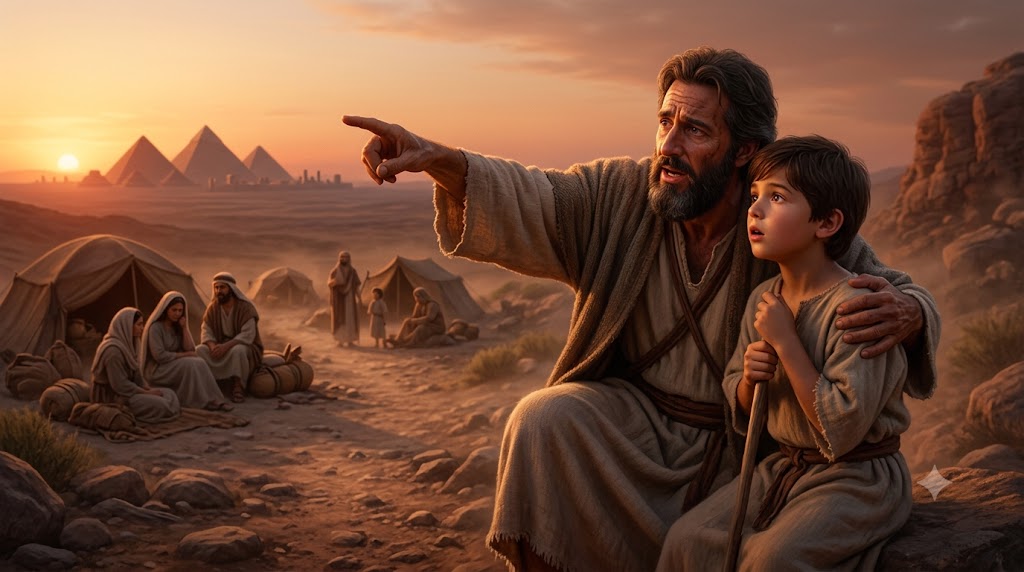
🐑 Act One — The Consecration of the Firstborn (Verses 1–16) “Then the LORD spoke to Moses, saying, ‘Consecrate to Me all the firstborn, whatever opens the womb among the children of Israel, both of man and beast; it is Mine.'”
It is Mine. On the night when every firstborn in Egypt died, Israel’s firstborn survived. To whom, then, did that surviving life now belong? God states it plainly—it had always belonged to Him.
Moses commands the people to remember this day.
“And Moses said to the people: ‘Remember this day in which you went out of Egypt, out of the house of bondage; for by strength of hand the LORD brought you out of this place. No leavened bread shall be eaten.'”
Out of the house of bondage. This phrase recurs throughout the rest of Scripture. Israel’s identity is repeatedly summarized in this single sentence—we were slaves, but the LORD brought us out.
The ordinance to eat unleavened bread for seven days is reaffirmed, and its purpose explained.
“And you shall tell your son in that day, saying, ‘This is done because of what the LORD did for me when I came up from Egypt.'”
Tell your son. This ordinance was never merely a private act of devotion. It was instruction meant to be passed to the next generation. Whenever a child asked why this was done, the parent would need to retell the story of that night.
Specific ordinances concerning the firstborn are also given.
“But every firstborn of a donkey you shall redeem with a lamb; and if you will not redeem it, then you shall break its neck. And all the firstborn of man among your sons you shall redeem.”
Redeem. A lamb stood in place of the donkey; a redemption price stood in place of a person. The principle from that night when judgment passed over—that something must die in place of another for life to continue—now continued to permeate the ordinary rhythms of daily life.
“It shall be as a sign to you on your hand and as a memorial between your eyes, that the LORD’s law may be in your mouth; for with a strong hand the LORD has brought you out of Egypt.”
A sign on the hand, a memorial between the eyes. This verse became the basis for the later Jewish tradition of binding phylacteries to the wrist and forehead. God’s saving acts were not meant to remain only in memory—they were to be inscribed on the hand and the eyes, on both action and thought.
🗺️ Act Two — The God Who Chose the Wilderness Road (Verses 17–22) When the people left Egypt, there was a faster road available.
“Then it came to pass, when Pharaoh had let the people go, that God did not lead them by way of the land of the Philistines, although that was near; for God said, ‘Lest perhaps the people change their minds when they see war, and return to Egypt.'”
It was not the nearest road. The way to the Philistines was the shortcut, but war awaited on that path. God knew the people were not yet ready. For those who had just emerged from slavery, facing war immediately might have driven them straight back into Egypt.
“So God led the people around by way of the wilderness of the Red Sea. And the children of Israel went up in orderly ranks out of the land of Egypt.”
Led them around. God’s guidance was never the shortest distance. It was, in fact, a detour. But that detour was not failure—it was wisdom, meant to protect the people.
A surprising scene is inserted into this chapter.
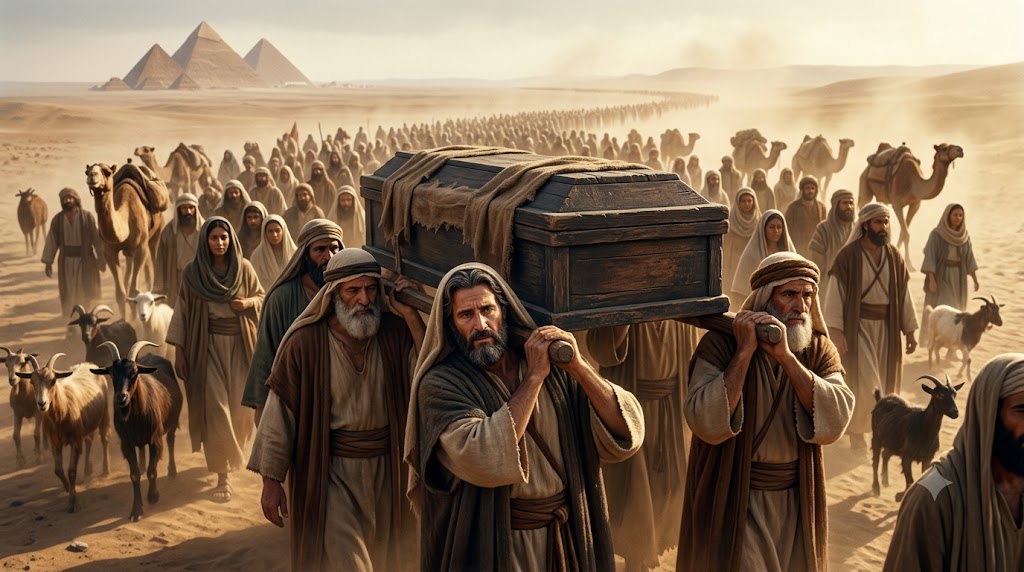
“And Moses took the bones of Joseph with him, for he had placed the children of Israel under solemn oath, saying, ‘God will surely visit you, and you shall carry up my bones from here with you.'”
The bones of Joseph. This was Joseph’s final request, given at the close of Genesis (Genesis 50). Before he died, he believed that God would one day surely lead Israel out of that land. And he asked that when that day came, his own bones be carried out along with them. More than four hundred years later, that promise was being kept, word for word.
It was a moment where one person’s faith reached fulfillment across many generations.
And the final verse of this chapter ties everything together.
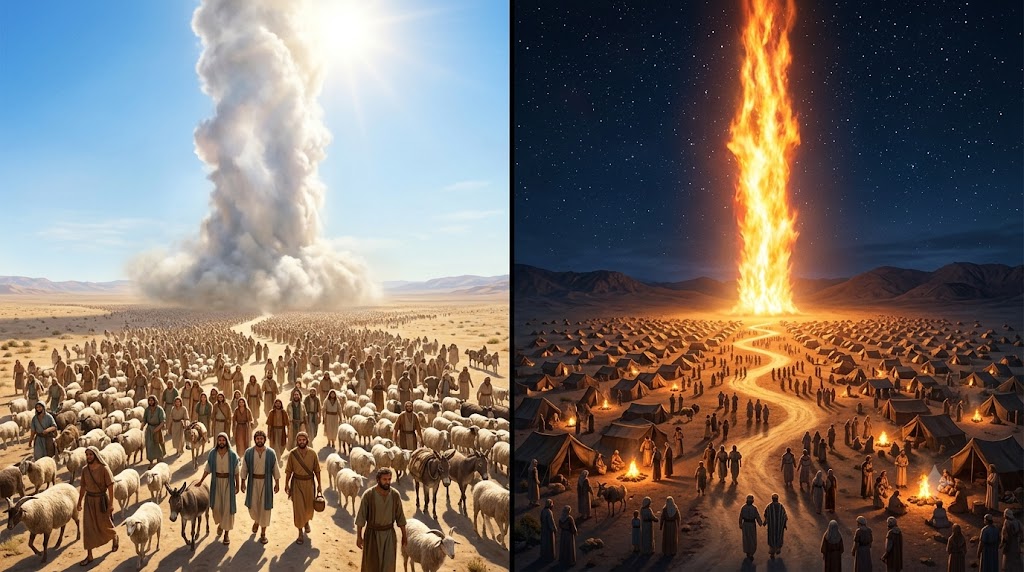
“And the LORD went before them by day in a pillar of cloud to lead the way, and by night in a pillar of fire to give them light, so as to go by day and night. He did not take away the pillar of cloud by day or the pillar of fire by night from before the people.”
Went before them. God was not one who merely issued directions from behind. He Himself went ahead. By day, a cloud shielded them from the scorching sun; by night, a fire lit their path through the darkness. Day or night, His guidance never ceased.
He did not take away the pillar of cloud by day or the pillar of fire by night from before the people. This closing sentence becomes a summary of the entire forty years to come in the wilderness. Circumstances would continue to change, but the guiding presence would never depart.
🕊️ Reflection — Not the Shortcut, But the Road Walked Together The truth that offers the deepest comfort in Exodus 13 is this: God did not lead Israel by the fastest road. Instead, He led them by the road they could actually bear—the road on which they could be made ready.
We often regard the detours of life as failures. We ask why we must go the long way when a shorter path seems to exist. But Exodus 13 offers a different perspective. God’s guidance considers not only the destination, but the condition of those who must walk the road. The Philistine road may have been shorter, but for this people, it was still too soon.
And then there are the bones of Joseph. Watching one person’s faith reach fulfillment four hundred years later teaches us that promises unfulfilled in our own generation are never in vain. Faith is sometimes fulfilled beyond the span of a single lifetime.
Finally, the pillar of cloud and the pillar of fire. God did not leave His people alone even in the wilderness. Day or night, His presence never departed. The same promise stands over our own wilderness.
“Might the detour you are walking through right now be, not a failure, but a season of preparation?”
📣 Coming Up Next Exodus Chapter 14 — The Red Sea Parts The Egyptian army pursues Israel once more. The sea ahead, the army behind—at the moment of greatest peril, Moses lifts his staff and the sea divides. The most dramatic scene in the history of the Exodus unfolds in the next episode.
#Exodus13 #ConsecrationOfTheFirstborn #FeastOfUnleavenedBread #PillarOfCloud #PillarOfFire #BonesOfJoseph #WildernessGuidance #TheLongerRoad #GodsPresence #TheExodus #BibleStudy #ChristianBlog #Exodus #OldTestament #Scripture #Church #DailyDevotional #BiblicalFaith #GodsPower