Exodus Series — Episode 12
🔥 Prologue — The Apex of All the Plagues, the Zenith of Salvation
Nine plagues had passed.
The Nile had run with blood. Frogs had blanketed the land. Gnats and flies had tormented man and beast. The livestock had died. Boils had erupted on every body. Hail had shattered everything in the open fields. Locusts had consumed what remained. Three days of impenetrable darkness had smothered the land. And still Pharaoh’s heart had not broken.
One plague remained. The heaviest. The most terrible. The most decisive. The night when every firstborn in Egypt would die—from the firstborn of Pharaoh on his throne to the firstborn of the prisoner in his dungeon, to the firstborn of the livestock in the field. The night when death would move through the entire land.
But that night, Israel was given something different.
The blood of a lamb. Applied to the doorposts. And when the blood was seen—death passed over.
The Passover. Hebrew Pesach—to pass over. The night death passed over. But looking deeper—the night God covered His people. The night the blood of a lamb shielded those it marked from the destroying force that moved through Egypt.
This night was the greatest typological foreshadowing in all of the Old Testament. One day John the Baptist would cry out beside the Jordan: “Behold! The Lamb of God who takes away the sin of the world!”
🌙 Act One — The Passover Ordinance: God Designs the Rescue (Verses 1–14)
“This month shall be your beginning of months; it shall be the first month of the year to you.”
God altered the calendar first. This month—the month of liberation—would now be the first month of the year. The day of salvation would become the new origin point of history.
Everything before the Exodus was now before. Everything after the Passover was a new beginning. For the redeemed, time is recalibrated from the moment of rescue.
“On the tenth of this month every man shall take for himself a lamb, according to the house of his father, a lamb for a household.”
The tenth day. A lamb was selected. And kept—until the fourteenth day at twilight, when it was slaughtered. Four days were spent living alongside the lamb. This was not an anonymous sacrifice—this was a known creature, observed, lived with, and then offered. The sacrifice was personal before it was theological.
The lamb’s qualifications were specified precisely.
“Your lamb shall be without blemish, a male of the first year.”
Without blemish. Without defect. Whole. Complete. This single requirement would echo across millennia—the writer of Hebrews would describe Jesus Christ as “a lamb without blemish and without spot.”
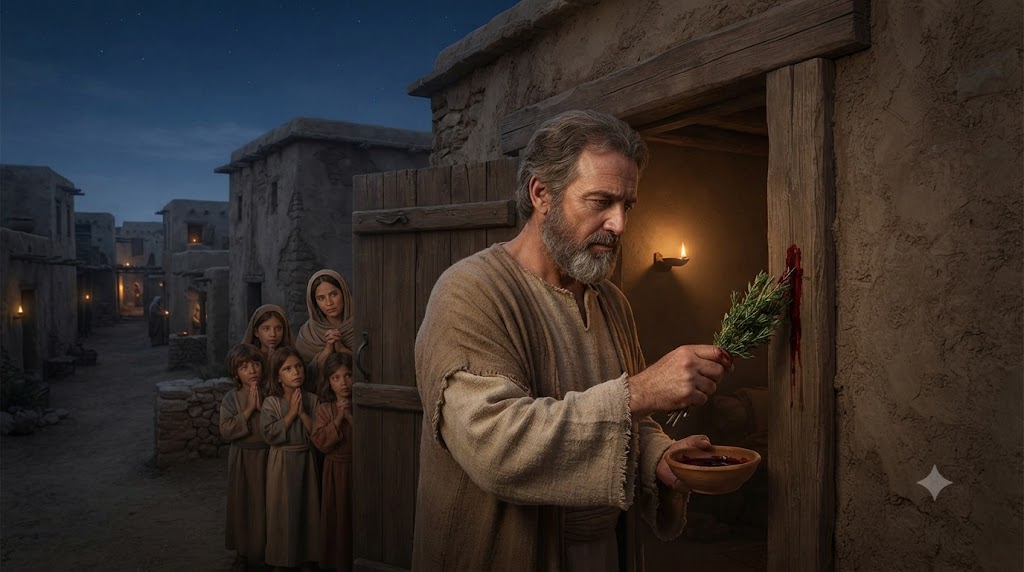
“And they shall take some of the blood and put it on the two doorposts and on the lintel of the houses where they eat it.”
The blood was applied to the door. Not inside—visibly on the outside. On the doorposts and the lintel. It was a declaration: this household is covered by the blood of the lamb.
“Now the blood shall be a sign for you on the houses where you are. And when I see the blood, I will pass over you.”
When I see the blood. What God looked for was not the size of the house. Not the moral record of its inhabitants. Not the length of their religious practice. Only—the blood. Is the blood present on the doorpost? That was the singular criterion.
This is the logic of salvation. Not how good I am—but whether the blood of the Lamb covers me.
🍽️ Act Two — The Passover Meal: Urgency Embodied in a Feast (Verses 8–11)
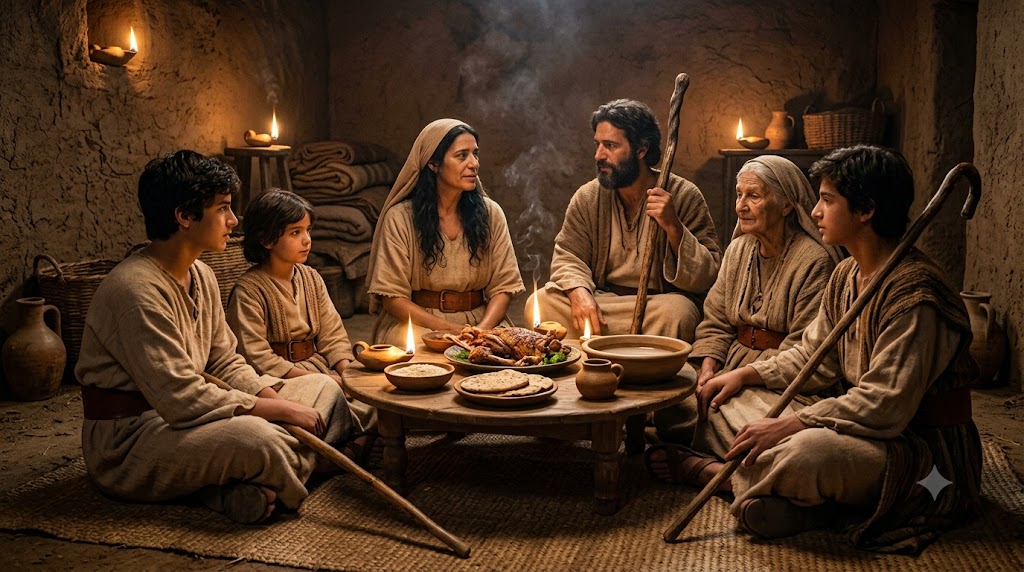
“Then they shall eat the flesh on that night; roasted in fire, with unleavened bread and with bitter herbs they shall eat it.”
Three foods. Three layers of meaning.
Roasted meat—the body of the lamb. Roasted entirely in fire. Not raw. Not boiled. Fire only. Fire was the symbol of judgment. Judgment had fallen on the lamb. Those who ate the lamb consumed the one upon whom judgment had fallen in their place.
Unleavened bread—bread made without yeast. No time for fermentation—they would be leaving in haste. But the deeper register: leaven throughout Scripture is a symbol of sin and corruption. The life of the redeemed is to be purged of the puffing influence of sin.
Bitter herbs—a taste of Egypt. The bitterness of four hundred years of slavery. Salvation does not erase the memory of suffering—it transforms it into gratitude. The bitter memory is held, tasted, and received as part of the story of deliverance.
“And thus you shall eat it: with a belt on your waist, your sandals on your feet, and your staff in your hand. So you shall eat it in haste. It is the LORD’s Passover.”
Standing. Belted. Sandaled. Staff in hand. Fully prepared for immediate departure. This was not a leisurely meal around a settled table. This was fuel consumed by people already in motion.
The life of the redeemed is not a life of permanent settlement in this world—it is the life of those always ready for the next departure.
💀 Act Three — The Tenth Plague: The Death of the Firstborn (Verses 12–13)
“For I will pass through the land of Egypt on that night, and will strike all the firstborn in the land of Egypt, both man and beast; and against all the gods of Egypt I will execute judgment: I am the LORD.”
God Himself would move through the land. Not an angel dispatched. Not a delegated judgment. The LORD Himself.
Against all the gods of Egypt I will execute judgment. The tenth plague was not merely the death of human firstborns—it was the comprehensive judicial sentence against Egypt’s entire divine hierarchy. The firstborn son of Pharaoh—himself considered divine—would die. The living deity of Egypt would be unable to protect his own household. The gods of Egypt would be exposed as powerless before the God of Hebrew slaves.
“Now the blood shall be a sign for you on the houses where you are. And when I see the blood, I will pass over you; and the plague shall not be on you to destroy you when I strike the land of Egypt.”
When I see the blood. Emphasized again. The determining factor was the blood on the doorpost. Not the identity of the inhabitants. Not their history or their righteousness. The blood. Present or absent.
Pesach—to pass over. Death saw the blood and moved past.
📅 Act Four — The Feast of Unleavened Bread: Perpetual Memory (Verses 14–20)
“So this day shall be to you a memorial; and you shall keep it as a feast to the LORD throughout your generations.”
A perpetual memorial. Not a one-time event. An annual re-living. Because salvation is sustained through remembrance.
Seven days of unleavened bread. All leaven removed from every household. Not just avoided—actively searched out and eliminated.
“Remove leaven from your houses.”
The life that follows salvation—a life of actively pursuing the removal of what corrupts. Grace accomplishes the rescue. Holiness is the direction of the rescued life.
🌑 Act Five — That Night: Death Moves Through Egypt (Verses 21–30)
“Then Moses called for all the elders of Israel and said to them, ‘Pick out and take lambs for yourselves according to your families, and kill the Passover lamb.'”
Moses transmitted the instruction. Take the lamb. Slaughter it. Apply the blood.
“And you shall take a bunch of hyssop, dip it in the blood that is in the basin, and strike the lintel and the two doorposts with the blood that is in the basin.”
Hyssop. The lowest, most common plant in the Levantine landscape. Not cedar—the most prestigious wood. Hyssop—the most humble. David would cry from the depth of his sin in Psalm 51: “Purge me with hyssop, and I shall be clean.” The blood of the lamb applied with the most humble instrument. This is the aesthetic of the gospel—the most magnificent rescue accomplished through the most lowly means.
“And none of you shall go out of the door of his house until morning.”
Stay inside. Behind the blood-covered door. Those inside the door were protected. Those who stepped outside—even with blood on the doorpost behind them—were exposed.
Faith is remaining inside the covering. Not one foot in the world and one foot sheltered by the blood—but staying within the boundary the blood establishes.
“For the LORD will pass through to strike the Egyptians; and when He sees the blood on the lintel and on the two doorposts, the LORD will pass over the door and not allow the destroyer to come into your houses to strike you.”
The destroyer could not cross the threshold marked by blood. The blood was the barrier. The boundary. The limit of death’s jurisdiction.
At midnight God moved through Egypt.
“And it came to pass at midnight that the LORD struck all the firstborn in the land of Egypt, from the firstborn of Pharaoh who sat on his throne to the firstborn of the captive who was in the dungeon, and all the firstborn of livestock.”
From the throne to the dungeon. No rank exempted. No social position offering immunity. Without the blood of the lamb—no one was protected. The criterion was singular and absolute.
“So there was a great cry in Egypt, for there was not a house where there was not one dead.”
Not a house where there was not one dead. The collective wail of an entire nation in a single night. The most massive single moment of grief in recorded history.
But in the houses of Israel—silence. Life. The blood had held.
🚪 Act Six — Pharaoh’s Surrender, the Departure Commanded (Verses 31–36)
“Then he called for Moses and Aaron by night, and said, ‘Rise, go out from among my people, both you and the children of Israel. And go, serve the LORD as you have said.'”
By night. Nine plagues had not broken Pharaoh. The tenth plague—the death of his firstborn son—broke him in a single night.
“Also take your flocks and your herds, as you have said, and be gone; and bless me also.”
Bless me also. The absolute sovereign of the world’s most powerful empire—asking for a blessing from the leader of his slave workforce. The inversion was total and complete.
The Egyptians urged Israel out with urgency.
“And the Egyptians urged the people, that they might send them out of the land in haste. For they said, ‘We shall all be dead.'”
We shall all be dead. Fear owned every Egyptian household. And Israel asked for silver and gold and clothing—and the Egyptians gave it freely. Four hundred and thirty years of unrecompensed labor—repaid in a single night by the sovereign hand of God.
🏃 Act Seven — The Departure: Four Hundred and Thirty Years End (Verses 37–42)
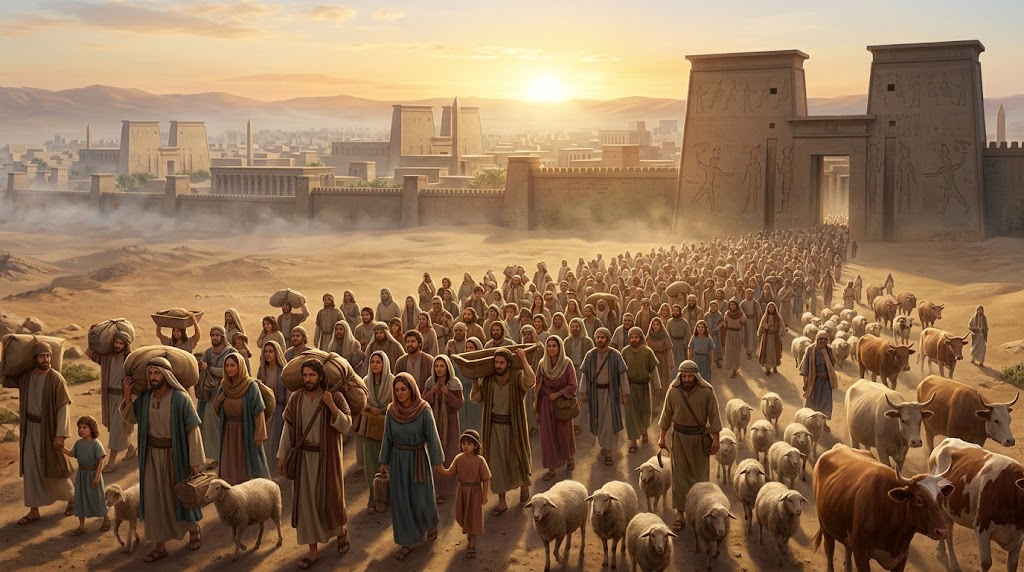
“Then the children of Israel journeyed from Rameses to Succoth, about six hundred thousand men on foot, besides children.”
Six hundred thousand men. Adding women, children and the elderly—a population exceeding two million walked out of Egypt that night.
“Now the sojourn of the children of Israel who lived in Egypt was four hundred and thirty years. And it came to pass at the end of the four hundred and thirty years—on that very same day—it came to pass that all the armies of the LORD went out from the land of Egypt.”
Four hundred and thirty years. Ended on a single day. When God’s timepiece reaches the appointed hour—four centuries of waiting concludes in one night.
“It is a night of solemn observance to the LORD for bringing them out of the land of Egypt. This is that night of the LORD, a solemn observance for all the children of Israel throughout their generations.”
Throughout their generations. The Passover was not a one-time historical event. It was a living, annual, perpetual act of remembrance. Year after year, Israel would return to this night—to remember who they were, and where they had been delivered from.
🕊️ Reflection — Is the Blood Applied to Your Doorpost Today?
Exodus Chapter 12 is the complete picture of the gospel.
A lamb died. A spotless lamb died in the place of those who would otherwise face the judgment. Its blood was applied to the door. God saw the blood. Death passed over.
The structure is identical to the cross. Jesus Christ—the Lamb of God—died. The spotless One died in the place of the stained. His blood covers those who shelter beneath it. God sees that blood. The judgment that would have fallen on us—passes over.
What God looked for was not the moral excellence of the household. Only the blood. Present or absent.
And they had to stay inside. Even with blood on the door—those who stepped outside were not protected. Faith is remaining within the covering. Not one foot in the world and one hand gripping the promise—but remaining fully within the shelter of the blood.
Taste the bitter herbs. Salvation does not falsify the memory of pain. It transforms it. The bitterness of what you came from is held within the feast—and becomes part of the story of gratitude.
Belt your waist. Put on your sandals. Take your staff. Do not attempt to permanently settle in a world that is not your home. You are a pilgrim moving through. Keep moving toward the land of promise.
“Is the blood of the Lamb applied over your doorpost today? What God sees is only the blood. Remain inside that covering. Do not step out from under it.”
📣 Coming Up Next
Exodus Chapter 13 — Consecrate the Firstborn, the Pillar of Cloud and Fire
The first commandment God issues after the Passover—consecrate every firstborn to the LORD. And as Israel begins walking into the wilderness, God goes before them—a pillar of cloud by day and a pillar of fire by night. The visible, moving presence of God leading His people unfolds in the next episode.
#Exodus12 #Passover #BloodOfTheLamb #DoorpostBlood #DeathOfTheFirstborn #TenthPlague #FeastOfUnleavenedBread #Pesach #TheExodus #FourHundredThirtyYears #LambOfGod #TypeOfSalvation #BibleStudy #ChristianBlog #Exodus #OldTestament #Scripture #Church #DailyDevotional #BiblicalFaith