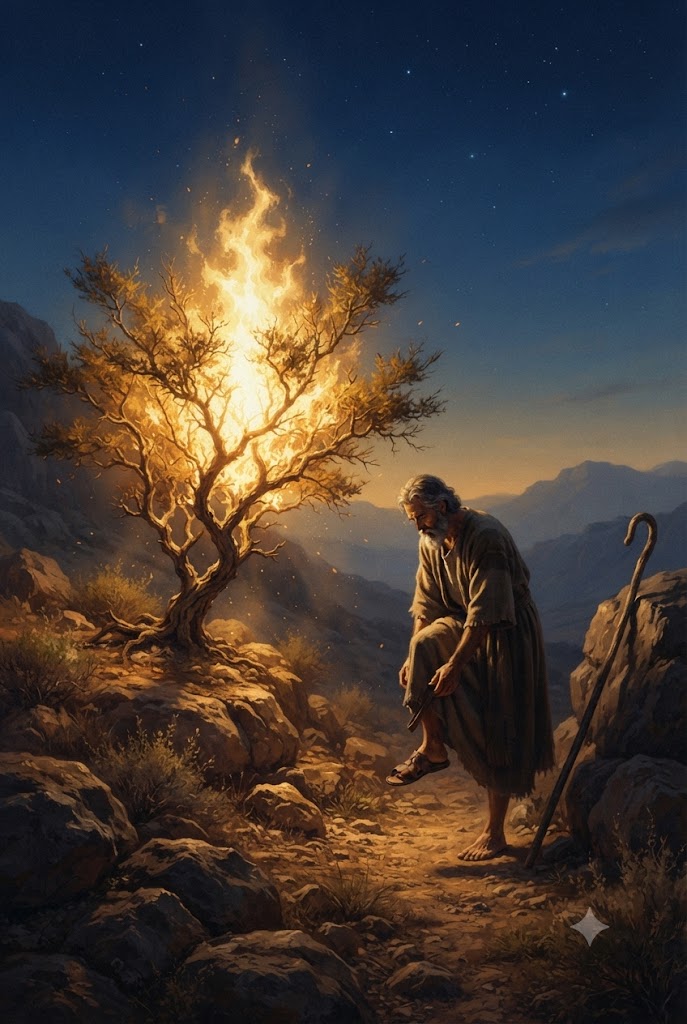
ACT ONE — The Bush That Would Not Burn
The western foothills of Horeb, in the wilderness of Midian. The day’s heat had baked the rocks, and now, as it withdrew, the long shadows of evening stretched across the slopes. Moses had been walking this ridge for forty years. He had once been a son of Pharaoh’s palace. Now he was nothing more than a shepherd tending his father-in-law Jethro’s flock. Since fleeing as a murderer, he had died twice — once as an Egyptian, once as a Hebrew.
Then, ahead of him, a bush was burning. Flames wrapped around its branches, yet the bush was not consumed. Moses stopped walking. “I will now turn aside and see this great sight, why the bush is not burnt.” As he approached, a voice split open the wilderness.
“Moses, Moses.” “Here am I.” “Draw not nigh hither: put off thy shoes from off thy feet, for the place whereon thou standest is holy ground.”
ACT TWO — A Calling Without a Name
God introduced Himself first through relationship. “I am the God of thy father, the God of Abraham, the God of Isaac, and the God of Jacob.” Moses hid his face, afraid to look upon God.
The voice continued with a calling. “I have surely seen the affliction of my people which are in Egypt, and have heard their cry… Come now therefore, and I will send thee unto Pharaoh, that thou mayest bring forth my people the children of Israel out of Egypt.”
Moses immediately pushed back. “Who am I, that I should go unto Pharaoh, and that I should bring forth the children of Israel out of Egypt?” It was a question about his own identity. But God did not answer that question directly. “Certainly I will be with thee.” The answer was not about who Moses was, but about who God would be present with.
ACT THREE — “I AM WHO I AM”
Moses asked again, this time more specifically. “Behold, when I come unto the children of Israel, and shall say unto them, The God of your fathers hath sent me unto you; and they shall say to me, What is his name? what shall I say unto them?”
In the ancient Near East, asking for a name was never a simple request for a label. A name carried the essence, the power, and the controllability of a being. Egypt had hundreds of gods, each named for a specific domain and function. Moses and the people of Israel were asking a familiar question — “What kind of god are you?”
God’s answer shattered that entire framework. “I AM THAT I AM” (Ehyeh Asher Ehyeh, אֶהְיֶה אֲשֶׁר אֶהְיֶה). And He continued, “Thus shalt thou say unto the children of Israel, I AM hath sent me unto you.”
This was a name that could never be filed into a list. Unlike the gods confined to specific domains, this was Being itself — without beginning, without cause, self-existent, the very ground of all existence. The Hebrew verb hayah carries more than static existence — it holds becoming, presence, accompaniment. So this name was less a static declaration of existence than a dynamic promise: “I will be there, exactly as I am.” In other words: “I will be present with you, in whatever form you need, exactly when you need it.”
ACT FOUR — YHWH, the Covenant Name
God then unfolded the name a little further. “The LORD God of your fathers… this is my name for ever, and this is my memorial unto all generations.”
“YHWH” comes from the same root as “Ehyeh,” but in the third person. Moses could not call God “I AM” — so the name the people would call upon God by becomes “He Is.” This is the covenant name. The self-existent Creator now enters into a specific relationship with Israel, binding Himself to become their God.
This name echoes again centuries later in the Gospel of John. When Jesus said, “Before Abraham was, I AM,” the Jewish leaders picked up stones. They knew exactly what those words meant. The name proclaimed at the burning bush now stood before them, clothed in flesh.
THEOLOGICAL REFLECTION — A Name Beyond Every Name
We long to define God — to enclose Him within theological systems, catechisms, frameworks we can grasp. But this scene at Horeb dismantles that very impulse. God did not answer “I am this kind of god” from a list of options. Instead, by saying “I AM WHO I AM,” He revealed Himself in a way that transcends every definition, while remaining deeply personal at the same time.
This is both mystery and comfort. God is too vast to be contained within our categories of understanding, yet close enough to say, “Certainly I will be with thee.” To Moses, standing in the middle of an identity crisis, God answered with His own identity. When we ask “Who am I?”, Scripture first tells us to ask “Who is God?”
“Certainly I will be with thee.” — Exodus 3:12
COMING UP NEXT
In the next deep-dive, we turn to the Passover lamb. On the night its blood was painted on the doorposts, death swept over all of Egypt — but the houses of Israel were passed over. We will look closely at how this event becomes a foreshadowing of the cross of Christ.
Tags: #Exodus #Exodus3 #Moses #BurningBush #IAmThatIAm #EhyehAsherEhyeh #YHWH #NameOfGod #MountHoreb #BibleStudy #DailyDevotional #Theology #Covenant #ChristianBlog #Scripture #DailyReflection #Calling #Faith #OldTestament #GodsPresence