Test Your Knowledge of One of the Greatest Stories Ever Told
🎯 12 Questions · 3 Levels · Full Explanations Included
Easy (Q1–4) · Intermediate (Q5–9) · Advanced (Q10–12)
🟢 PART 1 — THE BASICS
For Everyone Who Has Read the Story
✅ Question 1 — The Baby in the Basket
To protect the infant Moses from Pharaoh’s decree, his mother placed him in a basket and hid him. Where exactly did she hide him?
A) In a cave near the Nile
B) Among the reeds along the bank of the Nile River
C) In the desert beyond Egypt’s borders
D) In the house of a Hebrew neighbor
<details> <summary>👉 Click to Reveal the Answer</summary>
✅ Answer: B — Among the reeds along the bank of the Nile River
“But when she could hide him no longer, she got a papyrus basket for him and coated it with tar and pitch. Then she placed the child in it and put it among the reeds along the bank of the Nile.”
— Exodus 2:3
📖 Explanation:
Pharaoh had commanded that every Hebrew baby boy be thrown into the Nile. Moses’s mother Jochebed responded with breathtaking courage and ingenuity — she placed her son in the very river that was meant to kill him, trusting God to protect what she could no longer conceal. The Hebrew word for the basket (tebah) is the same word used for Noah’s ark — a deliberate echo connecting two great rescues across generations. Pharaoh’s own daughter discovered the child and chose to raise him as her son, making Moses simultaneously a child of Hebrew slaves and a prince of Egypt.
🌍 Geography Note: The Nile Delta region where this occurred corresponds to the eastern Nile Delta of modern Egypt — the area near ancient Goshen, where Israel’s population had settled. </details>
✅ Question 2 — The Burning Bush
When God first appeared to Moses at the burning bush, Moses was performing a specific task. What was he doing?
A) Praying alone in the wilderness
B) Leading his father-in-law’s flock near Mount Horeb
C) Traveling back toward Egypt
D) Drawing water from a well <details> <summary>👉 Click to Reveal the Answer</summary>
✅ Answer: B — Leading his father-in-law’s flock near Mount Horeb
“Now Moses was tending the flock of Jethro his father-in-law, the priest of Midian, and he led the flock to the far side of the wilderness and came to Horeb, the mountain of God.”
— Exodus 3:1
📖 Explanation:
Moses had fled Egypt forty years earlier after killing an Egyptian taskmaster. Now, at eighty years old, he was tending sheep in Midian — about as far from royal palace life as imaginable. The burning bush that was not consumed captured his attention, and God spoke from within it: “I AM WHO I AM.” This divine self-revelation — the name YHWH — became the foundational name of God throughout the Hebrew Bible. Moses’s forty years of wilderness shepherding was not wasted time; it was preparation for leading millions through the very wilderness he had learned to navigate.
🌍 Geography Note: Mount Horeb (also called Sinai) is traditionally identified with Jebel Musa in the southern Sinai Peninsula — today a major pilgrimage site in Egypt. </details>
✅ Question 3 — The Ten Plagues
The ten plagues of Egypt culminated in the most devastating judgment of all. What was the tenth and final plague?
A) Three days of total darkness covering Egypt
B) A swarm of locusts that devoured every crop
C) The death of every firstborn in Egypt
D) A catastrophic hailstorm unlike anything ever seen
<details> <summary>👉 Click to Reveal the Answer</summary>
✅ Answer: C — The death of every firstborn in Egypt
“At midnight the Lord struck down all the firstborn in Egypt, from the firstborn of Pharaoh, who sat on the throne, to the firstborn of the prisoner, who was in the dungeon, and the firstborn of all the livestock as well.”
— Exodus 12:29
📖 Explanation:
The ten plagues moved in deliberate escalation — each one targeting a specific Egyptian deity and dismantling the religious worldview that kept Pharaoh’s power intact. The final plague was the most personal and devastating: the death of every firstborn male, from Pharaoh’s household to the lowest prisoner’s cell. The only protection was the blood of a lamb painted on the doorposts — an act of faith that became the foundation of the Passover. This plague directly attacked Ra and Osiris, the Egyptian gods associated with life, death, and the divine status of Pharaoh himself, whose firstborn son was also taken. </details>
✅ Question 4 — Crossing the Sea
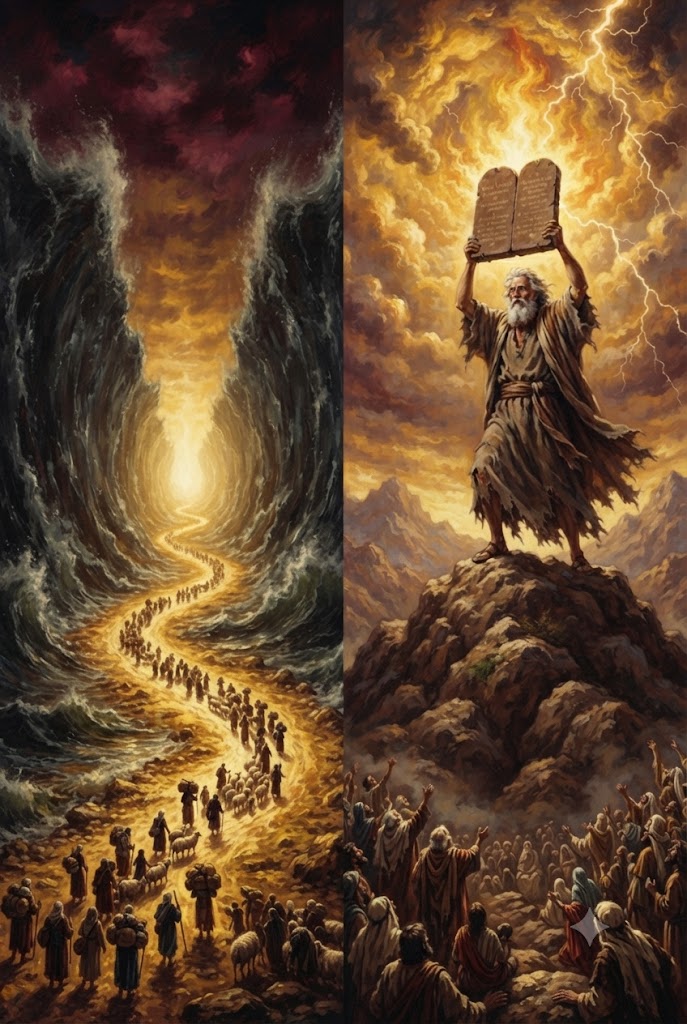
After leaving Egypt, Israel crossed through a miraculously divided body of water. What did Moses do to cause the water to part?
A) He prayed on his knees throughout the night
B) He struck the water with his staff
C) He stretched out his hand over the sea
D) He commanded the water in the name of God
<details> <summary>👉 Click to Reveal the Answer</summary>
✅ Answer: C — He stretched out his hand over the sea
“Then Moses stretched out his hand over the sea, and all that night the Lord drove the sea back with a strong east wind and turned it into dry land. The waters were divided.”
— Exodus 14:21
📖 Explanation:
With Pharaoh’s army pursuing them and the sea before them, Israel was trapped. God’s instruction was striking in its simplicity: stretch out your hand. Moses obeyed, and God worked through the night with a powerful east wind. The Israelites crossed on dry ground between walls of water on both sides. When the Egyptians followed, Moses stretched out his hand again — and the waters returned. The entire Egyptian army was destroyed. Moses and Miriam then led Israel in one of Scripture’s great songs of celebration: “The Lord is my strength and my defense; he has become my salvation.” (Exodus 15:2) </details>
🟡 PART 2 — INTERMEDIATE
For the Committed Bible Student
✅ Question 5 — The Song of Moses
After crossing the sea safely, Israel celebrated with singing. What is the name of the triumphal song recorded in Exodus 15, and who led the women in dancing alongside Moses?
A) The Song of Deliverance, led by Deborah
B) The Song of Moses, led by Miriam
C) The Hallel, led by Aaron’s wife Elisheba
D) The Victory Hymn, led by Zipporah
<details> <summary>👉 Click to Reveal the Answer</summary>
✅ Answer: B — The Song of Moses, led by Miriam
“Then Miriam the prophet, Aaron’s sister, took a timbrel in her hand, and all the women followed her, with timbrels and dancing. Miriam sang to them: ‘Sing to the Lord, for he is highly exalted. Both horse and driver he has hurled into the sea.'”
— Exodus 15:20–21
📖 Explanation:
Miriam is one of the first women in Scripture explicitly given the title prophet. Her response to Israel’s deliverance was immediate, embodied, and communal — timbrels, dancing, and song. The Song of Moses in Exodus 15:1–18 is one of the oldest pieces of poetry in the entire Bible, with linguistic features that scholars date to a very early period of Hebrew literary history. This song would echo across Scripture — it reappears, transformed and glorified, in Revelation 15:3, sung by the saints who have overcome the final beast, connecting Israel’s first great deliverance to the ultimate redemption. </details>
✅ Question 6 — The Ten Commandments
When Moses received the Ten Commandments on Mount Sinai and descended to the Israelite camp, what scene did he encounter that caused him to shatter the stone tablets?
A) The people were fighting among themselves over food and water
B) The people were bowing before a golden calf they had made
C) The people had abandoned the camp and begun marching back toward Egypt
D) Aaron was offering unauthorized sacrifices on an improvised altar
<details> <summary>👉 Click to Reveal the Answer</summary>
✅ Answer: B — The people were bowing before a golden calf they had made
“When Moses approached the camp and saw the calf and the dancing, his anger burned and he threw the tablets out of his hands, breaking them to pieces at the foot of the mountain.”
— Exodus 32:19
📖 Explanation:
Moses had been on Mount Sinai for forty days. The people, growing anxious over his absence, pressured Aaron to make them a visible god. Aaron collected their gold jewelry and fashioned a golden calf — an image associated with the Egyptian god Apis and the Canaanite fertility deities. The irony was devastating: at the very moment God was giving Israel his Law on the mountain, Israel was breaking its most fundamental commandments in the valley below. Moses’s shattering of the tablets was not mere rage — it was a visual declaration that the covenant had already been broken by the people before it was formally received. </details>
✅ Question 7 — The Manna and Quail
In the wilderness, God provided Israel with bread from heaven called manna. What specific instructions were given about collecting it on the sixth day, and why?
A) They were to collect double the normal amount to prepare for the Sabbath
B) They were to collect only half the normal amount as an act of humility
C) They were to collect none at all, trusting God to provide directly on the seventh day
D) They were to share their collection equally with all neighboring tribes
<details> <summary>👉 Click to Reveal the Answer</summary>
✅ Answer: A — They were to collect double the normal amount to prepare for the Sabbath
“On the sixth day, they are to prepare what they bring in, and that is to be twice as much as they gather on the other days.”
— Exodus 16:5
📖 Explanation:
The manna provision was not only about feeding Israel — it was a weekly curriculum in trust and Sabbath observance. On ordinary days, anyone who gathered more than needed found the excess rotting by morning. On the sixth day, they were specifically commanded to gather twice as much — and this double portion kept fresh through the Sabbath. Any who went out to gather on the seventh day found nothing. The system was designed so that Israel could not work their way to security — they had to receive it as gift, day by day, with one day of rest built into the rhythm. Jesus alluded to this directly when he taught his disciples to pray: “Give us today our daily bread.” </details>
✅ Question 8 — Jethro’s Wisdom
Moses’s father-in-law Jethro visited the Israelite camp and observed Moses at work. What problem did he identify, and what solution did he recommend?
A) Moses was teaching incorrect laws and needed correction from the elders
B) Moses was judging all disputes alone and would exhaust himself — he needed to appoint capable leaders to share the load
C) Moses was spending too much time away from his family and needed to delegate his priestly duties
D) Moses was making decisions too quickly without consulting God — he needed to wait and pray longer before ruling
<details> <summary>👉 Click to Reveal the Answer</summary>
✅ Answer: B — Moses was judging all disputes alone and would exhaust himself
“What you are doing is not good. You and these people who come to you will only wear yourselves out. The work is too heavy for you; you cannot handle it alone.”
— Exodus 18:17–18
📖 Explanation:
Jethro observed Moses sitting from morning until evening, with a line of Israelites stretching as far as the eye could see — every dispute, every question, every conflict brought directly to him. Jethro’s counsel was essentially the first recorded lesson in organizational leadership in Scripture: delegate authority through a tiered system of capable, trustworthy leaders who could handle smaller cases, bringing only the most significant matters to Moses. This advice — from a Midianite priest who was Moses’s father-in-law — created the judicial infrastructure that would eventually evolve into Israel’s governance system. Great leadership recognizes its own limits. </details>
✅ Question 9 — The Passover Lamb
The Passover regulations given in Exodus 12 included very specific requirements for the lamb to be sacrificed. Which of the following was NOT one of the requirements?
A) The lamb must be without defect — a year-old male
B) The lamb must be slaughtered at twilight on the fourteenth day of the first month
C) None of the lamb’s bones were to be broken
D) The lamb must be entirely consumed within three days
<details> <summary>👉 Click to Reveal the Answer</summary>
✅ Answer: D — The lamb must be entirely consumed within three days
“Do not leave any of it until morning; if some is left till morning, you must burn it.”
— Exodus 12:10
📖 Explanation:
The regulations specified that the lamb must be eaten that same night — not over three days. Any portion remaining by morning was to be burned, not saved. The other requirements listed — unblemished, year-old male (A), slaughtered at twilight on the fourteenth (B), no broken bones (C) — were all explicit Passover regulations. The detail about unbroken bones in Exodus 12:46 became one of the most precise messianic prophecies in the Hebrew Bible: John 19:36 explicitly states that the soldiers’ decision not to break Jesus’s legs at the crucifixion fulfilled this scripture — connecting the Passover lamb of Egypt directly to the Lamb of God at Calvary. </details>
🔴 PART 3 — ADVANCED
For the Serious Student of Scripture
✅ Question 10 — The Tabernacle’s Holy of Holies
The innermost sanctuary of the Tabernacle — the Holy of Holies — contained the Ark of the Covenant. What were the precise dimensions of the Holy of Holies as specified in Exodus?
A) 10 cubits long, 10 cubits wide, 10 cubits high
B) 20 cubits long, 10 cubits wide, 10 cubits high
C) 5 cubits long, 5 cubits wide, 5 cubits high
D) 15 cubits long, 15 cubits wide, 10 cubits high
<details> <summary>👉 Click to Reveal the Answer</summary>
✅ Answer: A — 10 cubits long, 10 cubits wide, 10 cubits high
“Make a curtain of blue, purple and scarlet yarn and finely twisted linen… Hang the curtain from the clasps and place the ark of the covenant law behind the curtain. The curtain will separate the Holy Place from the Most Holy Place.”
— Exodus 26:31–33
📖 Explanation:
The Tabernacle’s overall structure was 30 cubits long and 10 cubits wide. The Holy Place occupied 20 cubits, and the Holy of Holies — the Most Holy Place — occupied the remaining 10 cubits, making it a perfect cube of 10×10×10 cubits. This cubic form was not accidental. A perfect cube represents perfect completeness and divine symmetry. When Solomon later built the permanent Temple, the Holy of Holies was expanded to a perfect cube of 20×20×20 cubits. And in Revelation 21:16, the New Jerusalem itself is described as a perfect cube — “its length, width and height are equal” — suggesting that the ultimate dwelling of God with humanity is itself the cosmic Holy of Holies. </details>
✅ Question 11 — The Divine Name
When Moses asked God for his name at the burning bush, God revealed a profound and mysterious answer. What is the significance of the name God gave — and what does the Hebrew word YHWH actually mean?
A) “The God of Abraham” — emphasizing his covenant relationship with the patriarchs
B) “I AM WHO I AM” — pointing to God’s self-existent, eternal, and uncaused nature
C) “The Almighty One” — emphasizing his omnipotence over all creation
D) “The Holy God” — emphasizing his complete separation from all that is impure
<details> <summary>👉 Click to Reveal the Answer</summary>
✅ Answer: B — “I AM WHO I AM” — pointing to God’s self-existent, eternal, and uncaused nature
“God said to Moses, ‘I AM WHO I AM. This is what you are to say to the Israelites: I AM has sent me to you.'”
— Exodus 3:14
📖 Explanation:
The Hebrew YHWH derives from the verb hayah — to be, to exist. The name declares that God is pure existence itself — he does not receive being from anything outside himself. He simply is. All other things exist contingently — they could not exist, or could cease to exist. God’s existence is necessary, eternal, and uncaused. This name was considered so sacred that the Jewish tradition ceased to pronounce it aloud, substituting Adonai (Lord) whenever it appeared in reading. English translations typically render it as LORD in small capitals. The resonance of this name extends into the New Testament: seven times in the Gospel of John, Jesus uses the absolute “I AM” (ego eimi in Greek) without a predicate — I AM the bread of life, I AM the light of the world, I AM the resurrection — deliberately invoking the divine name of Exodus 3:14 and identifying himself with the God of the burning bush. </details>
✅ Question 12 — The Priestly Breastplate
The high priest’s breastplate — one of the most intricate garments in Scripture — contained twelve precious stones representing the twelve tribes of Israel. Two special objects were also kept in or on the breastplate for determining God’s will. What were these two objects called?
A) The Ephod and the Mitre
B) The Urim and the Thummim
C) The Ark and the Mercy Seat
D) The Menorah and the Shewbread
<details> <summary>👉 Click to Reveal the Answer</summary>
✅ Answer: B — The Urim and the Thummim
“Also put the Urim and the Thummim in the breastpiece, so they may be over Aaron’s heart whenever he enters the presence of the Lord. Thus Aaron will always bear the means of making decisions for the Israelites over his heart before the Lord.”
— Exodus 28:30
📖 Explanation:
The Urim (אוּרִים) and Thummim (תֻּמִּים) were sacred objects carried in the high priest’s breastplate and used to discern God’s will in specific situations — particularly for national decisions. The meanings of the names are debated: Urim may relate to the Hebrew word for light, and Thummim to completeness or perfection. Exactly how they functioned — whether they were cast like lots, or produced light, or worked through some other mechanism — is not fully explained in Scripture and remains one of the Bible’s most intriguing unresolved questions. They were consulted at critical moments in Israel’s history (1 Samuel 28:6, Numbers 27:21) and eventually ceased to be used after the period of the First Temple. Rabbinical tradition holds that they will be restored in the messianic age. </details>
🏆 HOW DID YOU SCORE?
| Score | Result |
|---|---|
| 10–12 Correct | 🏆 Exodus Expert — Exceptional! You know this book deeply. |
| 7–9 Correct | 📖 Serious Student — Strong knowledge with room to go deeper. |
| 4–6 Correct | 🌱 Growing Learner — Good foundation. Keep reading and studying! |
| 0–3 Correct | 🔍 Just Beginning — The journey starts here. Every expert once began at zero. |
📌 Key Themes to Explore Further
- Passover and its fulfillment in Jesus Christ (Exodus 12 / John 1:29)
- The divine name YHWH and Jesus’s “I AM” statements (Exodus 3 / John 8:58)
- The Tabernacle as a pattern of heaven (Exodus 25–40 / Hebrews 8–9)
- Moses as a type of Christ (Deuteronomy 18:15 / Acts 3:22)
Tags: #ExodusBibleQuiz #BibleQuiz #ExodusStudy #OldTestament #BibleStudy #ChristianBlog #TenCommandments #MosesAndPharaoh #Passover #Tabernacle #TenPlagues #BibleKnowledge #ScriptureQuiz #ChristianFaith #BiblicalHistory #SundaySchool #ChurchQuiz #BibleFacts #GodsPlan #Exodus