PROLOGUE — Order Even in the Most Joyful Moment
If Leviticus 11 dealt with holiness at the dinner table, chapter 12 stands before the most fundamental human event of all: the birth of life.
Childbirth was, and remains, one of the most joyful and awe-inspiring moments in human experience. Yet Leviticus declares that even in this moment of joy, God’s purity regulations apply. This does not mean birth itself is sinful or defiled. Rather, it shows that even the most intense of human events — the shedding of blood and the physical vulnerability that accompanies new life — must be handled with order before a holy God.
ACT ONE — When a Son Is Born (verses 1–4)
“Speak unto the children of Israel, saying, If a woman have conceived seed, and born a man child: then she shall be unclean seven days; according to the days of the separation for her infirmity shall she be unclean.”
Seven days unclean — the same principle applied in the menstrual regulations of chapter 15. The blood accompanying birth created a temporary state of ritual impurity.
Then, on the eighth day, something profoundly significant occurs.
“And in the eighth day the flesh of his foreskin shall be circumcised.”
The circumcision on the eighth day connects directly to the covenant sign given to Abraham in Genesis 17. It is worth noting that the eighth day is also, medically speaking, the point at which a newborn’s vitamin K–dependent blood clotting factors reach their peak — a detail later observers have often pointed to as remarkable ancient wisdom embedded within the law.
After the circumcision, the purification period continued.
“And she shall then continue in the blood of her purifying three and thirty days; she shall touch no hallowed thing, nor come into the sanctuary, until the days of her purifying be fulfilled.”
Thirty-three days — combined with the initial seven, a total of forty days. During this time the woman could not enter the sanctuary, but this was not a mark of guilt. It was a season of recovery and rest — a space graciously given for her body to heal and for her to remain quietly with new life.
ACT TWO — When a Daughter Is Born (verse 5)
“But if she bear a maid child, then she shall be unclean two weeks, as in her separation: and she shall continue in the blood of her purifying threescore and six days.”
Two weeks and sixty-six days — a total of eighty days, double the period for a son. This text has raised many questions over the centuries, and Scripture itself does not explicitly state the reason for the difference.
Various interpretations have been offered. Some scholars point to the covenantal act of circumcision as shortening the period associated with a son. Others suggest ancient observations about postpartum recovery patterns may be reflected in the text. What remains unchanged, however, is the truth already established in Genesis 1 — that both male and female equally bear the image of God. This passage concerns ritual regulation, not theological hierarchy.
ACT THREE — The Purification Offering: A Lamb and a Dove (verses 6–8)
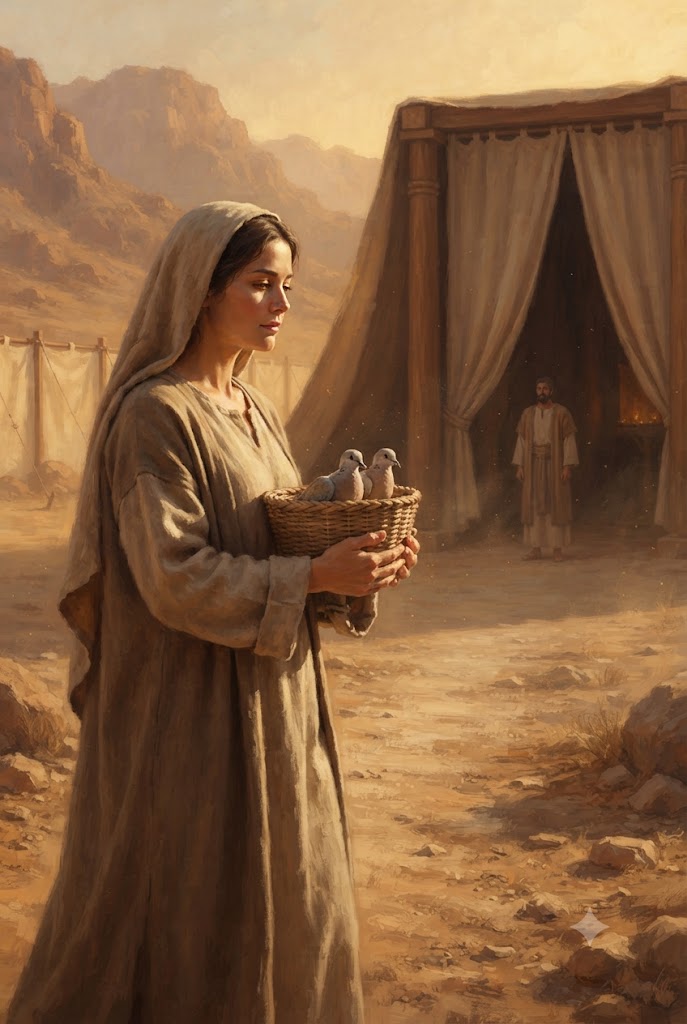
When the days of purification were complete, the woman was to come before the sanctuary with an offering.
“And when the days of her purifying are fulfilled, for a son, or for a daughter, she shall bring a lamb of the first year for a burnt offering, and a young pigeon, or a turtledove, for a sin offering, unto the door of the tabernacle of the congregation, unto the priest.”
A burnt offering and a sin offering — a ritual through which the restored woman was welcomed back into fellowship with God. But in the verse that follows, God’s careful compassion becomes evident.
“And if she be not able to bring a lamb, then she shall bring two turtles, or two young pigeons; the one for the burnt offering, and the other for a sin offering: and the priest shall make an atonement for her, and she shall be clean.”
If she is not able. An explicit provision was made for the poor. God’s law was never designed only for the wealthy — no one was to be barred from approaching God because of financial hardship.
The New Testament, in Luke 2:22–24, records that Mary and Joseph, bringing the infant Jesus to the temple, offered exactly this provision — “a pair of turtledoves, or two young pigeons.” It is a quiet but powerful witness to the economic humility of Jesus’s earthly family. When the Son of God entered the world, He was placed under the very regulation designed for the poorest among His people.
REFLECTION — Divine Order Even in Fragility
Leviticus 12 may at first appear strange and difficult to understand. But at its center lies deep grace. God was present even in the most vulnerable, blood-marked moment of new life. And He did not rush the woman’s recovery — whether forty days or eighty, she was given ample space to heal.
This chapter also reveals that God’s law never excluded the poor. If a lamb could not be afforded, two doves were enough. The way to approach God was never measured by financial means, but opened wide to a heart willing to obey.
Can you trust that even the fragile, recovering seasons of your own life rest within an order and grace that God Himself has prepared?
NEXT EPISODE PREVIEW
Leviticus Chapter 13 — the diagnosis and quarantine regulations for skin disease begin. God’s meticulous care for the holiness of the community, exercised even through the diagnosis of physical illness, unfolds in the next episode.
Tags: #Leviticus12 #PurificationAfterChildbirth #EighthDayCircumcision #TurtledovesAndLambs #ProvisionForThePoor #LukeGospelDoves #Leviticus #BibleDevotional #ChristianBlog #BibleStudy #OldTestament #Bible #Church #Devotion #Christianity #PurificationRite #SignOfCovenant #BirthOfLife #GraceOfGod #DailyDevotional