Exodus Series — Episode 32
🔥 Prologue — Two Worlds, Above the Mountain and Below On the mountain above, the blueprint of holiness was being completed.
The Tabernacle, the priesthood, the incense, the Sabbath—all of it intricately planned for the presence of God. And at last, Moses received the tablets written by God’s own hand. But at that very same time, down at the foot of the mountain, an entirely different story was unfolding.
Exodus 32 contains one of the most devastating scenes of betrayal in all of Scripture. Barely any time had passed since the covenant was sealed, and the very people who had entered into that covenant were now breaking it themselves. This chapter is one where grace and sin, intercession and judgment, collide violently.
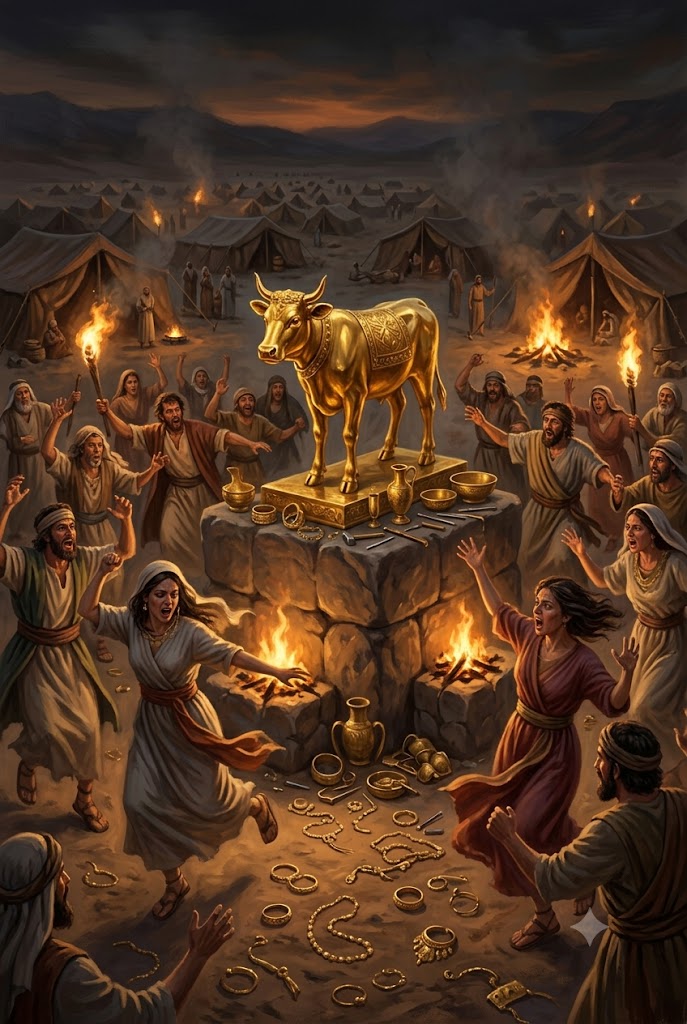
🐂 Act One — Making the Golden Calf (Verses 1–6) “Now when the people saw that Moses delayed coming down from the mountain, the people gathered together to Aaron, and said to him, ‘Come, make us gods that shall go before us; for as for this Moses, the man who brought us up out of the land of Egypt, we do not know what has become of him.'”
Saw that Moses delayed. This was where it all began. As the waiting stretched on, the people’s trust began to falter. The forty days had been, for God, an appointed period of preparation—but for the people, it felt like an unbearable silence.
This Moses. Notice how cold this brief phrase sounds. He who, only shortly before, had been their leader was now referred to with the distancing phrase “this Moses.”
Astonishingly, Aaron, who should have resisted this demand, complies instead.
“And Aaron said to them, ‘Break off the golden earrings which are in the ears of your wives, your sons, and your daughters, and bring them to me.’… And Aaron received the gold from their hand, and he fashioned it with an engraving tool, and made a molded calf.”
Fashioned it with an engraving tool. Aaron did not merely fail to resist—he actively participated in crafting the image. The contrast is stark with chapter 25, where Bezalel, filled with the Spirit, crafted the furnishings of the Tabernacle; here, Aaron carves an idol. The same craftsmanship could be used for entirely opposite purposes.
And the people’s response follows.
“Then they said, ‘This is your god, O Israel, that brought you out of the land of Egypt!'”
This is your god. How blatant this statement is. They did not entirely reject monotheism—they attempted to replace God with an image. This was a direct violation of the very second commandment—do not make a carved image.
Aaron even proclaims a feast for this occasion.
“So when Aaron saw it, he built an altar before it. And Aaron made a proclamation and said, ‘Tomorrow is a feast to the LORD.'”
A feast to the LORD. This was the most tragic distortion of all. This idolatry was still being carried out in the name of the LORD.
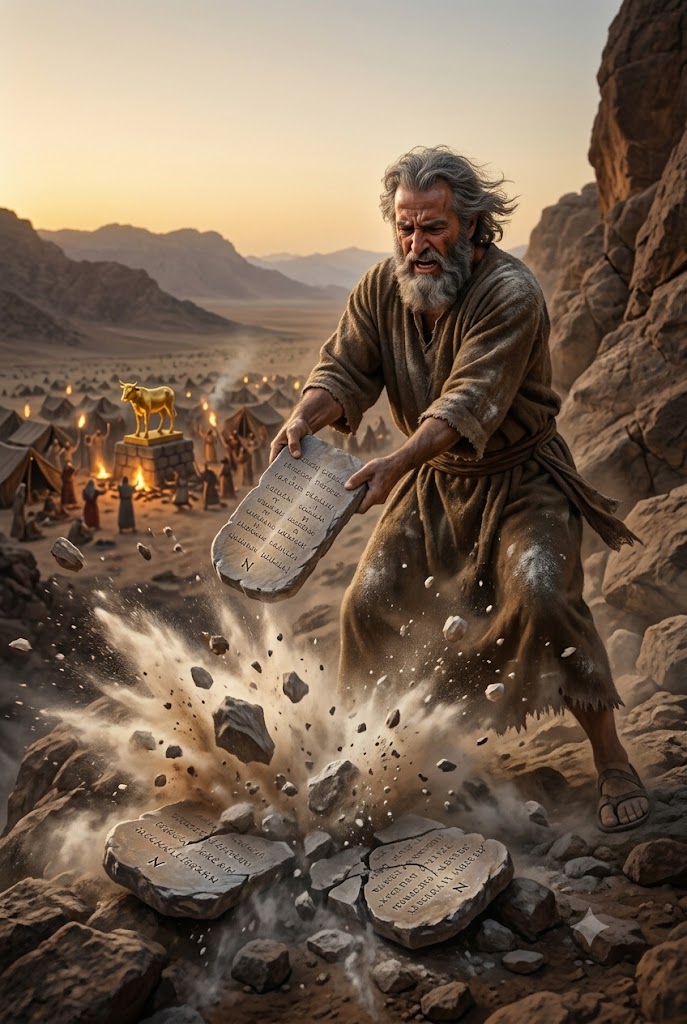
⚡ Act Two — God’s Wrath and Moses’ Intercession (Verses 7–14) On the mountain, God knows all of this immediately.
“And the LORD said to Moses, ‘Go, get down! For your people whom you brought out of the land of Egypt have corrupted themselves.'”
Your people whom you brought out. This shift in language is subtle but striking. Those who, just a moment before, had been “My people” are now referred to by God as “your people.”
God’s wrath is overwhelming.
“I have seen this people, and indeed it is a stiff-necked people! Now therefore, let Me alone, that My wrath may burn hot against them and I may consume them. And I will make of you a great nation.”
Let Me alone. This phrase is intriguing. God speaks as though Moses were capable of restraining Him. This hints that God had already left the possibility of intercession open.
And Moses actually intercedes, right there.
“Then Moses pleaded with the LORD his God, and said: ‘LORD, why does Your wrath burn hot against Your people whom You have brought out of the land of Egypt with great power and a mighty hand?'”
Moses appeals to God with three arguments. First, that the Egyptians would see this and mock God.
“Why should the Egyptians speak, and say, “He brought them out to harm them, to kill them in the mountains, and to consume them from the face of the earth”?”
Second, that God should remember the covenant promises made to Abraham, Isaac, and Israel.
“Remember Abraham, Isaac, and Israel, Your servants, to whom You swore by Your own self, and said to them…”
The outcome of this intercession is remarkable.
“So the LORD relented from the harm which He said He would do to His people.”
The LORD relented. This verse is one of the most mysterious in all of Scripture. Moses’ intercession had an actual effect in turning back God’s wrath. It was a powerful testimony to the power of prayer.
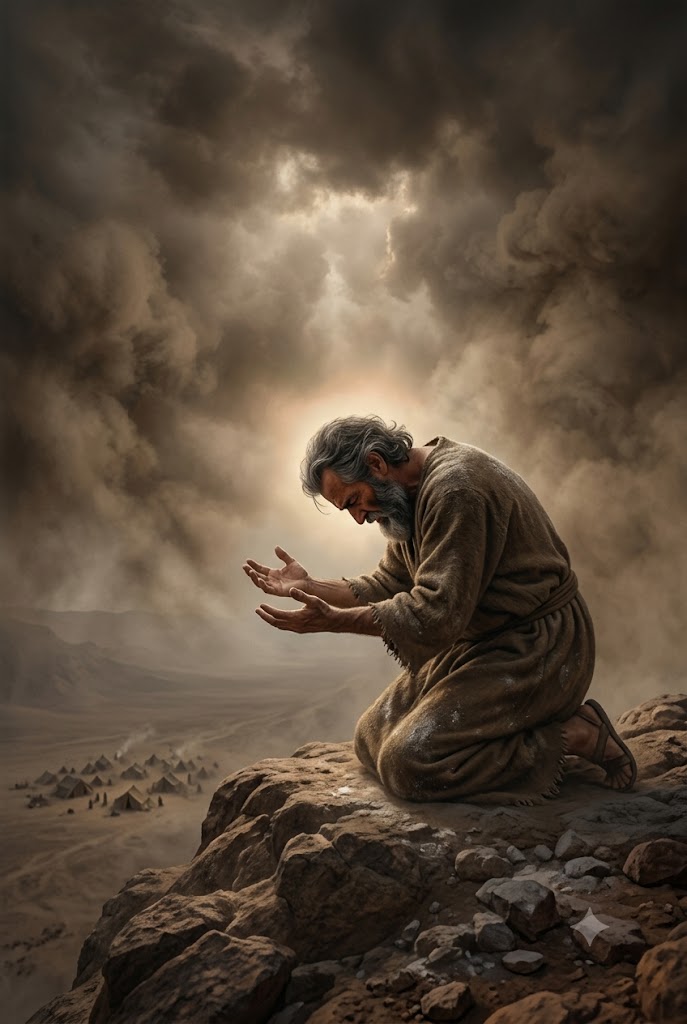
😢 Act Three — The Tablets Are Broken (Verses 15–29) Moses comes down from the mountain. In his hands were the two tablets written by God’s own hand.
“And Moses turned and went down from the mountain, and the two tablets of the Testimony were in his hand. The tablets were written on both sides; on the one side and on the other they were written. Now the tablets were the work of God, and the writing was the writing of God engraved on the tablets.”
And as he drew near the camp, the sight that met him overwhelmed him.
“So it was, as soon as he came near the camp, that he saw the calf and the dancing. So Moses’ anger became hot, and he cast the tablets out of his hands and broke them at the foot of the mountain.”
Cast the tablets out of his hands and broke them at the foot of the mountain. This scene carries powerful symbolic weight. The holy tablets, written by God’s own hand, were shattered because of the people’s sin. The covenant was broken—literally and symbolically—in that same moment.
Moses then completely destroys the idol.
“Then he took the calf which they had made, burned it in the fire, and ground it to powder; and he scattered it on the water and made the children of Israel drink it.”
Ground it to powder, scattered it on the water, made them drink it. This intense act went beyond mere destruction. The people had to literally swallow the false god they had worshiped. It was a symbolic judgment—their sin entering into their own bodies.
Moses holds Aaron accountable.
“And Moses said to Aaron, ‘What did this people do to you that you have brought so great a sin upon them?'”
Aaron’s excuse was feeble.
“So Aaron said… ‘And I said to them, “Whoever has any gold, let them break it off.” So they gave it to me, and I cast it into the fire, and this calf came out.'”
This calf came out. Aaron evades responsibility, speaking as though he had made nothing at all—as though the calf had simply appeared on its own.
And judgment follows.
“So the sons of Levi did according to the word of Moses. And about three thousand men of the people fell that day.”
This devastating judgment shows, with painful clarity, just how heavy the cost of sin truly was.
🙏 Act Four — Intercession Resumed (Verses 30–35) But even after this judgment, Moses’ intercession does not end.
“Then it came to pass on the next day that Moses said to the people, ‘You have committed a great sin. So now I will go up to the LORD; perhaps I can make atonement for your sin.'”
Moses ascends the mountain once more, and comes before God. And his prayer reaches the most astonishing moment in this entire chapter.
“Then Moses returned to the LORD and said, ‘Oh, these people have committed a great sin, and have made for themselves a god of gold! Yet now, if You will forgive their sin—but if not, I pray, blot me out of Your book which You have written.'”
Blot me out of Your book. This is one of the most dramatic expressions of intercession in all of Scripture. Moses completely identified himself with the people, staking even his own salvation to plead on their behalf.
God’s response reveals the balance between justice and mercy.
“And the LORD said to Moses, ‘Whoever has sinned against Me, I will blot him out of My book… nevertheless, in the day when I visit for punishment, I will visit punishment upon them for their sin.'”
And the chapter closes with a brief conclusion.
“So the LORD plagued the people because of what they did with the calf which Aaron made.”
🕊️ Reflection — A Stiff Neck, and a Name Pled Not to Be Blotted Out The truth that shakes the heart most deeply in Exodus 32 is this: barely forty days after the covenant had been sealed, the very people who had entered into it broke it themselves. As we read this story, we may be tempted to condemn them easily. But honestly asking ourselves, we too know how easily we turn our gaze toward something else, when waiting stretches on and silence grows unbearable.
And Aaron’s excuse—”this calf came out”—reflects back to us our own language of evading responsibility. How often do we, too, refuse to own our choices, attributing them instead to circumstance or coincidence?
But the most powerful moment of this chapter is not judgment—it is intercession. The scene where Moses prayed, “blot me out of Your book,” foreshadows Christ, who would later be blotted out in our place so that our own names might remain in the book of life (compare Romans 9:3).
“When you waver in the midst of waiting, what is it that you reach toward?”
📣 Coming Up Next Exodus Chapter 33 — Seeking God’s Presence After the incident of the golden calf, Moses seeks a deeper presence from God. That fervent cry—”Show me Your glory”—unfolds in the next episode.
#Exodus32 #TheGoldenCalf #ThisCalfCameOut #TheTabletsAreBroken #MosesIntercedes #BlotMeOutOfYourBook #AStiffNeckedPeople #TheExodus #BibleStudy #ChristianBlog #Exodus #OldTestament #Scripture #Church #DailyDevotional #BiblicalFaith #GodsPower