Exodus Series — Episode 31
🔥 Prologue — From Blueprint to Execution From chapters 25 through 30, God had revealed a detailed blueprint of the Tabernacle and all its furnishings, the priestly garments and ordination, and even the incense and anointing oil.
Now, in Exodus 31, that blueprint is handed over to the people who would actually build it. Bezalel and Oholiab—these two names appear for the first time, and God fills them with special ability to carry out this vast undertaking.
And this chapter returns once more to the Sabbath, bringing this long revelation at Mount Sinai to its close. Finally, Moses receives the two tablets written by God’s own hand, in preparation to come down from the mountain.
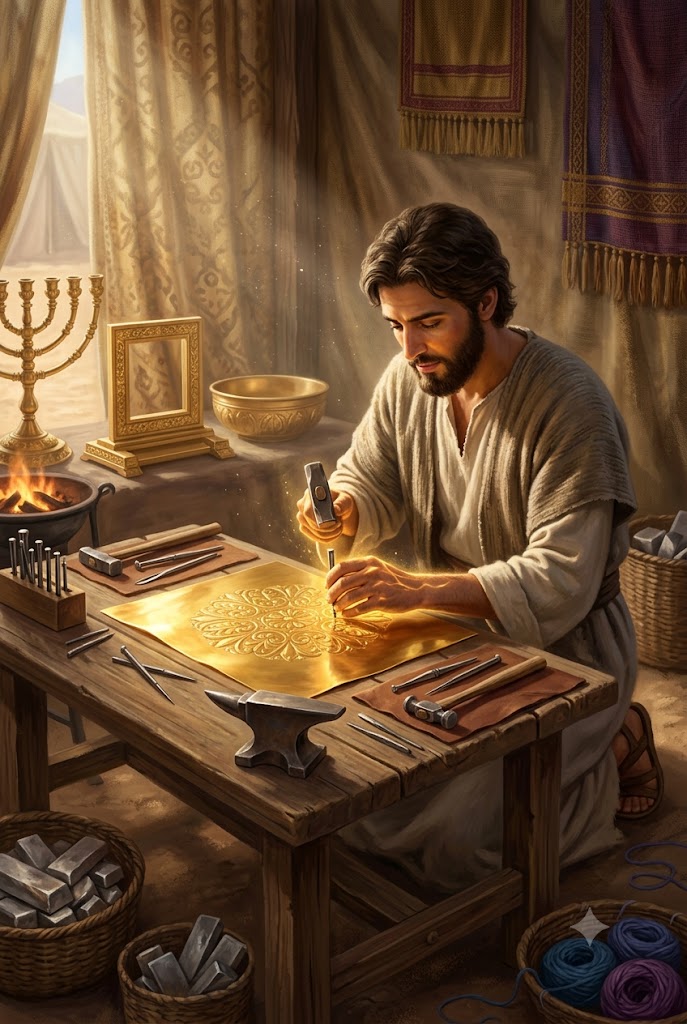
🎨 Act One — Bezalel and Oholiab (Verses 1–11) “Then the LORD spoke to Moses, saying: ‘See, I have called by name Bezalel the son of Uri, the son of Hur, of the tribe of Judah.'”
Called by name. This expression is deeply personal. God did not seek out an anonymous craftsman—He called a specific individual by name. A calling was always concrete.
And the ability given to him is explained.
“And I have filled him with the Spirit of God, in wisdom, in understanding, in knowledge, and in all manner of workmanship, to design artistic works, to work in gold, in silver, in bronze, in cutting jewels for setting, in carving wood, and to work in all manner of workmanship.”
Filled him with the Spirit of God. This verse carries profound theological significance. The Spirit of God was poured out for wisdom, understanding, and knowledge—that is, for practical skill and artistic talent. We often confine the work of the Spirit only to the spiritual or prophetic realm, but Scripture denies that limitation here. Working metal, cutting gemstones, carving wood—these too were gifts God Himself poured out.
A companion is appointed alongside Bezalel.
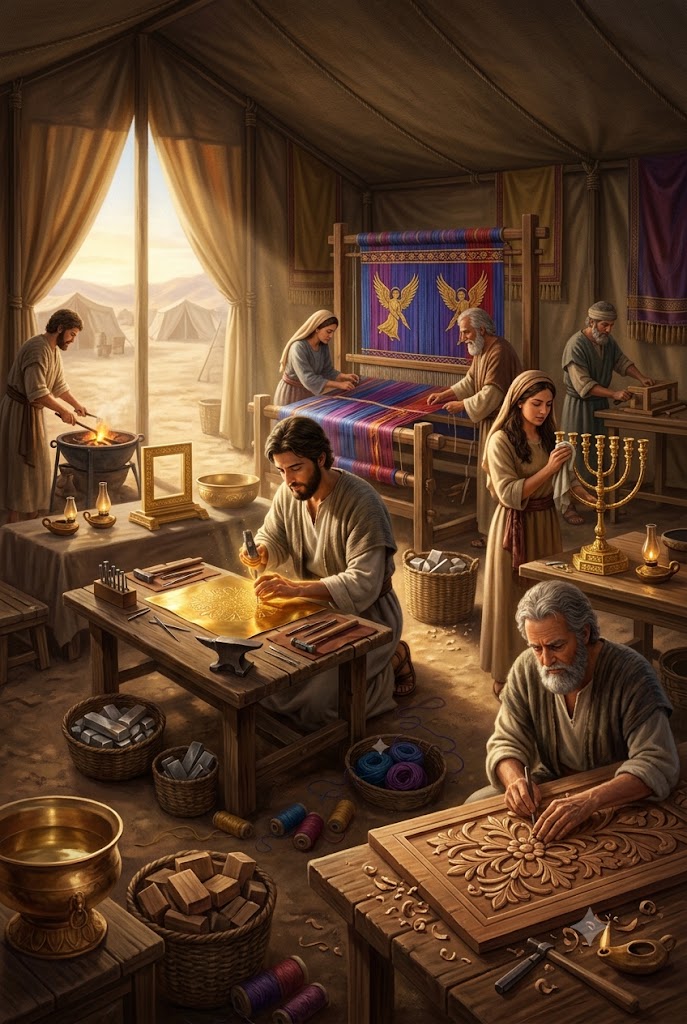
“And I have appointed with him Aholiab the son of Ahisamach, of the tribe of Dan; and I have put wisdom in the hearts of all the gifted artisans, that they may make all that I have commanded you.”
Oholiab. This great work was not accomplished by the genius of one man alone. Bezalel and Oholiab, and further, all who had a wise heart—the gifts of the entire community had to come together.
The list of what was to be made is summarized once more.
“The tabernacle of meeting, the ark of the Testimony and the mercy seat that is on it, and all the furniture of the tabernacle—the table and its utensils, the pure gold lampstand with all its utensils, the altar of incense, the altar of burnt offering with all its utensils, and the laver and its base—the garments of ministry, the holy garments for Aaron the priest and the garments of his sons, to minister as priests, and the anointing oil and sweet incense for the holy place. According to all that I have commanded you they shall do.”
Everything revealed from chapter 25 to chapter 30 is now summarized in this single sentence as a list of objects to actually be made. The plan was now moving into the stage of execution.
🕊️ Act Two — The Sabbath, an Everlasting Sign (Verses 12–17) Just before this vast revelation concerning the Tabernacle draws to a close, God returns once more to the Sabbath.
“Speak also to the children of Israel, saying: ‘Surely My Sabbaths you shall keep, for it is a sign between Me and you throughout your generations, that you may know that I am the LORD who sanctifies you.'”
A sign between Me and you. The Sabbath was never merely a regulation about rest. It was a marker of the relationship between Israel and God. It is no accident that the Sabbath is mentioned again at this very point—right at the moment all the detailed instructions concerning the Tabernacle come to a close. If the Tabernacle was the symbol of the place where God would dwell, the Sabbath was the symbol commemorating that presence within time itself.
And the gravity of this commandment is emphasized once more.
“You shall keep the Sabbath, therefore, for it is holy to you. Everyone who profanes it shall surely be put to death; for whoever does any work on it, that person shall be cut off from among his people.”
This severity shows that the Sabbath was never merely an optional custom, but a central provision of the covenant.
“Work shall be done for six days, but the seventh is the Sabbath of rest, holy to the LORD. Whoever does any work on the Sabbath day, he shall surely be put to death.”
And the rhythm of creation is presented once more as its foundation.
“For in six days the LORD made the heavens and the earth, and on the seventh day He rested and was refreshed.”
Rested and was refreshed. This expression is deeply striking. Even Almighty God rested after creation. This shows that rest is not a sign of weakness—it is a rhythm inscribed within the very order of creation itself.
📜 Act Three — Receiving the Tablets (Verse 18) The chapter closes with a brief but deeply symbolic verse.
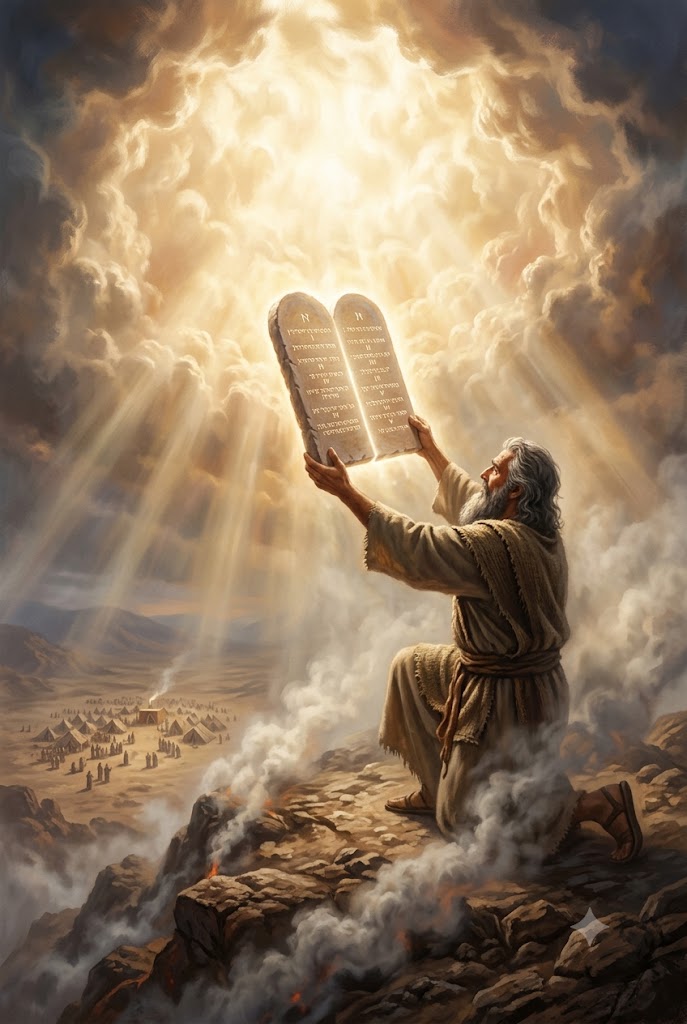
“And when He had made an end of speaking with him on Mount Sinai, He gave Moses two tablets of the Testimony, tablets of stone, written with the finger of God.”
Written with the finger of God. Up to this point, Moses had served as the one who conveyed and recorded God’s words. But these tablets were different—they were not written by Moses’ hand, but directly by the hand of God Himself.
This short verse signals that the vast revelation, spanning six chapters, had finally reached its completion. But at the same time, this scene is also a moment of silence foreshadowing the dramatic reversal about to unfold in the next chapter. Down at the foot of the mountain, something else entirely was already underway.
🕊️ Reflection — A Gift at the Fingertips, A Sign Within Time The most striking truth in Exodus 31 is this: the place where God’s Spirit descended was never confined only to prophecy or miracle. In Bezalel’s fingertips—in the intricate skill of working gold and cutting gemstones—God’s Spirit worked just the same.
This is an important truth for us today as well. The professional skills we hold, our artistic talents, everything we do with our hands—all of it can become a gift poured out by God. Faith and everyday skill were never separate spheres.
And the Sabbath appearing once more at the very edge of this vast Tabernacle revelation. This teaches us an important balance. No matter how holy the purpose, ceaseless labor was never justified. Even the building of the Tabernacle itself could not step outside the rhythm of the Sabbath.
Finally, the tablets written by God’s own hand. This reminds us that God’s word, in the end, is given directly, beyond any human mediator.
“Can the skill and talent at your own fingertips also be regarded as a gift poured out by God?”
📣 Coming Up Next Exodus Chapter 32 — The Golden Calf While God and Moses shared all this holy revelation on the mountain, the people below were making a golden calf. The most dramatic moment of betrayal, arriving so soon after the covenant had been sealed, unfolds in the next episode.
#Exodus31 #BezalelAndOholiab #FilledWithTheSpiritOfGod #ASignOfTheSabbath #TabletsWrittenByGodsOwnHand #AGiftAtTheFingertips #TheExodus #BibleStudy #ChristianBlog #Exodus #OldTestament #Scripture #Church #DailyDevotional #BiblicalFaith #GodsPower