For Glory and For Beauty — Exodus Chapter 28: The Holy Garments of the Priesthood Exodus Series — Episode 28
🔥 Prologue — What Clothing Speaks The instructions for building the Tabernacle were nearing completion.
Now God turns His attention to those who would serve within it—the priests. But surprisingly, this chapter begins not with the priest’s qualifications or duties, but with the clothing they would wear. The ephod, the breastplate, the robe, the turban, the sash—every detail of these garments is meticulously designed.
Clothing was not merely decoration for outward appearance. It was a symbolic language, revealing who a person was and what role they carried. As we move through this chapter, we discover the profound meaning inscribed into every single garment.
✨ Act One — For Glory and For Beauty (Verses 1–5) “Now take Aaron your brother, and his sons with him, from among the children of Israel, that he may minister to Me as priest, Aaron and Aaron’s sons: Nadab, Abihu, Eleazar, and Ithamar.”
The priesthood was granted to a specific family—Aaron and his sons. This was not a position acquired by volunteering, but a calling God Himself appointed.
“And you shall make holy garments for Aaron your brother, for glory and for beauty.”
For glory and for beauty. This phrase sets the direction for the entire chapter. The priest’s garments could not be merely functional. They had to display the dignity and beauty of one who stood before God.
And the people who would carry out this work are introduced.
“So you shall speak to all who are gifted artisans, whom I have filled with the spirit of wisdom, that they may make Aaron’s garments, to consecrate him, that he may minister to Me as priest.”
Whom I have filled with the spirit of wisdom. The very act of making these garments required a special gift poured out by God. Artistic skill was joined together with divine inspiration.
🎽 Act Two — The Ephod and the Breastplate (Verses 6–30) Instructions for the ephod, the centerpiece of the priestly garments, are given first.
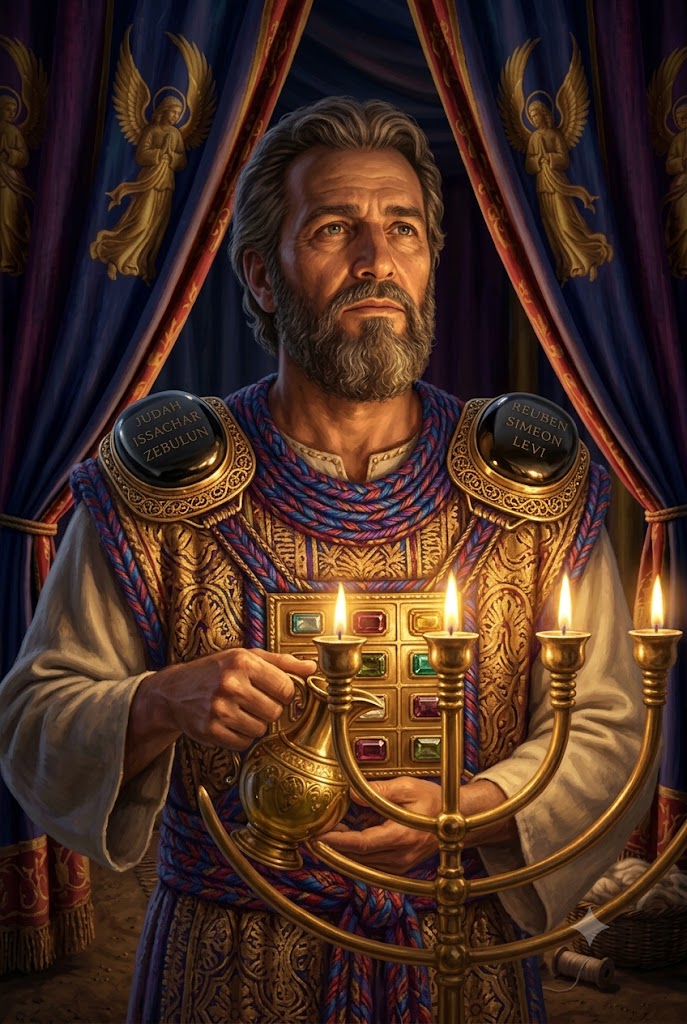
“They shall make the ephod of gold, blue, purple, and scarlet thread, and fine woven linen, artistically worked.”
Special gemstones were mounted on each shoulder of the ephod.
“Then you shall take two onyx stones and engrave on them the names of the sons of Israel… and put the two stones on the shoulders of the ephod as memorial stones for the sons of Israel. So Aaron shall bear their names before the LORD on his two shoulders as a memorial.”
Engrave on them the names of the sons of Israel. At this moment, the symbolic meaning of the priestly garments begins to unfold. Aaron would literally carry the names of the twelve tribes of Israel upon his shoulders as he stood before God. He did not stand merely as an individual—he came forward representing the entire people.
And instructions for the even more remarkable breastplate follow.
“You shall make the breastplate of judgment. Artistically woven according to the workmanship of the ephod you shall make it: of gold, blue, purple, and scarlet thread, and fine woven linen, you shall make it.”
Twelve gemstones, set in four rows, were mounted upon this breastplate.
“And you shall put settings of stones in it, four rows of stones… These stones shall be according to the names of the sons of Israel, twelve according to their names, like the engravings of a signet, each one with its own name; they shall be according to the twelve tribes.”
The names of the twelve tribes are engraved once more—this time not on the shoulders, but over the heart.
“So Aaron shall bear the names of the sons of Israel on the breastplate of judgment over his heart, when he goes into the holy place, as a memorial before the LORD continually.”
Over his heart. The shoulder was the place that bore burdens; the heart was the place where affection dwelt. Aaron had to carry Israel upon his shoulders while also holding them close to his heart as he came before God. Responsibility and love were inscribed together upon his very body.
Something mysterious was also placed within the breastplate.
“And you shall put in the breastplate of judgment the Urim and the Thummim, and they shall be over Aaron’s heart when he goes in before the LORD. So Aaron shall bear the judgment of the children of Israel over his heart before the LORD continually.”
The Urim and the Thummim—the precise nature and use of these objects remains not fully understood even today, but they are believed to have been used to discern God’s will. The priest was not merely one who performed rituals—he was also a channel through which the will of God was conveyed to the people.
🔔 Act Three — The Robe and the Remaining Garments (Verses 31–43) Instructions follow for the robe to be worn beneath the ephod.
“You shall make the robe of the ephod all of blue… And upon its hem you shall make pomegranates of blue, purple, and scarlet, all around its hem, and bells of gold between them all around.”
Golden bells and pomegranates. This combination is quite striking. The bells make sound; the pomegranates are silent. The two were alternated all around the hem of the robe.
“And it shall be upon Aaron when he ministers, and its sound shall be heard when he goes into the holy place before the LORD and when he comes out, that he may not die.”
Its sound shall be heard. This sound served a practical purpose. As Aaron moved in and out of the Most Holy Place, that sound was a signal to those outside, indicating that he was still alive and moving. Coming before the presence of a holy God was a matter of the utmost gravity—one on which life itself hung.
Instructions for the turban are equally detailed.
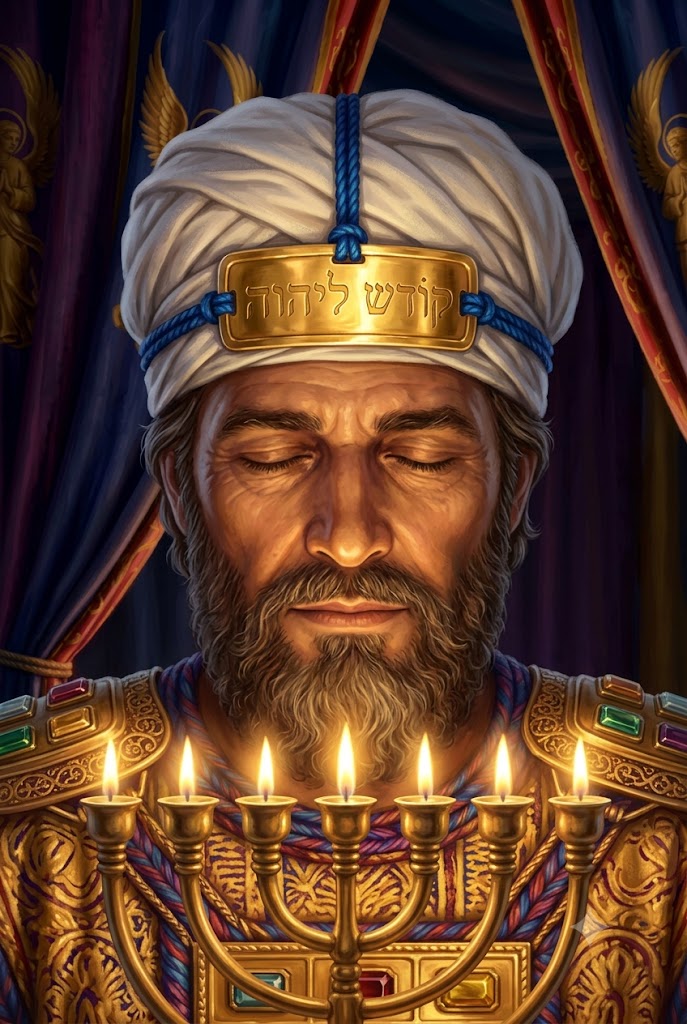
“You shall also make a plate of pure gold and engrave on it, like the engraving of a signet: ‘HOLINESS TO THE LORD.’ And you shall put it on a blue cord, that it may be on the turban; it shall be on the front of the turban.”
HOLINESS TO THE LORD. Upon Aaron’s forehead sat this gold plate, bearing this short but powerful phrase. It was a marker declaring that his entire being, from the very top of his body, was dedicated to God.
“So it shall be on Aaron’s forehead, that Aaron may bear the iniquity of the holy things which the children of Israel hallow in all their holy gifts; and it shall always be on his forehead, that they may be accepted before the LORD.”
That Aaron may bear the iniquity. That small gold plate on Aaron’s forehead was a symbol bearing, on the people’s behalf, the reality that they could never be perfectly holy on their own.
The chapter closes with instructions for the garments of Aaron’s sons and the undergarments to cover the body.
“They shall be on Aaron and on his sons when they come into the tabernacle of meeting, or when they come near the altar to minister in the holy place, that they do not incur iniquity and die. It shall be a statute forever to him and his descendants after him.”
🕊️ Reflection — A Burden on the Shoulders, A Love Upon the Heart The truth to be most deeply engraved from Exodus 28 is this: the high priest stood before God bearing the people’s names both on his shoulders and over his heart. The shoulder symbolized carrying a burden; the heart symbolized holding something dear. A true mediator had to carry the weight of the people while also embracing them in love.
This was, ultimately, a foreshadowing of Christ. He carried the weight of our sin upon His shoulders, and at the same time held His love for us within His heart. This double symbolism inscribed within the high priest’s garments finds its full fulfillment in the New Testament.
And the sound of the bells. This asks us something. When we approach God, do we still remember how solemn and careful that approach must be? Standing before holiness was never a light matter.
Finally, the plate on the forehead reading “HOLINESS TO THE LORD.” This principle—that our entire being must be dedicated to God—applies to us today just as it did then.
“Are you standing before God, bearing someone’s name upon your shoulders and within your heart?”
📣 Coming Up Next Exodus Chapter 29 — The Ordination of the Priests The specific ordination ceremony consecrating Aaron and his sons as priests follows. The story of people being set apart as holy through anointing and sacrifice unfolds in the next episode.
#Exodus28 #PriestlyGarments #TheEphodAndBreastplate #NamesOfTheTwelveTribes #UrimAndThummim #GoldenBellsAndPomegranates #HolinessToTheLord #TheExodus #BibleStudy #ChristianBlog #Exodus #OldTestament #Scripture #Church #DailyDevotional #BiblicalFaith #GodsPower