Exodus Series — Episode 26
🔥 Prologue — The Invisible Takes Visible Form The design for the Ark of the Covenant, the table of showbread, and the lampstand had been given.
But the space in which these holy furnishings would stand did not yet exist. Exodus 26 addresses that space—the structure of the Tabernacle itself. The colors and materials of the curtains, the exact number and arrangement of the frames, and even the veil separating the Most Holy Place from the Holy Place. This chapter is the blueprint for the actual structure in which God’s presence would dwell.
Within this detail, we discover an important truth. Holiness did not remain merely an abstract concept. It took on a concrete form that had to be actually built, erected, and arranged.
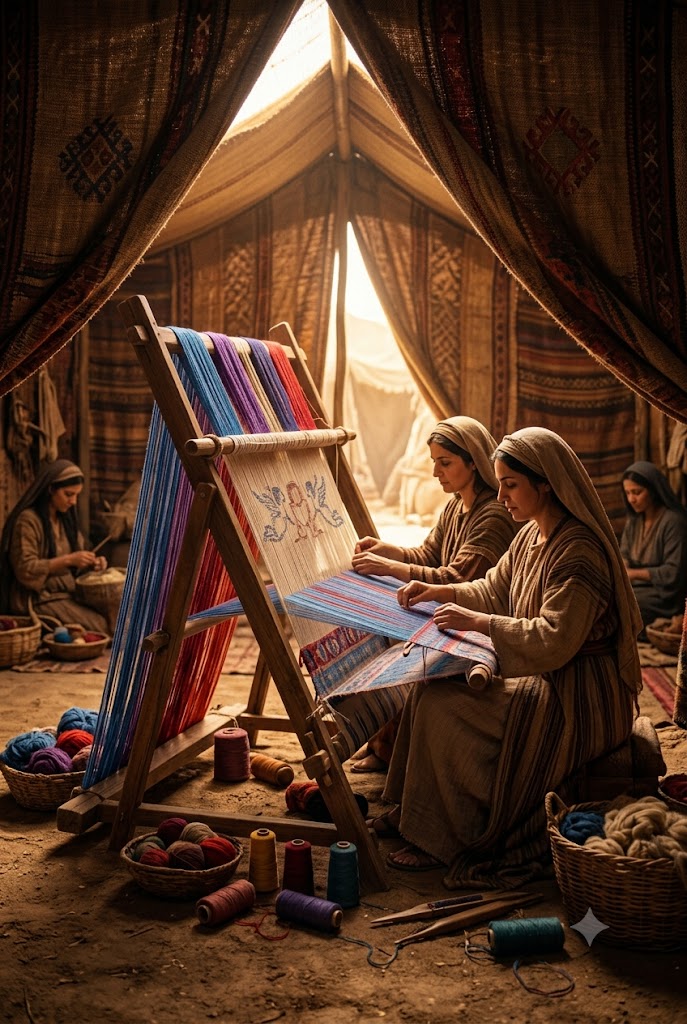
🎨 Act One — Ten Curtains (Verses 1–14) “Moreover you shall make the tabernacle with ten curtains of fine woven linen and blue, purple, and scarlet thread; with artistic designs of cherubim you shall weave them.”
Ten curtains. These curtains, forming the innermost layer of the Tabernacle, were no ordinary cloth. They were intricate works of art woven with blue, purple, and scarlet thread, even embroidered with the figures of cherubim.
“The length of each curtain shall be twenty-eight cubits, and the width of each curtain four cubits; and every one of the curtains shall have the same measurements.”
Precise dimensions are emphasized once again. Five curtains were to be joined together to form each of two large sections, which were then joined to one another with loops and clasps.
“You shall make loops of blue yarn on the edge of the curtain that is on the outer edge of one set, and likewise you shall do on the outer edge of the curtain of the second set… and you shall make fifty clasps of gold, and couple the curtains together with the clasps, so it shall be one tabernacle.”
So it shall be one tabernacle. Several pieces joined together to form a single complete structure—this was an important principle running through the entire Tabernacle. Various materials, colors, and separate pieces were brought together into one unified dwelling place.
Instructions for the additional covering follow as well.
“You shall also make curtains of goats’ hair, to be a tent over the tabernacle. You shall make eleven curtains.”
And atop this, God commands a further covering of ram skins dyed red, and badger skins. Thus the Tabernacle was a structure built in multiple layers—from an intricate work of art on the inside, out to a practical waterproof covering on the outside.
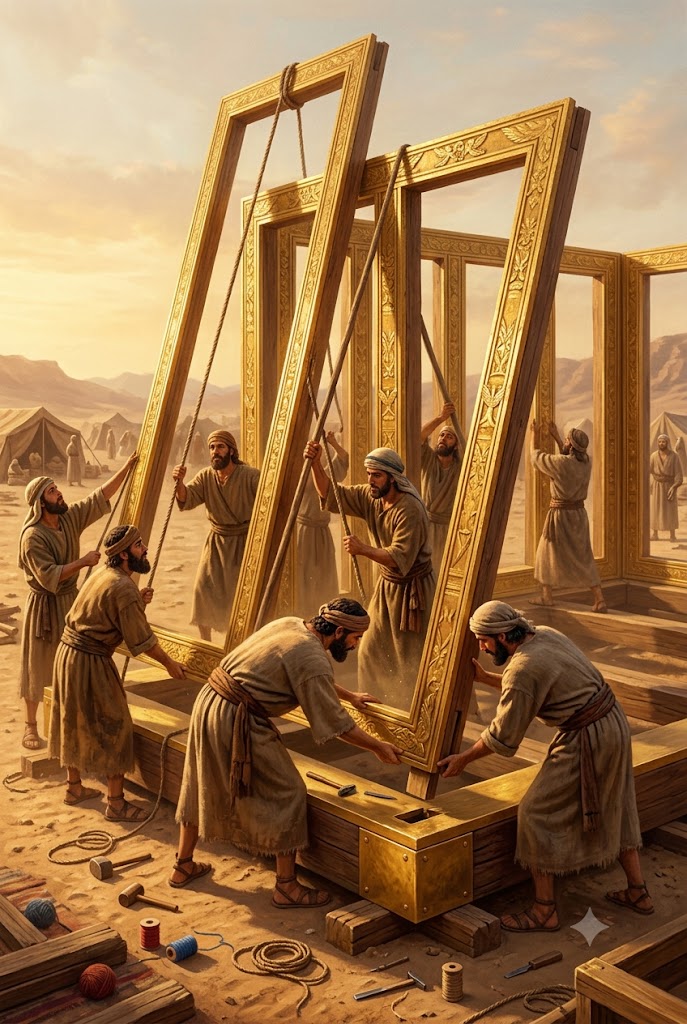
🏗️ Act Two — Acacia Wood Frames (Verses 15–30) Following the curtains, instructions are given for the frames that would form the skeleton of the Tabernacle.
“And for the tabernacle you shall make the boards of acacia wood, standing upright. Ten cubits shall be the length of a board, and a cubit and a half shall be the width of each board.”
The exact number and arrangement are also specified.
“And for the south side of the tabernacle you shall make twenty boards… and for the far side of the tabernacle, westward, you shall make six boards.”
This intricate structure shows that the Tabernacle needed not only beauty, but also durability. Amid the constant movement of wilderness life, this structure had to be erected and dismantled again and again. It had to be both beautiful and practical.
“There shall be two tenons in each board for binding one to another. Thus you shall make for all the boards of the tabernacle.”
For binding one to another. Here again the principle of connection and unity is emphasized. Not individual, separate frames, but frames interlocked together to form one sturdy wall.
Instructions for the horizontal bars follow as well.
“And you shall make bars of acacia wood: five for the boards on one side of the tabernacle, five bars for the boards on the other side of the tabernacle, and five bars for the boards of the side of the tabernacle, for the far side westward.”
And this section, too, closes with that now-familiar phrase.
“And you shall raise up the tabernacle according to its pattern which you were shown on the mountain.”
According to the pattern shown on the mountain. This principle, already emphasized in chapter 25, is reaffirmed once more—following the exact pattern God had revealed, not human creativity.
🔀 Act Three — The Veil Separating the Most Holy Place (Verses 31–37) Now instructions are given for the decisive element separating the interior of the Tabernacle—the veil.
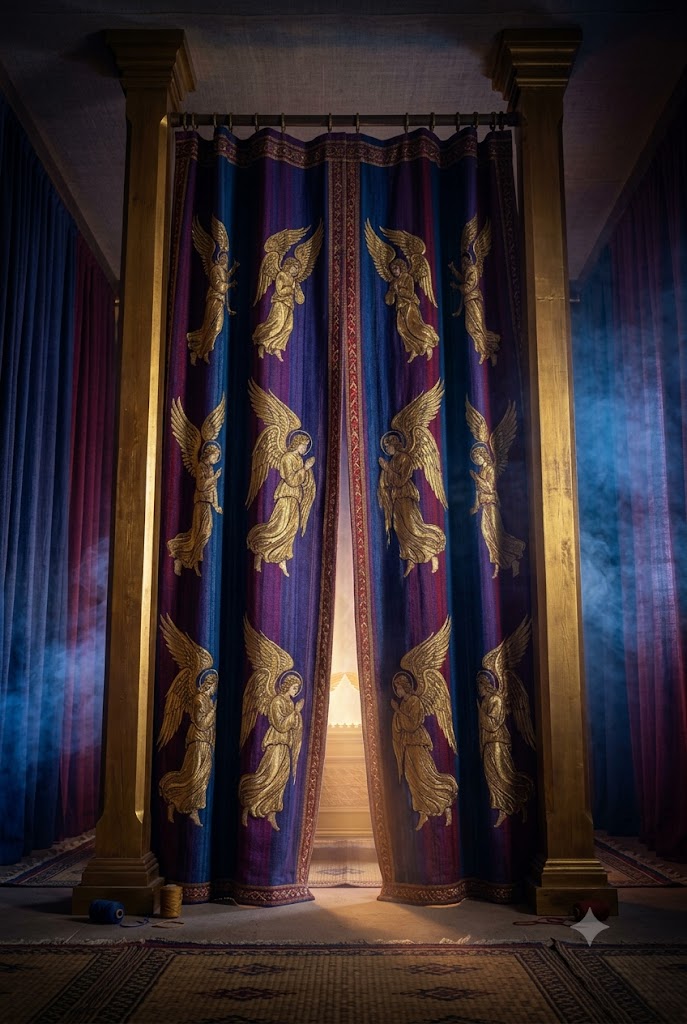
“And you shall make a veil woven of blue, purple, and scarlet thread, and fine woven linen. It shall be woven with an artistic design of cherubim.”
This veil formed the boundary dividing the Holy Place from the Most Holy Place.
“You shall hang it upon the four pillars of acacia wood overlaid with gold… And you shall bring the ark of the Testimony in there, behind the veil. The veil shall be a divider for you between the holy place and the Most Holy.”
The veil shall be a divider between the holy place and the Most Holy. Within this short sentence, the same principle of holiness already experienced at Mount Sinai is inscribed once again. The most holy space—where God’s presence dwelt, the Most Holy Place—could not be approached by just anyone. This veil was the physical expression of that holiness.
Just how significant a symbol this veil was becomes clear at the moment of Jesus’ death on the cross. According to Matthew 27:51, at that very moment the veil of the Temple was torn from top to bottom. That tearing was a symbolic event revealing that, through Christ, the distance between God and humanity had finally, dramatically, been closed.
The chapter closes with the curtain for the entrance of the Tabernacle.
“You shall make a screen for the door of the tabernacle, woven of blue, purple, and scarlet thread, and fine woven linen, made with embroidery.”
🕊️ Reflection — Layers Upon Layers, and a Veil That Would Be Torn Exodus 26 may read, at first glance, like an architectural blueprint. But within this intricate structure lies a profound theological message. The Tabernacle was built in layers upon layers—from the outermost waterproof covering, to the practical goats’ hair curtain within, to the beautifully embroidered linen curtain at the very center. And within that center, the Holy Place and the Most Holy Place were divided yet again by a veil.
This structure reveals that approaching God was a gradual matter, never something to be taken lightly. But at the same time, we must not forget that beyond all these layers—there was, in the end, God’s presence. Layer upon layer of barriers existed, but at the very center there was always an encounter.
And the veil that concealed the Most Holy Place. Throughout the Old Testament era, this veil marked a boundary that only the High Priest could cross, once a year. But the fact that, in the New Testament, this very veil was torn symbolizes a remarkable turning point. No longer did one need to pass through layer upon layer merely to draw near to God.
“Are there still layers of veils remaining in your own life that stand between you and an encounter with God?”
📣 Coming Up Next Exodus Chapter 27 — The Bronze Altar and the Courtyard of the Tabernacle Instructions follow concerning the bronze altar to be placed in the outer courtyard of the Tabernacle, and the structure of the courtyard that would surround the entire dwelling place. The final blueprint of God’s dwelling taking physical shape unfolds in the next episode.
#Exodus26 #CurtainsOfTheTabernacle #AcaciaFrames #TheMostHolyPlace #ADividerBetweenHolyAndMostHoly #AccordingToThePatternShown #TheVeilThatWouldBeTorn #TheExodus #BibleStudy #ChristianBlog #Exodus #OldTestament #Scripture #Church #DailyDevotional #BiblicalFaith #GodsPower