Exodus Series — Episode 15
🔥 Prologue — The Test Begins Where the Song Ends The sea had swallowed Egypt’s army.
Israel stood on the far shore, having crossed on dry ground. Behind them, the waves were settling. Ahead of them, the wilderness stretched out. In that moment, one of the greatest songs of praise in all of Scripture bursts forth.
Exodus 15 is a chapter with two entirely different faces. The first half is a song of victory—the praise of Moses and Miriam, considered among the oldest poetry in Scripture. But the second half shows that same exhilaration turning to complaint in less than three days.
The distance between praise and complaint is much shorter than we tend to think.
🎶 Act One — The Song of Moses (Verses 1–19) “Then Moses and the children of Israel sang this song to the LORD, and spoke, saying: ‘I will sing to the LORD, for He has triumphed gloriously! The horse and its rider He has thrown into the sea!'”
I will sing to the LORD. This song is considered among the oldest pieces of poetry in the entire Hebrew Bible. What had been narrated in prose is now expressed again in poetry, in song. Some experiences are too large for narrative alone—they must be sung to be fully held.
“The LORD is my strength and song, and He has become my salvation; He is my God, and I will praise Him; my father’s God, and I will exalt Him.”
My strength, my song, my salvation. The threefold repetition of “my” is striking. This was not merely a celebration of the nation’s collective victory—it was each person’s personal confession of the salvation they had experienced.
The song vividly depicts the destruction of Egypt’s army.
“Pharaoh’s chariots and his army He has cast into the sea; his chosen captains also are drowned in the Red Sea. The depths have covered them; they sank to the bottom like a stone.”
They sank to the bottom like a stone. The chariot force that had been Egypt’s pride vanished in an instant. What had appeared to be the mightiest military power on earth turned out to be, in the hand of God, no more than a stone sinking into the depths.
Then the song turns its gaze toward God’s guidance.
“You in Your mercy have led forth the people whom You have redeemed; You have guided them in Your strength to Your holy habitation.”
In Your mercy. The reason for salvation was never Israel’s worthiness. It was God’s mercy alone. This connects precisely with the theology of Passover in chapter 12—salvation always begins with grace.
The song goes on to anticipate, almost prophetically, the journey Israel would face ahead.
“The people of Philistia will be seized with trembling; then the chiefs of Edom will be dismayed; the mighty men of Moab, trembling will take hold of them; all the inhabitants of Canaan will melt away. Fear and dread will fall on them; by the greatness of Your arm they will be as still as a stone, till Your people pass over, O LORD, till the people pass over whom You have purchased.”
These verses read almost like a prophecy looking forward. Every nation Israel would soon encounter would already be gripped with fear at the mere report of this event.
The song closes with a magnificent hope.
“You will bring them in and plant them in the mountain of Your inheritance, in the place, O LORD, which You have made for Your own dwelling, the sanctuary, O LORD, which Your hands have established. The LORD shall reign forever and ever.”
After this song, a brief passage introduces Miriam.
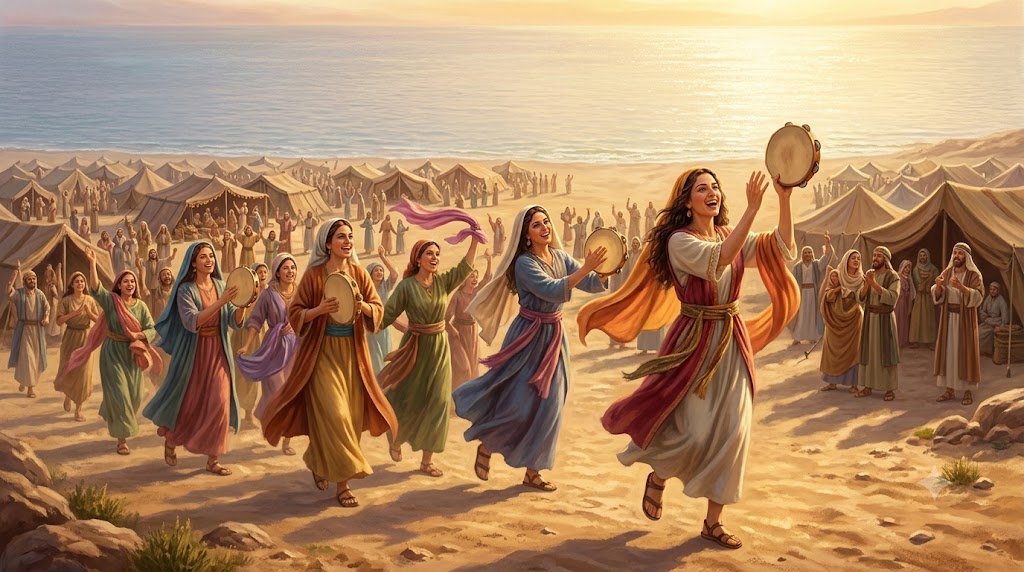
“Then Miriam the prophetess, the sister of Aaron, took the timbrel in her hand; and all the women went out after her with timbrels and with dances. And Miriam answered them: ‘Sing to the LORD, for He has triumphed gloriously! The horse and its rider He has thrown into the sea!'”
Miriam and the women. Following the song of the male leaders comes the dancing and antiphonal song of the women. The joy of victory was something the whole community shared together.
🏜️ Act Two — The Bitter Waters of Marah (Verses 20–26) But barely three days after the song ended, the situation shifted dramatically.
“So Moses brought Israel from the Red Sea; then they went out into the Wilderness of Shur. And they went three days in the wilderness and found no water.”
Three days. Before the memory of that dramatic moment at the sea had even faded, the people confronted the wilderness reality of thirst. Exhilaration is momentary; life continues.
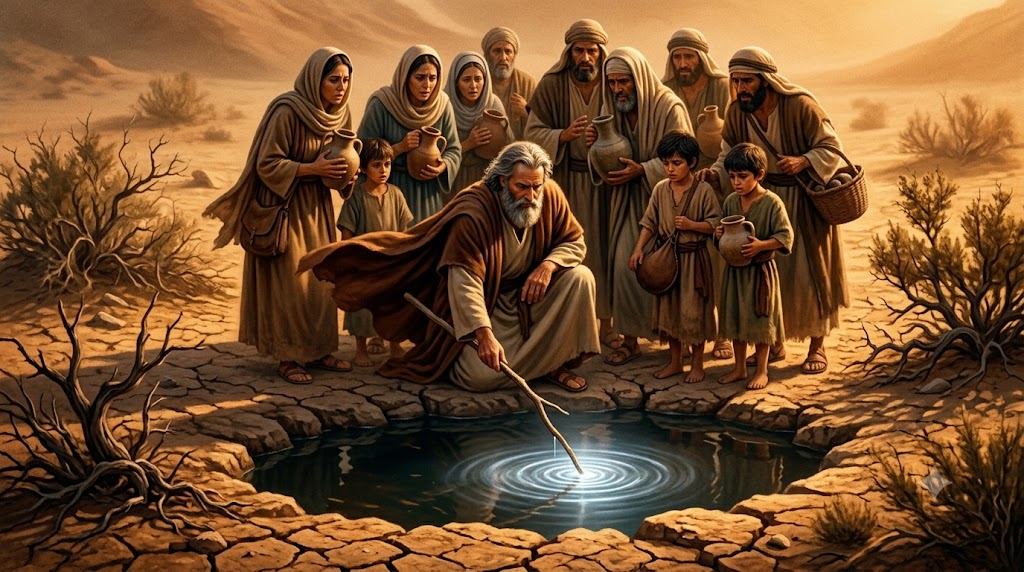
“Now when they came to Marah, they could not drink the waters of Marah, for they were bitter. Therefore the name of it was called Marah.”
Marah—meaning bitter. They found water, but it was water they could not drink. It was a moment when hope turned to disappointment.
“And the people complained against Moses, saying, ‘What shall we drink?'”
The people who had watched the sea part with their own eyes now complained again over a single bitter spring. This sudden shift honestly reveals human nature. Even right after witnessing the greatest of miracles, faith can waver again in the face of small deprivation.
But Moses’ response differed from the people’s complaint.
“So he cried out to the LORD, and the LORD showed him a tree. When he cast it into the waters, the waters were made sweet.”
He cried out to the LORD. The people complained to Moses, but Moses cried out to God. Facing the same hardship, the direction was entirely different. Complaint was aimed at a person; prayer was aimed at God.
A tree. The text does not specify what kind of tree it was. But when it was cast into the water, the bitter water turned sweet. God had already prepared the answer—right beside the problem, waiting to be found.
Immediately after this event, God establishes an important principle.
“There He made a statute and an ordinance for them, and there He tested them, and said, ‘If you diligently heed the voice of the LORD your God and do what is right in His sight, give ear to His commandments and keep all His statutes, I will put none of the diseases on you which I have brought on the Egyptians. For I am the LORD who heals you.'”
I am the LORD who heals you. This is the first time God introduces Himself as “the LORD who heals.” The event of turning Marah’s bitter water sweet became the first sign revealing this healing character of God.
🌴 Act Three — Restoration at Elim (Verse 27) The chapter closes with a short, beautiful scene of rest.
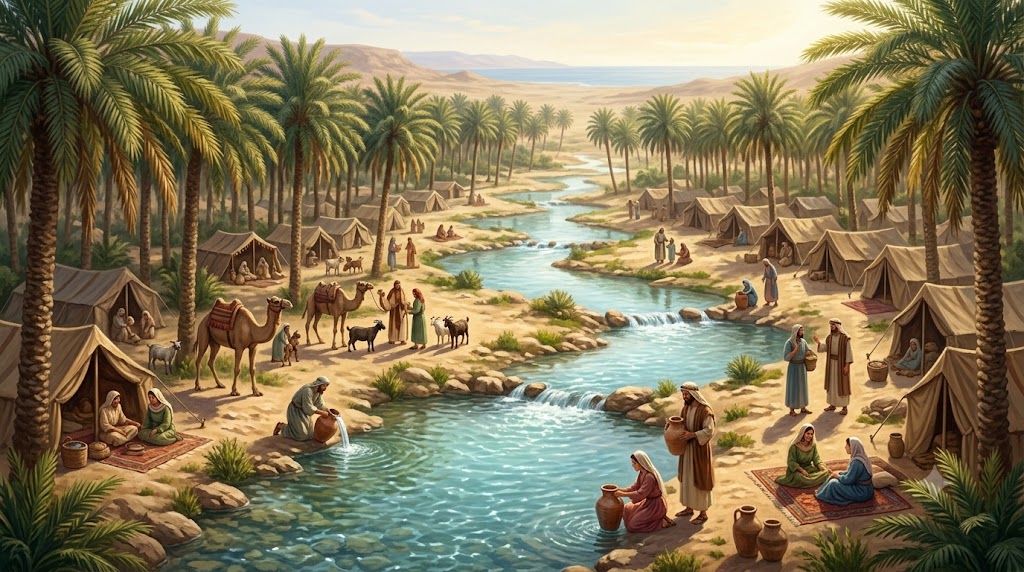
“Then they came to Elim, where there were twelve wells of water and seventy palm trees; so they camped there by the waters.”
Twelve wells, seventy palm trees. Immediately after passing through the bitter waters of Marah, God led them to an abundant oasis. Restoration always followed the test.
Twelve springs—a number evoking Israel’s twelve tribes. Seventy palm trees—a number evoking the seventy elders of Israel who would later be appointed. It may be coincidence, but many commentators see in these numbers a picture of the abundance God had prepared for the entire people.
🕊️ Reflection — Three Days After the Song of Victory The most striking fact in Exodus 15 is timing. Only three days separated the miracle at the Red Sea from the complaint at Marah. Just three days after experiencing the greatest deliverance, the people were complaining again.
This is not a story meant to condemn us. Rather, it is a mirror held up to ourselves. We too can be fervently grateful right after a great blessing, only to waver again at the smallest lack. Spiritual maturity is not measured by the persistence of emotion, but by where we turn when hardship comes.
Moses did not complain—he cried out. This distinction is decisive. Blaming a person in the face of a problem and bringing that problem to God lead down entirely different paths.
And let us remember that Elim came after Marah. The test of bitter water was not permanent. God always prepares a place of restoration after the test. The wilderness journey was not an unbroken chain of hardship, but a rhythm of hardship and restoration, alternating.
“Are you at Marah right now, or at Elim? Wherever you stand, that place too remains within God’s guidance.”
📣 Coming Up Next Exodus Chapter 16 — Bread from Heaven, the Manna When food runs out in the wilderness, the people complain once more. But God sends manna down from heaven, and through this daily bread begins to teach them to trust Him. The story of grace renewed fresh each day unfolds in the next episode.
#Exodus15 #SongOfMoses #SongOfMiriam #BitterWatersOfMarah #TheLordWhoHeals #OasisAtElim #PraiseAndComplaint #FirstTestInTheWilderness #TheExodus #BibleStudy #ChristianBlog #Exodus #OldTestament #Scripture #Church #DailyDevotional #BiblicalFaith #GodsPower