Exodus Series — Episode 9
🔥 Prologue — What the Plagues Change Is Not the Circumstances, But the Person The fourth plague had passed.
The flies departed, Pharaoh found relief, and once again he hardened his heart. The pattern was already familiar. A plague arrives, he appears to yield. The plague departs, he returns to form.
But starting with the fifth plague, something begins to shift.
Not the intensity of the plagues—their nature. Until now, the plagues had been discomforts. Frogs, gnats, flies—irritating, repulsive things. But from here forward, the plagues change character. Livestock die. Boils erupt on the body. Fire mixed with ice falls from the sky.
The plagues now touch property, then the body itself, and finally begin to threaten life.
And for the first time, something different comes out of Pharaoh’s mouth: “I have sinned.” But was even that confession real?
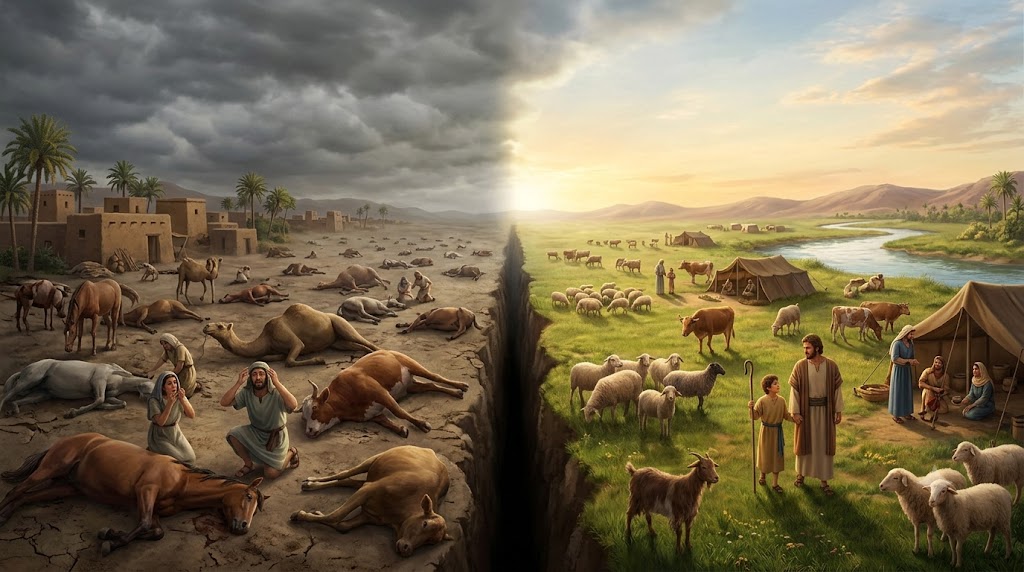
🐄 Act One — The Fifth Plague: Death of Livestock (Verses 1–7) “Then the LORD said to Moses, ‘Go in to Pharaoh and tell him, “Thus says the LORD God of the Hebrews: Let My people go, that they may serve Me.”‘”
The same demand again. Let My people go. But this time the warning that followed carried a different weight.
“For if you refuse to let them go, and still hold them, behold, the hand of the LORD will cause a very severe pestilence on your livestock in the field, on the horses, the donkeys, the camels, the herds, and the flocks.”
Pestilence. This time the target was not mere inconvenience—it was property itself. Horses and donkeys were transportation. Cattle and sheep were livelihood. Camels were trade. The very economic foundation of Egypt was now under threat.
And this plague came with a precise timetable.
“And the LORD appointed a set time, saying, ‘Tomorrow the LORD will do this thing in the land.’ So the LORD did this thing on the next day, and all the livestock of Egypt died; but of the livestock of the children of Israel, not one died.”
Tomorrow. God announced the exact moment in advance—proof that this was no accident. A natural disaster cannot be scheduled. But God set the time, and it came to pass exactly as declared.
And once more, a distinction appeared.
“All the livestock of Egypt died, but of the livestock of the children of Israel, not one died.”
The same land, the same air, the same sky above—yet Egypt’s livestock perished while Israel’s survived. Pharaoh sent men to verify it.
“Then Pharaoh sent, and indeed, not even one of the livestock of the Israelites was dead. But the heart of Pharaoh was hardened, and he did not let the people go.”
He checked. He verified. It was true. And still—his heart remained hard. The problem was never insufficient evidence. The evidence was overwhelming. The problem was the will.
This is the essence of hardness—not a lack of proof, but a refusal to be moved by it.
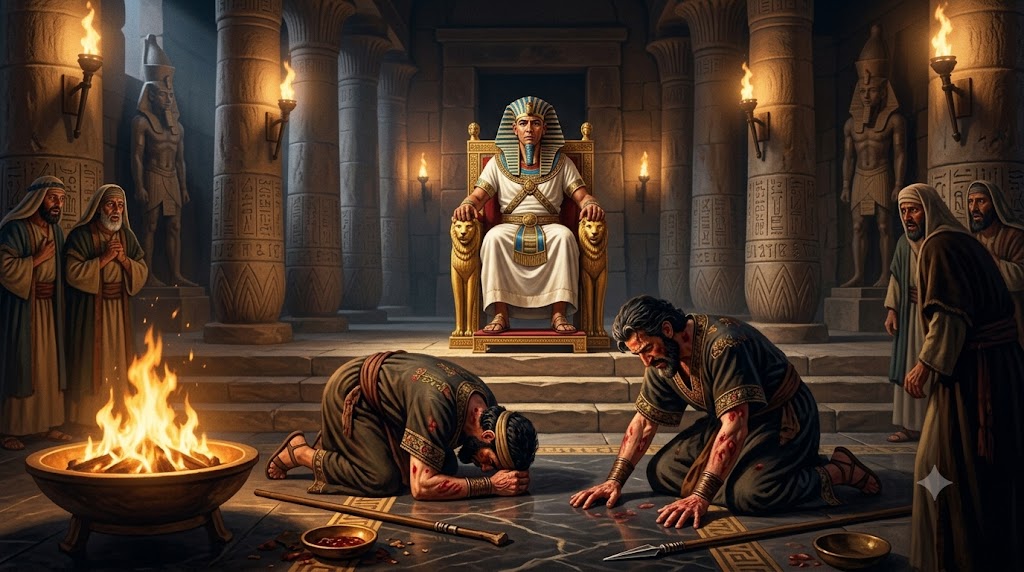
🩹 Act Two — The Sixth Plague: Boils (Verses 8–12) The sixth plague began in an entirely different manner than those before it.
“So the LORD said to Moses and Aaron, ‘Take handfuls of ashes from a furnace, and let Moses scatter it toward the heavens in the sight of Pharaoh.'”
Ashes from a furnace. Some interpret this as residue from Egyptian sacrificial furnaces; others simply as ordinary household ash. Either way—something ordinary and unremarkable became the instrument of judgment.
“And it will become fine dust in all the land of Egypt, and it will cause boils that break out in sores on man and beast throughout the land of Egypt.”
Boils. This was pain inflicted directly on the body. Previous plagues had afflicted the environment—the river, the frogs, the insects, the livestock. But this time it was the human body itself. There was nowhere to flee. The affliction traveled with the person.
And here appears one of the most symbolic scenes of the chapter.
“And the magicians could not stand before Moses because of the boils, for the boils were on the magicians and on all the Egyptians.”
Even the magicians could not stand. Until now they had kept appearing—imitating the frogs, failing at the gnats, yet still present at Pharaoh’s side. But now their own bodies broke down. It was not merely that their power failed—their very presence collapsed.
Those who had imitated the power of God could no longer even protect their own flesh.
And here the biblical text introduces a decisive phrase for the first time.
“But the LORD hardened the heart of Pharaoh, and he did not heed them, just as the LORD had spoken to Moses.”
The LORD hardened Pharaoh’s heart. Until now, the recurring phrase had been “Pharaoh hardened his own heart.” Now the subject changes. It is attributed to God.
This verse has long stood at the center of theological debate. But following the narrative’s trajectory—Pharaoh had already hardened his own heart repeatedly, by his own choice, again and again. And at a certain point, God confirmed his repeated choice as his settled path. The door Pharaoh had shut on his own was not reopened by God.
Continued refusal eventually becomes a prison of one’s own making.
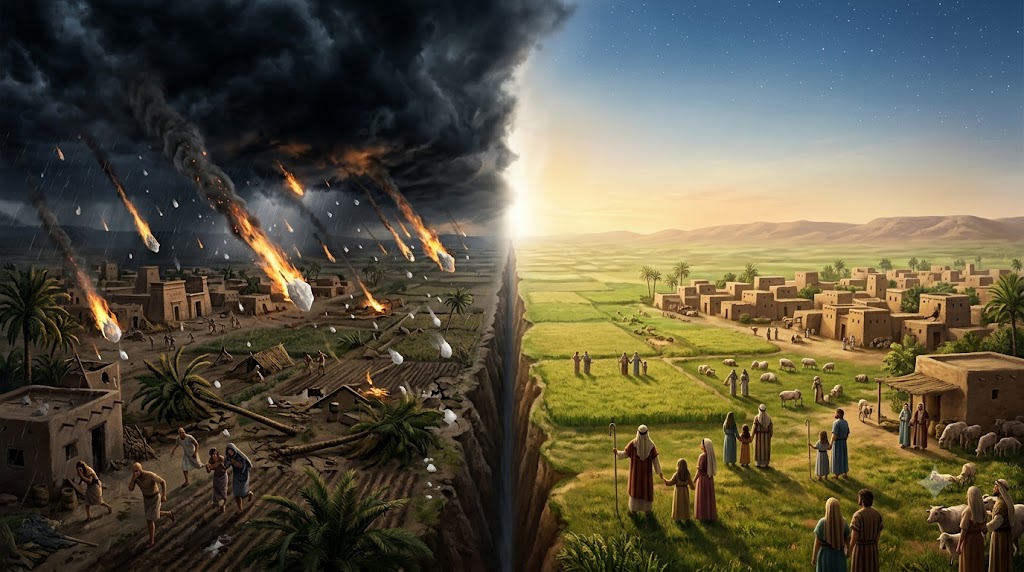
⛈️ Act Three — The Seventh Plague: Hail (Verses 13–35) In the seventh plague, God’s words carry a weight unlike anything before.
“Then the LORD said to Moses, ‘Rise early in the morning and stand before Pharaoh, and say to him, “Thus says the LORD God of the Hebrews: Let My people go, that they may serve Me.”‘”
The same demand—but what follows opens an entirely new dimension.
“For at this time I will send all My plagues to your very heart, and on your servants and on your people, that you may know that there is none like Me in all the earth. Now if I had stretched out My hand and struck you and your people with pestilence, then you would have been cut off from the earth. But indeed for this purpose I have raised you up, that I may show My power in you, and that My name may be declared in all the earth.”
That you may know that there is none like Me in all the earth. Now the purpose of the plagues is stated explicitly. This was never merely about breaking Pharaoh’s resistance. It was about making God known to the entire world. Even Pharaoh’s hardness became, within God’s larger plan, a stage on which His power was displayed.
The warning that followed was unusually detailed.
“Behold, tomorrow about this time I will cause very heavy hail to rain down, such as has not been in Egypt since its founding until now. Therefore send now and gather your livestock and all that you have in the field, for the hail shall come down on every man and every animal which is found in the field and is not brought home; they shall die.”
Here a remarkable verse follows.
“He who feared the word of the LORD among the servants of Pharaoh made his servants and his livestock flee to the houses. But he who did not regard the word of the LORD left his servants and his livestock in the field.”
Even among Pharaoh’s own officials, there was division. Some took the warning seriously and prepared. Others dismissed it. The same warning reached everyone—but the response was each person’s own choice. Even in the face of judgment, people still chose.
Then the hail fell.
“And Moses stretched out his rod toward heaven; and the LORD sent thunder and hail, and fire darted to the ground. And the LORD rained hail on the land of Egypt. So there was hail, and fire mingled with the hail, so very heavy that there was none like it in all the land of Egypt since it became a nation.”
Fire mixed with hail. Ice and fire—two elements that cannot naturally coexist—came together in the hand of God. Even the order of nature became an instrument of divine judgment.
“And the hail struck throughout the whole land of Egypt, all that was in the field, both man and beast; and the hail struck every herb of the field and broke every tree of the field. Only in the land of Goshen, where the children of Israel were, there was no hail.”
Once more, Goshen is named. Under the same sky, hail fell in one place and not another. Even as judgment swept across the whole earth, the place where God’s people dwelt remained set apart.
And finally—something new emerges from Pharaoh.
“And Pharaoh sent and called for Moses and Aaron, and said to them, ‘I have sinned this time. The LORD is righteous, and my people and I are wicked. Entreat the LORD, for it is enough that there be no more mighty thundering and hail. I will let you go, and you shall stay no longer.'”
I have sinned this time. For the first time, a confession of sin from Pharaoh’s own mouth. The LORD is righteous, and my people and I are wicked—it sounds theologically precise, as if he were genuinely acknowledging both God’s righteousness and his own guilt.
Moses responded to this confession.
“And Moses said to him, ‘As soon as I have gone out of the city, I will spread out my hands to the LORD; the thunder will cease, and there will be no more hail, that you may know that the earth is the LORD’s.'”
Moses already knew, even as he agreed to intercede, what would follow.
“But as for you and your servants, I know that you will not yet fear the LORD God.”
And indeed—
“So Moses went out of the city from Pharaoh and spread out his hands to the LORD; then the thunder and the hail ceased, and the rain was not poured on the earth. And when Pharaoh saw that the rain, the hail, and the thunder had ceased, he sinned yet more; and he hardened his heart, he and his servants.”
He sinned yet more. The moment the hail stopped, the confession vanished with it. “I have sinned” had not been repentance—it had been a temporary measure to escape pain. It was the language of crisis, not the language of a changed heart.
“So the heart of Pharaoh was hard, and he did not let the children of Israel go, just as the LORD had spoken by Moses.”
The same sentence, repeated a third time. When the plague ceases, the hardness returns.
🕊️ Reflection — Between the Confession of Crisis and the Confession of the Heart The verse that grips the heart most in Exodus 9 is Pharaoh’s own words:
“I have sinned this time.”
This time. That phrase reveals everything. Pharaoh was not confessing sin—he was confessing that this particular plague had become unbearable. Genuine repentance does not change when circumstances change. But Pharaoh’s confession arrived with the hail and disappeared the moment the hail stopped.
We too often confuse the language of crisis with the language of the heart. Prayers spoken in hardship can feel genuine in the moment—but the real test is whether that prayer continues once the circumstances improve. Real repentance is not the words “I was wrong this time,” but a lasting change in the direction of one’s life.
Yet this chapter also has another face. The officials who feared the word of the LORD and moved their servants and livestock to safety in advance. Even within a hardened court, there were those who listened to the warning and obeyed. Even in the midst of judgment, people were divided between those who prepared and those who dismissed it.
And Goshen again. Even as hail covered the earth, the place where God’s people dwelt remained distinguished. The more intense the judgment grew, the sharper that distinction became.
“Is your confession language that vanishes once the crisis passes—or is it a genuine turning that reshapes the direction of your life?”
📣 Coming Up Next Exodus Chapter 10 — Locusts and Darkness The eighth and ninth plagues arrive. Locusts devour everything that remains, and for three days a thick darkness that can be felt covers the whole land of Egypt. Even Pharaoh’s own officials begin to turn against him, and the negotiations grow ever more desperate. The countdown toward the final plague begins in the next episode.
#Exodus9 #LivestockPlague #BoilsPlague #HailPlague #IHaveSinnedThisTime #PharaohsHardHeart #GoshenDistinguished #GodsPower #CrisisConfession #TrueRepentance #TenPlagues #BibleStudy #ChristianBlog #Exodus #OldTestament #Scripture #Church #DailyDevotional #BiblicalFaith #GodsPower