Exodus Series — Epis
🔥 Prologue — God’s Method of Answering a Question
Pharaoh had asked.
“Who is the LORD, that I should obey His voice to let Israel go?”
It was a question of contempt. A question of dismissal. Who is this God that two aging Hebrew men speak of—not worth my attention. Not worth my acknowledgment.
But God was not offended by the question. Instead—He chose to answer it. Not with words. With actions. Not with explanation. With demonstration. Not with argument. With power.
Exodus Chapter 7 is the opening movement of that answer.
The overture of the ten plagues. The first chapter of the story in which Egypt’s gods are systematically dismantled one by one. On the day the Nile ran with blood—Pharaoh began to learn who the LORD was.
👑 Act One — God Positions Moses Before Pharaoh (Verses 1–7)
“So the LORD said to Moses: ‘See, I have made you as God to Pharaoh, and Aaron your brother shall be your prophet.'”
As God to Pharaoh. A staggering declaration.
Moses had said he was slow of speech. Inadequate. Unqualified. Yet God positioned him before Pharaoh as one bearing divine authority. In a world where Pharaoh himself held the status of a living deity, Moses would stand before him bearing a higher authority still. Aaron would function as his prophet—the one who speaks the words of the one who receives them from God.
The structure was defined. God speaks. Moses receives. Aaron proclaims. This three-tier architecture would drive the entire drama of the Exodus.
“And I will harden Pharaoh’s heart, and multiply My signs and My wonders in the land of Egypt.”
I will harden Pharaoh’s heart. One of the most theologically debated statements in all of Scripture. What does it mean for God to harden Pharaoh’s heart?
This was not divine coercion producing evil in a previously neutral soul. Pharaoh was already hardened—his resistance to Israel’s God was already the established posture of his reign. What God was doing was allowing that pre-existing hardness to fulfill its function within a larger sovereign design. Every refusal of Pharaoh became the stage on which God’s power would be demonstrated with greater clarity. The harder the resistance, the more undeniable the eventual breakthrough.
“But Pharaoh will not heed you, so that I may lay My hand on Egypt and bring My armies and My people, the children of Israel, out of the land of Egypt by great judgments.”
God knew in advance that Pharaoh would refuse. And that refusal was incorporated into the divine plan rather than being a disruption of it. The rejection did not delay the liberation. It amplified the glory of the liberation when it finally came.
“And the Egyptians shall know that I am the LORD.”
The declared purpose of everything that follows. Not revenge. Not destruction for its own sake. The plagues were a sustained revelation—an extended answer to Pharaoh’s original question. You asked who the LORD is. These demonstrations are His answer.
“Moses was eighty years old and Aaron was eighty-three years old when they spoke to Pharaoh.”
Eighty. Eighty-three. The world calls these the years of retirement. The years of diminishment. God called them the years of maximum commission. The divine timetable operates on entirely different coordinates than human expectation.
🐍 Act Two — Aaron’s Staff Becomes a Serpent (Verses 8–13)
The first confrontation before Pharaoh.
“Then the LORD spoke to Moses and Aaron, saying, ‘When Pharaoh speaks to you, saying, “Show a miracle for yourselves,” then you shall say to Aaron, “Take your rod and cast it before Pharaoh, and let it become a serpent.”‘”
The scenario was anticipated. Pharaoh would demand a demonstration. The instruction was ready.
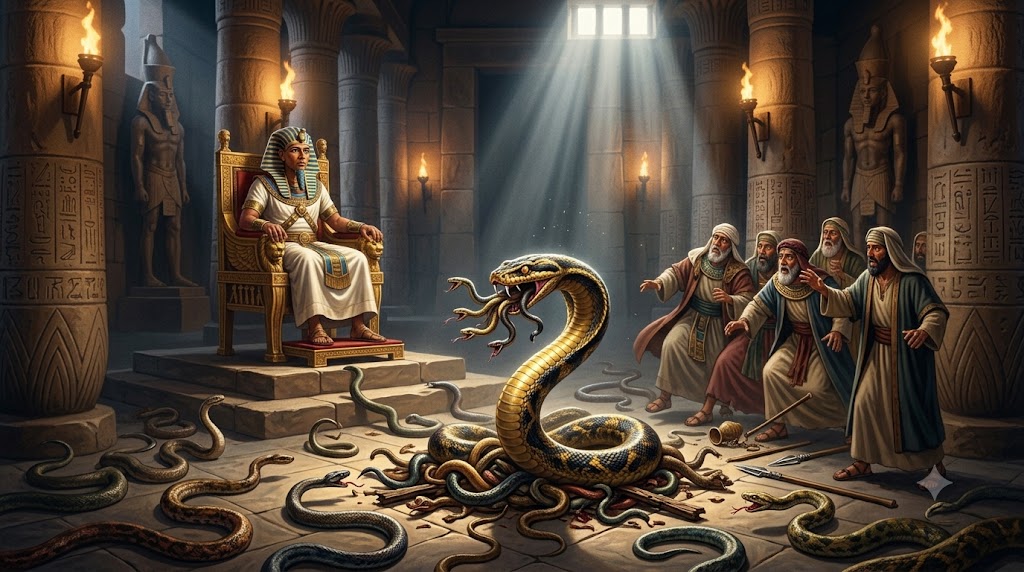
“So Moses and Aaron went in to Pharaoh, and they did so, just as the LORD commanded. And Aaron cast down his rod before Pharaoh and before his servants, and it became a serpent.”
The staff became a serpent on the floor of the most powerful palace on earth. Before Pharaoh and every one of his officials.
Pharaoh did not stand passively.
“But Pharaoh also called the wise men and the sorcerers; so the magicians of Egypt, they also did in like manner with their enchantments.”
Pharaoh’s magicians replicated the sign. Their staffs also became serpents. Imitation. Counterfeit. But then—
“But Aaron’s rod swallowed up their rods.”
Swallowed. Aaron’s serpent consumed every serpent the magicians had produced. This was not a competition between comparable powers. This was the total consumption of Egypt’s occult capability by the power of the living God.
Yet Pharaoh’s response?
“But Pharaoh’s heart grew hard, and he did not heed them, as the LORD had said.”
Hardened. He had witnessed a staff become a serpent. He had watched Aaron’s serpent consume all of the others. And his heart had not moved. Exactly as God had said it would be.
A hardened heart remains hardened before miracles. For the one who refuses to see, no quantity of evidence is ever sufficient.
🩸 Act Three — The First Plague: The Nile Turned to Blood (Verses 14–25)
“So the LORD said to Moses: ‘Pharaoh’s heart is hard; he refuses to let the people go.'”
Refused. The first plague was now decreed.
“Go to Pharaoh in the morning, when he goes out to the water, and you shall stand by the river’s bank to meet him.”
Morning. The time when Pharaoh went to the Nile. In ancient Egypt, the Pharaoh performed morning ritual ablutions at the Nile—a religious ceremony of reverence toward Hapi, the god of the Nile. God chose this precise location deliberately. The very river Pharaoh worshipped as divine—that river would now become the canvas of God’s self-revelation.
“Thus says the LORD: ‘By this you shall know that I am the LORD.'”
Declared again. The purpose of the plague was knowledge. Pharaoh asked who the LORD was. The river was about to show him.
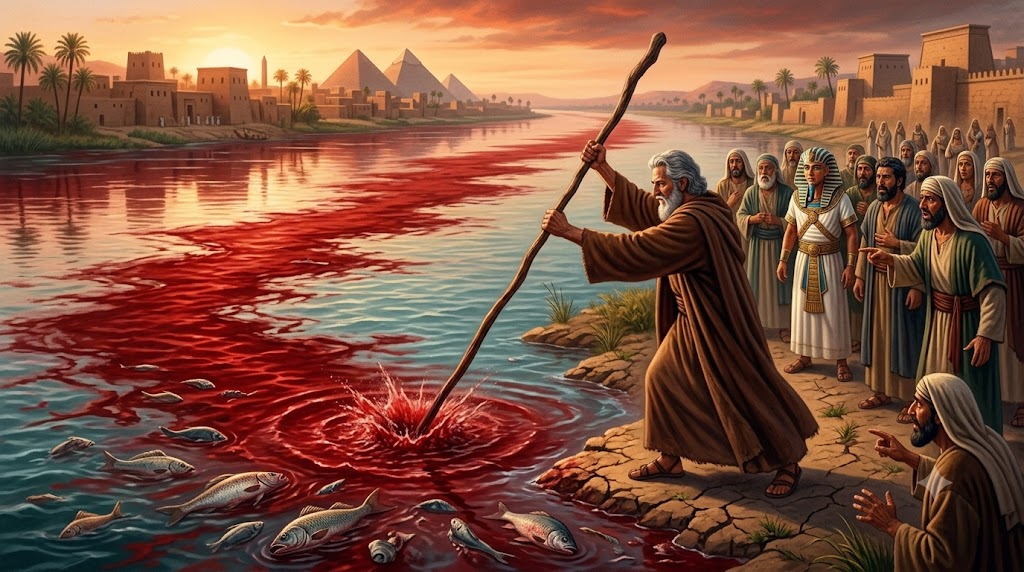
“Then Moses and Aaron did so, just as the LORD commanded. So he lifted up the rod and struck the waters that were in the river, in the sight of Pharaoh and in the sight of his servants. And all the waters that were in the river were turned to blood.”
The Nile turned to blood.
The Nile—the circulatory system of the entire Egyptian civilization. The river worshipped as Hapi, the deity of abundance, fertility and life. The very source of Egypt’s agricultural prosperity and national identity. It ran red.
“The fish that were in the river died, the river stank, and the Egyptians could not drink the water of the river.”
The fish died. The stench spread. The water became undrinkable. The river of life became a river of death. The god that Egypt worshipped became an object of divine judgment.
“And there was blood throughout all the land of Egypt.”
Every vessel holding water—wood, stone—blood. The entire nation affected. No exemption. No corner of Egypt’s water supply remained untouched.
Pharaoh’s magicians attempted imitation.
“Then the magicians of Egypt did so with their enchantments; and Pharaoh’s heart grew hard.”
The irony was sharp. They replicated the plague—turning more water to blood in a land already bereft of drinkable water. They added to the problem rather than solving it. But Pharaoh considered this sufficient: my magicians can do the same, therefore nothing supernatural has occurred.
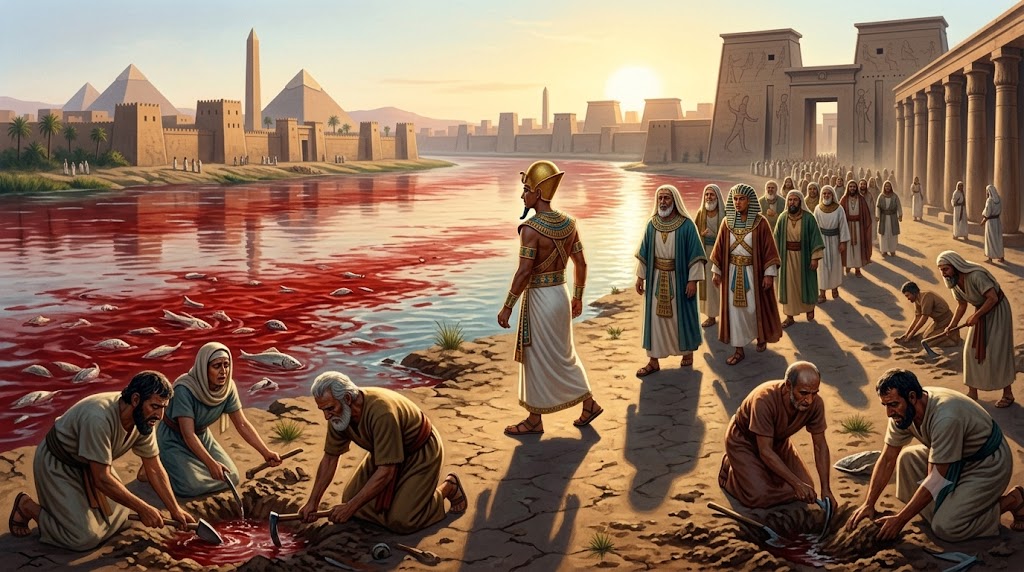
“And Pharaoh turned and went into his palace. Neither was his heart moved by this.”
He turned and went inside. The river was blood. The people had no water to drink. And Pharaoh walked back into his palace. This is the essence of the hardened heart—the refusal to register what the eyes have clearly seen.
“So all the Egyptians dug all around the river for water to drink, because they could not drink the water of the river.”
The people dug along the riverbank searching for groundwater. When leaders refuse to acknowledge catastrophe—the people absorb the consequences. The plague lasted seven days.
🕊️ Reflection — Is a Plague Judgment or Revelation?
Reading Exodus Chapter 7, one question demands attention. Why does God speak through plagues?
The answer is embedded in the text itself: “The Egyptians shall know that I am the LORD.” The plagues were not primarily acts of punishment. They were acts of revelation. God making Himself known through the most undeniable medium available.
To a civilization that worshipped the Nile as a deity—turning the Nile to blood was the most powerful possible self-introduction. What you call a god, I govern. What you worship for life, I can turn to death. I am the LORD.
God still works this way. He sometimes touches the things we depend upon most heavily. The career, the health, the relationship, the financial security—when the things we trust more than God begin to tremble, God is speaking through the trembling. “I am the LORD.”
Before the first plague, Pharaoh had two options. He could turn. Or he could harden further. He chose the latter. Which do we choose when God’s power touches what we have been leaning on most heavily—do we see it as an invitation to reexamine our dependencies, or do we harden further?
“What is your Nile today? When God lays His hand on the thing you have been depending on more than Him—how will you respond?”
📣 Coming Up Next
Exodus Chapter 8 — Frogs, Gnats and Flies: The Plagues Intensify
The second through fourth plagues arrive in rapid succession. Frogs swarm every corner of Egypt. The dust of the earth becomes gnats. Swarms of flies descend. The magicians make their first honest confession—“This is the finger of God.” And Pharaoh attempts his first negotiation. The drama intensifies in the next episode.
#Exodus7 #TenPlagues #NileTurnedToBlood #FirstPlague #AaronsStaff #PharaohsHardHeart #EgyptianMagicians #WhoIsTheLord #DivinRevelation #JudgmentAndRevelation #Exodus #BibleStudy #ChristianBlog #OldTestament #Scripture #Church #DailyDevotional #BiblicalFaith #GodsPower #Intercession