Exodus Series — Episode 2
🔥 Prologue — The River of Execution Becomes the Cradle of Liberation
Pharaoh’s infanticide mandate had blanketed all of Egypt.
The moment a Hebrew male infant drew his first breath, the Nile was to swallow him whole. The imperial sword stood at the threshold of every Hebrew household. The wailing of infants torn from their mothers’ arms echoed across the entirety of Goshen. The empire was convinced it had executed a comprehensive termination of Israel’s next generation.
But the Sovereign Architect had not gone silent.
A breathtaking cosmic inversion was about to unfold—the very river designated as an instrument of mass execution was about to become the cradle of the greatest liberator in human history. At the precise moment the empire was at peak confidence, the most dramatic reversal in redemptive history was being engineered in the shadows.
Three women—a desperate mother, an unsuspecting princess, and a watchful young girl—would become the instruments through which the Sovereign God raised His deliverer inside the very palace that sought his destruction.
👶 Act One — The Levite Child: Three Months of Hidden Life (Verses 1–2)
“And a man of the house of Levi went and took as wife a daughter of Levi. So the woman conceived and bore a son. And when she saw that he was a beautiful child, she hid him three months.”
In the quiet chambers of a Levite household, a child was born.
Scripture records the event without fanfare. A single sentence—yet within it lay the seed of cosmic reversal. Born to Amram and Jochebed of the tribe of Levi, this infant arrived precisely during the height of Pharaoh’s systemic infanticide campaign.
The mother looked upon the child. She saw that he was beautiful—the Hebrew tov, meaning good, pleasing, excellent. The exact word deployed in Genesis 1 when God surveyed His creation and declared it good. What Jochebed perceived was not merely maternal affection. It was a faith-perception—a Spirit-illumined recognition of the divine goodness flowing through this child’s existence.
Three months. Jochebed concealed her son at the cost of her own life. Hebrews 11 testifies: “They were not afraid of the king’s command.” Where the midwives Shiphrah and Puah had exercised courage in the delivery room, Jochebed’s courage extended through ninety days of daily, domestic, hidden defiance.
But three months marked the outer boundary of concealment. The infant’s voice had grown, the scrutiny of neighbors had intensified. The moment of impossible decision had arrived.
🌿 Act Two — The Reed Ark: A Faith Vessel Sealed with Pitch and Resin (Verses 3–4)
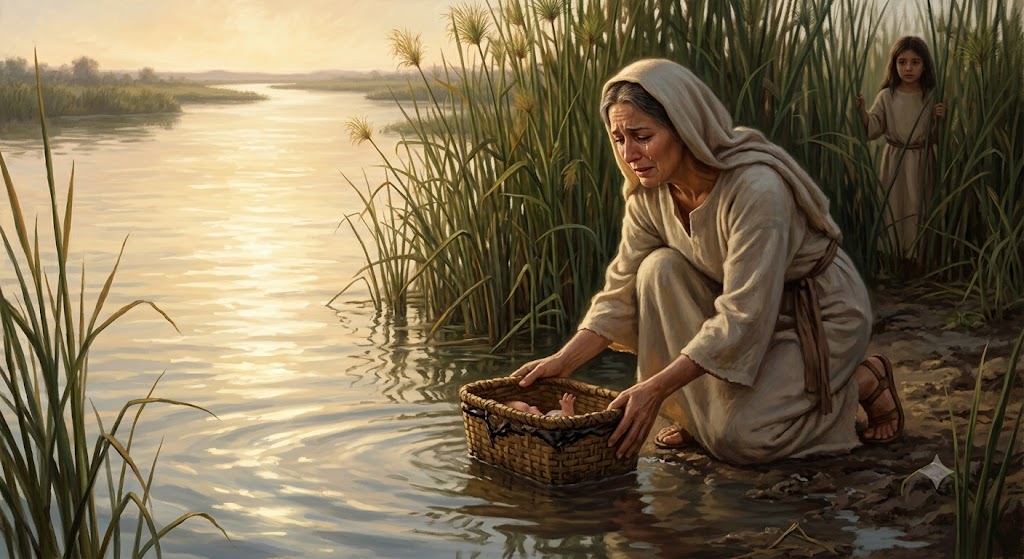
“But when she could no longer hide him, she took an ark of bulrushes for him, daubed it with asphalt and pitch, put the child in it, and laid it in the reeds by the river’s bank. And his sister stood afar off, to know what would be done to him.”
When concealment reached its absolute limit, Jochebed made a sovereign decision.
A basket woven from papyrus reeds harvested from the Nile’s own banks. Sealed with bitumen and pitch to prevent the river from entering—a waterproofed micro-ark. The same material that had insulated Noah’s ark against the flood now wrapped itself around a single infant as a shell of divine protection.
Jochebed lowered the child into the basket.
This scene arrests the soul. A mother placing her own son onto the surface of the very river designated for his execution—this was not abandonment. This was not resignation. This was the most radical act of faith in the patriarchal narrative thus far. It was the declaration that this river does not belong to Pharaoh. That this child’s destiny is governed not by the current of the Nile but by the unseen hand of the Covenant God.
His sister Miriam stationed herself at a distance, eyes locked on the vessel as it drifted among the reeds. In that small girl’s gaze—taut with tension, prayer, and desperate hope—beat the hidden heart of this entire narrative.
👑 Act Three — The Princess, the Discovery, and the Sovereign Infiltration of the Empire (Verses 5–10)
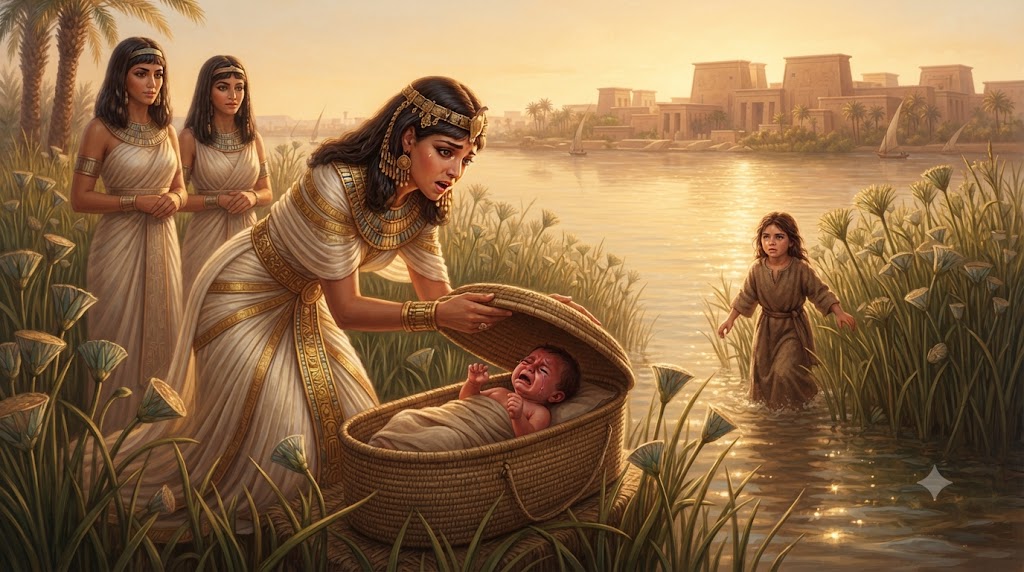
“Then the daughter of Pharaoh came down to bathe at the river. And her maidens walked along the riverside; and when she saw the ark among the reeds, she sent her maid to get it.”
Pharaoh’s daughter descended to the Nile to bathe.
Was this coincidence? Absolutely not. The precise morning, the precise hour, the precise location at which the princess appeared—this was the sovereign choreography of the Almighty. Among the millions inhabiting Egypt, the only person capable of discovering a tiny floating basket among the reeds, the only person with both the authority and the compassion to override the imperial edict—was positioned in that exact spot at that exact moment.
The princess opened the basket. The infant cried.
“And when she opened it, she saw the child, and behold, the baby wept. So she had compassion on him, and said, ‘This is one of the Hebrews’ children.'”
She knew immediately. This was a Hebrew infant. The very category her father had condemned to liquidation. The imperial law was unambiguous. Yet—she had compassion.
One woman’s mercy rewrote history.
At that precise moment, Miriam materialized.
“Then his sister said to Pharaoh’s daughter, ‘Shall I go and call a nurse for you from the Hebrew women, that she may nurse the child for you?'”
The strategic brilliance of a child watching from the reeds. The moment Miriam registered the princess’s emotional connection to the infant, she stepped into the narrative. The phrase for you—a masterstroke of diplomacy—framed the entire offer around the princess’s benefit. This single sentence arranged for Jochebed to be commissioned as her own son’s nursemaid.
“Pharaoh’s daughter said to her, ‘Take this child away and nurse him for me, and I will give you your wages.'”
Jochebed nursed her own son. With the full authorization of the royal household. Compensated by the imperial treasury. The very empire that had decreed the destruction of this child now funded his mother to raise him. This was the divine irony—the sovereign justice—the breathtaking audacity of God’s governance.
“And the child grew, and she brought him to Pharaoh’s daughter, and he became her son. So she called his name Moses, saying, ‘Because I drew him out of the water.'”
Moses. From the Hebrew mashah—to draw out. A name assigned by a gentile princess. Yet encoded within it was the entire trajectory of his prophetic mission—this child would one day draw out an entire nation from the iron furnace of imperial bondage. His name was his prophecy.
💔 Act Four — The Prince Who Could Not Unsee His Brothers’ Suffering (Verses 11–15)
“Now it came to pass in those days, when Moses was grown, that he went out to his brethren and looked at their burdens.”
The decades dissolved.
Moses had matured within the palace architecture—educated in all the wisdom of Egypt, positioned within the highest corridors of imperial power, formed by the most sophisticated civilization on earth. Yet in the depths of his identity, the blood of the covenant people still flowed.
One day Moses went out to where his brothers labored. He saw their burdens. He witnessed an Egyptian taskmaster striking a Hebrew worker. Something volcanic ignited within him.
“So he looked this way and that way, and when he saw no one, he killed the Egyptian and hid him in the sand.”
Moses executed the taskmaster. Buried the evidence.
Was this righteous indignation or premature activation? The orientation was aligned—but the methodology was unrefined. Moses carried the knowledge of his calling. But the season of divine deployment had not yet arrived. Movement outside of divine timing, outside of divine commissioning—this triggered the wilderness curriculum.
The following day, Moses encountered two Hebrews in conflict. He intervened. Their response was devastating.
“Who made you a prince and a judge over us? Do you intend to kill me as you killed the Egyptian?”
The secret had been compromised. Pharaoh was informed. Moses had no choice but to flee—abandoning the palace, relinquishing the power, departing for the wilderness of Midian.
🌿 Act Five — The Wilderness Well: The New Household (Verses 16–22)
“Now the priest of Midian had seven daughters. And they came and drew water, and they filled the troughs to water their father’s flock.”
A wilderness well. Moses sat.
The seven daughters of Jethro, priest of Midian, arrived to water their flock. Shepherds drove them away. Moses rose. He defended them. He watered the flock himself.
In the palace and in the wilderness—when Moses saw the vulnerable being crushed, he advanced toward them. This was not an acquired behavior. This was the deliverer’s DNA that God had embedded at the core of his identity.
Zipporah, one of Jethro’s daughters, became Moses’ wife. A son was born. Moses named him Gershom.
“‘For I have been a stranger in a foreign land.'”
Stranger. The word that defined Moses’ compound identity. Born Hebrew. Raised Egyptian. Now a wilderness shepherd. The in-between man—belonging entirely to neither world. Yet this liminal identity was the Sovereign Architect’s most elegant design. Only one who intimately knew both worlds could stand between them as the bridge of liberation.
😢 Act Six — The Cry That Pierced the Heavens (Verses 23–25)
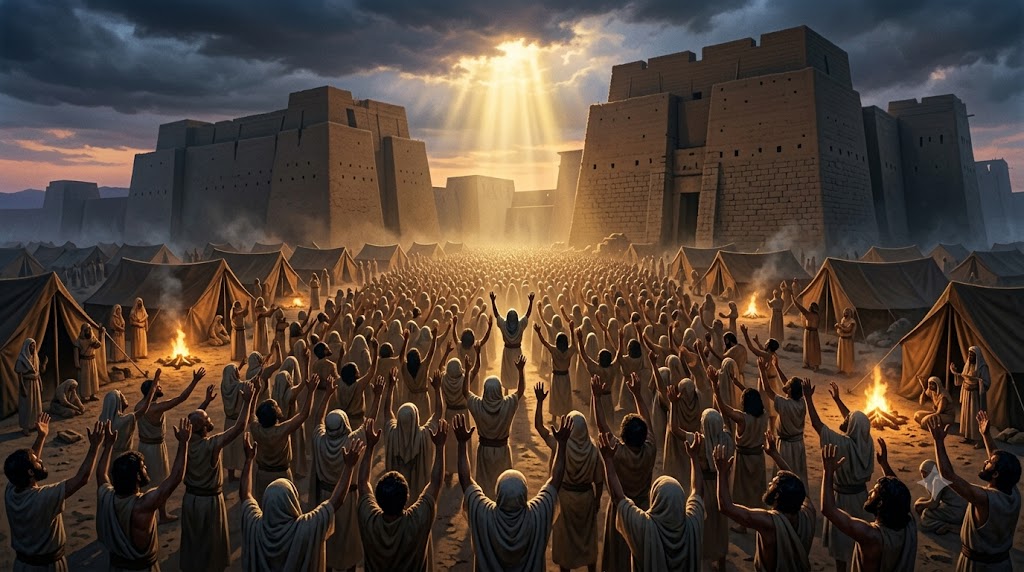
“Now it happened in the process of time that the king of Egypt died. Then the children of Israel groaned because of the bondage, and they cried out; and their cry came up to God because of the bondage.”
A new king. The same suffering.
They groaned. They cried out. And that cry—ascended directly to God.
“So God heard their groaning, and God remembered His covenant with Abraham, with Isaac, and with Jacob.”
Remembered. God had not forgotten. His silence had never been indifference. The fullness of time had arrived. The covenant was activated. The divine timepiece began to move.
“And God looked upon the children of Israel, and God acknowledged them.”
Looked upon. Acknowledged. Two verbs. Yet within those two verbs resided the entirety of the Exodus. When God sees and when God remembers—history is restructured.
🕊️ Reflection — The Reed Basket on the River and the Precision of Providence
Exodus Chapter 2 encodes three magnificent revelations.
First, God works through the seemingly powerless. Moses was not preserved by military force or royal decree. He was preserved by a mother’s love, a sister’s quick thinking, and a princess’s compassion. God initiates history from the most improbable coordinates—from within a woven reed basket holding a weeping infant.
Second, the wilderness is the laboratory of formation. Moses was not shaped within the marble corridors of the palace. He was forged within the stripping severity of the Midian wilderness. The forty years that appeared to subtract from his destiny were in fact the most precise curriculum of preparation. Your wilderness is not dismantling you—it is completing you.
Third, God hears every cry. The groaning of Israel ascended to the throne of God. He saw. He remembered. Your cry in this season has not evaporated unheard. He is not silent. He is orchestrating the precise alignment of your liberation.
“Are you terrified of where the current is taking the reed basket you have released? Remember who owns the river. The same God who governed the Nile governs yours.”
📣 Coming Up Next
Exodus Chapter 3 — The Burning Bush: The Name Above All Names Revealed
Deep in the wilderness of Midian, tending his father-in-law’s flock, Moses encounters a phenomenon that defies natural law—a bush engulfed in fire that is not consumed. From within that paradoxical flame, the Sovereign God discloses His eternal name: “I AM WHO I AM.” The formal ignition of the Exodus engine commences in our next episode.
#Exodus2 #BirthOfMoses #ArkOfBulrushes #NileRiver #Jochebed #Miriam #PharaohsDaughter #NameOfMoses #MidianWilderness #CryToGod #DivinProvidence #DelibererPrepared #WildernessCurriculum #BibleStudy #ChristianBlog #Exodus #OldTestament #Scripture #Church #DailyDevotional