At the end of chapter 19, the pieces of a dismembered body were sent throughout Israel. This chapter shows how the tribes actually responded to that message. That response leads to a civil war that nearly wipes one of Israel’s twelve tribes off the map.
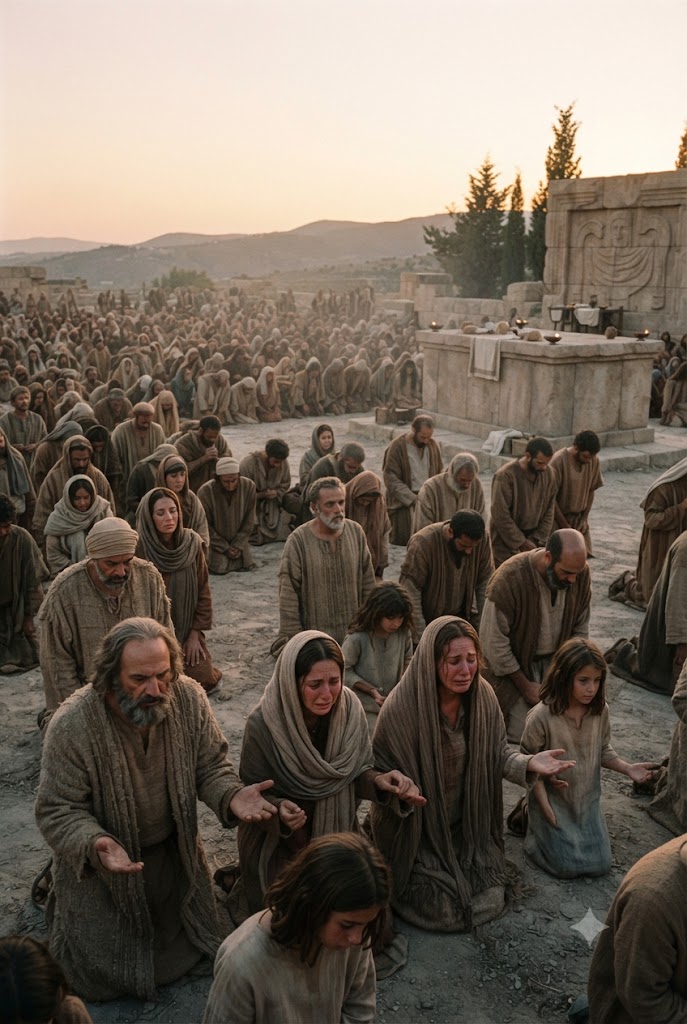
From Dan to Beersheba, and from the land of Gilead, the children of Israel gather at Mizpah. The text records four hundred thousand footmen assembled. They summon the Levite and ask him what happened. His account sounds noticeably slanted in his own favor. He describes nearly being killed himself, but never mentions that he was the one who handed his concubine over to the mob in the first place.
Israel rises as one and sends messengers to Benjamin with a demand: “Deliver us the men, the children of Belial, which are in Gibeah, that we may put them to death, and put away evil from Israel.” This is exactly the just principle already laid out in Deuteronomy 13 and 17 — clear evil within a community must be dealt with.
But Benjamin refuses.
“But the children of Benjamin would not hearken to the voice of their brethren the children of Israel.”
That one sentence causes everything that follows. Rather than handing over the obvious criminals within their own tribe, Benjamin chooses instead to fight alongside them against the rest of Israel. Protecting their own tribe takes priority over justice.
War begins. Israel inquires of God first, and Judah is told to go up first. But something surprising happens in the first battle.
“And the children of Benjamin came forth out of Gibeah, and destroyed down to the ground of the Israelites that day twenty and two thousand men.”
The just side doesn’t automatically win. Israel goes back to God weeping, asks again, and is told to go up again. But on the second day they lose eighteen thousand more.
This repetition is strange. A clearly righteous cause, formal inquiry of God, explicit permission granted — so why does Israel keep losing? The text never directly answers that. But something shifts by the time Israel goes up a third time.
“Then all the children of Israel, and all the people, went up, and came unto the house of God, and wept, and sat there before the LORD, and fasted that day until even, and offered burnt offerings and peace offerings before the LORD.”
This time they’re not simply asking for victory. They fast, they weep, they sacrifice. The change in posture is clear. And this time God’s answer is explicit: “Go up; for to morrow I will deliver them into thine hand.”
Israel uses an ambush strategy, nearly identical to the one Joshua used at Ai. The main force acts as a decoy while a hidden company takes the undefended city of Gibeah. This time, the victory is total.
The outcome is devastating. The entire tribe of Benjamin is nearly wiped out. “So that all which fell that day of Benjamin were twenty and five thousand men that drew the sword.” Only six hundred men escape to the rock of Rimmon and survive.
Finishing this chapter leaves a strange residue. Israel fought for a righteous cause, through proper procedure, with God’s explicit permission. And the outcome was one of the twelve tribes nearly erased from existence. Everyone wins, and yet no one really seems to.
There’s a pattern running through this chapter. Leaving obvious evil unaddressed leads to disaster. Dealing with that evil produces another disaster of its own. The line between carrying out justice and annihilating a brother barely holds here. The next chapter shows how Israel tries to clean up the consequences of what it has just done.
Tags: #Judges20 #CivilWarWithBenjamin #RefusingABrother #VictoryAfterAThirdFast #BenjaminNearlyWipedOut #BetweenJusticeAndDisaster #Judges #BibleDevotional #BibleStudy #OldTestament