PROLOGUE — A Dark Episode Outside the Cycle
Judges 9, strictly speaking, stands outside the cyclical structure of the judges — Abimelech was never a judge raised up by God, but a usurper who sought to make himself king. This chapter shows the dark seed foreshadowed at the end of chapter 8 growing into a horrifying reality.
ACT ONE — The Massacre of Seventy Brothers (verses 1–6)
“And Abimelech the son of Jerubbaal went to Shechem unto his mother’s brethren… Speak, I pray you, in the ears of all the men of Shechem, Whether is better for you, either that all the sons of Jerubbaal, which are threescore and ten persons, reign over you, or that one reign over you?”
The men of Shechem supported Abimelech and gave him seventy pieces of silver, with which he hired reckless men.
“And he went unto his father’s house at Ophrah, and slew his brethren the sons of Jerubbaal, being threescore and ten persons, upon one stone: notwithstanding yet Jotham the youngest son of Jerubbaal was left; for he hid himself.”
Slew them upon one stone. This is one of the most brutal events in the entirety of Judges — this mass killing of brothers by a brother shows that the religious corruption symbolized by Gideon’s ephod had now spread into political violence as well.
ACT TWO — Jotham’s Parable (verses 7–21)
Jotham, the sole survivor, cried out a remarkably symbolic parable from Mount Gerizim.
“The trees went forth on a time to anoint a king over them; and they said unto the olive tree, Reign thou over us. But the olive tree said unto them, Should I leave my fatness, wherewith by me they honour God and man, and go to be promoted over the trees?”
The olive tree, the fig tree, and the vine each in turn refused to become king — they were already content bearing their own genuinely beneficial fruit. Finally, the trees asked the bramble.
“Then said all the trees unto the bramble, Come thou, and reign over us. And the bramble said unto the trees, If in truth ye anoint me king over you, then come and put your trust in my shadow: and if not, let fire come out of the bramble, and devour the cedars of Lebanon.”
Only the bramble accepted the offer to become king. The point of this parable is scathing — the genuinely beneficial things (olive, fig, vine) had no interest in the ambition of rule, but only the useless bramble, bearing no fruit at all, craved the throne. Jotham directly declared that this parable applied exactly to Abimelech and the men of Shechem, prophesying that disaster would come between them.
ACT THREE — The Fulfillment of the Prophecy, Mutual Destruction (verses 22–57)
Three years later, God actually sent an evil spirit between Abimelech and the men of Shechem.
“Then God sent an evil spirit between Abimelech and the men of Shechem; and the men of Shechem dealt treacherously with Abimelech.”
The rebellion of the men of Shechem and Abimelech’s brutal suppression followed, and Abimelech ultimately destroyed the city of Shechem completely and sowed it with salt. But his own end came in a remarkably humiliating way.
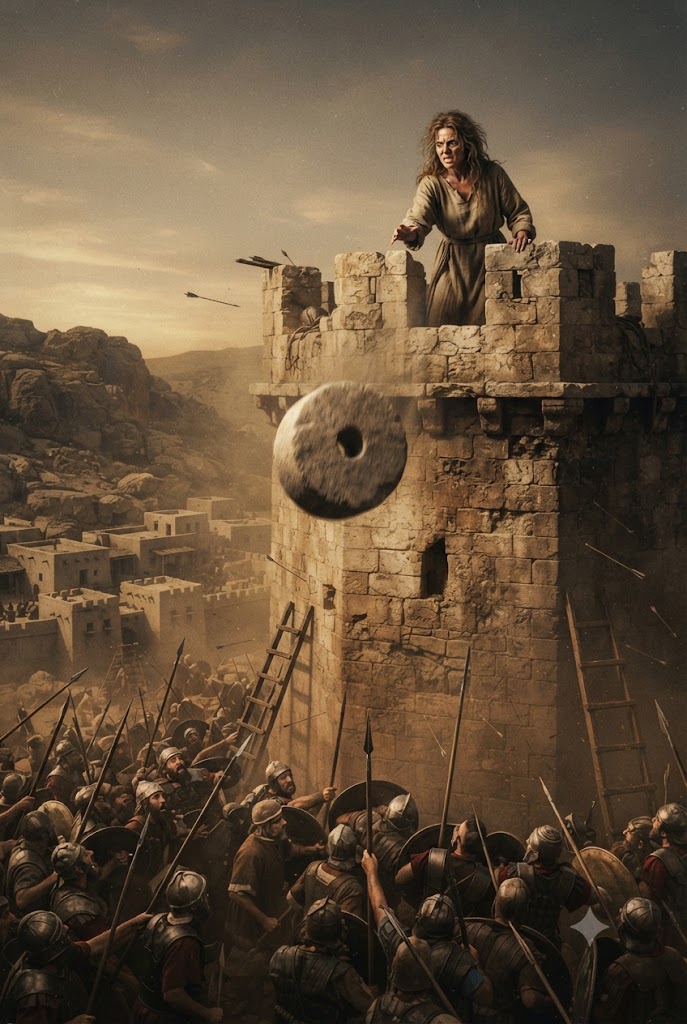
“And Abimelech came unto Thebez… there was a strong tower… And Abimelech came unto the tower, and fought against it… And a certain woman cast a piece of a millstone upon Abimelech’s head, and all to brake his skull. Then he called hastily unto the young man his armourbearer, and said unto him, Draw thy sword, and slay me, that men say not of me, A woman slew him. And his young man thrust him through, and he died.”
A woman cast a millstone… and he died. Abimelech, who had made himself king, ultimately met his end by a millstone thrown by an unnamed woman — his kingship, which began by massacring his own brothers, ended in the most humiliating way possible.
ACT FOUR — God’s Just Reckoning (verses 56–57)
This chapter closes with a theological reckoning.
“Thus God rendered the wickedness of Abimelech, which he did unto his father, in slaying his seventy brethren… And upon them came the curse of Jotham the son of Jerubbaal.”
REFLECTION — The Inevitable Collapse of Power Built on Violence
The heavy warning Judges 9 gives us is that power built on violence and political ambition can never last. Abimelech’s kingship began in the bloodshed of fratricide from the very start, and ultimately collapsed within that very same cycle of violence.
In the pursuit of power or influence, are you avoiding the temptation to justify unjust means?
NEXT EPISODE PREVIEW
Judges Chapter 10 — the two minor judges, Tola and Jair, and Israel’s renewed descent into corruption, follow.
Tags: #Judges9 #AbimelechsUsurpation #MassacreOfSeventyBrothers #JothamsParable #OnlyTheBrambleAccepted #DeathByMillstone #Judges #BibleDevotional #ChristianBlog #BibleStudy #OldTestament #Bible #Church #Devotion #Christianity #CollapseOfPowerBuiltOnViolence #GodsJustReckoning #DailyDevotional