🔥 Prologue — Two Questions That Have Stopped Readers for Centuries
There is a moment when reading Genesis where everything seems to stop.
Cain has murdered Abel. God has cursed him. He is sent out to wander the earth. And then — just verses later — Cain has a wife. A son is born. A great city is built.
Wait. Where did the wife come from? Who filled that city? Weren’t only Adam, Eve, and Cain left?
These questions look like contradictions on the surface. But that appearance is deceptive. When we examine the literary structure of Genesis, the recording conventions of ancient Hebrew literature, and the archaeological geography of the ancient Near East, these apparent mysteries resolve themselves — and in doing so, they reveal the remarkable precision of the biblical text rather than undermining it.
Two questions. Both deserve a thorough answer.
Where did Cain’s wife come from? And where is the City of Enoch located today?
🧬 Act One — Cain’s Wife: Not What the Bible Hid, But What the Reader Missed
① Eve Was the Mother of All the Living
“Adam named his wife Eve, because she would become the mother of all the living.” (Genesis 3:20)
The Bible makes an unambiguous declaration here. Eve — Havah in Hebrew — is the mother of every living human being. This is simultaneously a theological statement and a genealogical one. There was no separate creation of another human race. All of humanity descends from a single ancestral line.
This means Cain’s wife was a descendant of Eve — in other words, his sister or a niece born from a sibling not mentioned by name.
Does that feel uncomfortable? Before reacting, we need to examine exactly where that discomfort comes from — and whether it applies to the world of early Genesis.
② The Time Compression of Genesis — The Decades We Skipped Over
The most common mistake readers make when approaching the early chapters of Genesis is assuming a compressed timeline — that Cain murdered Abel almost immediately after Adam and Eve were expelled from Eden, while the human population was still in single digits.
A closer reading of the genealogical record tells a radically different story.
“When Adam had lived 130 years, he had a son in his own likeness, in his own image; and he named him Seth. After Seth was born, Adam lived 800 years and had other sons and daughters.” (Genesis 5:3–4)
Adam was 130 years old when Seth was born. Seth, Scripture tells us, was given to Eve as a replacement for Abel after his death. This means that the murder of Abel — and Cain’s subsequent exile — occurred sometime before Adam reached 130. How long before? The text does not specify. But it could easily have been decades, or even a century, after Adam and Eve first began having children.
Now consider what that means demographically. If early humans lived for hundreds of years — as the genealogies of Genesis 5 consistently record — then their reproductive capacity across that time was vast. Within the first hundred years of human history, a single couple living for centuries and bearing children across their extended lifespan could generate a population numbering in the hundreds or even thousands.
By the time Cain committed his crime, the world was not nearly as empty as casual reading suggests.
③ The People Cain Feared — The Most Telling Detail
“Cain said to the Lord, ‘My punishment is more than I can bear. Today you are driving me from the land, and I will be hidden from your presence; I will be a restless wanderer on the earth, and whoever finds me will kill me.'” (Genesis 4:13–14)
Read that carefully. Whoever finds me will kill me.
Cain did not say “if someone finds me.” He said “whoever finds me” — using the language of a crowd, of an undefined and substantial population. He was afraid of multiple unknown parties who might encounter him on his wanderings.
This fear is only coherent if a significant number of people already existed on the earth. If humanity consisted of only three or four individuals, this fear would be absurd. The very grammar of Cain’s terrified plea is evidence of a world already substantially populated by Adam and Eve’s descendants.
God’s response reinforces this reading. He placed a mark on Cain so that “anyone who finds him will not kill him.” The word “anyone” again implies a multitude. Protection from a crowd requires a visible sign. Protection from a handful of known family members would require something very different.
④ Why Did the Hebrew Text Not Mention Cain’s Sister by Name?
Understanding the literary conventions of ancient Hebrew genealogical writing is essential here.
Hebrew genealogical records operate on a principle of purposive selection. They do not record everything that happened. They record what is relevant to the theological and covenantal narrative being constructed. Characters and events that do not directly advance the story of redemptive history are systematically omitted.
Cain’s wife is not named because her identity does not affect the trajectory of the story. She plays no further role in the biblical narrative. Her genealogical significance is zero from the perspective of the covenant line. So the text moves on without introducing her.
This is not deception. It is editorial discipline. The same principle governs the genealogy of Matthew 1, which presents the lineage of Jesus by skipping multiple generations — not to falsify the record, but to highlight the theologically significant individuals within it.
Ancient readers understood this convention instinctively. Modern Western readers, trained to expect biographical comprehensiveness, tend to misread the silence as a gap.
⑤ Was Early Sibling Marriage Genetically Dangerous? The Scientific Answer
The most visceral objection to the idea that Cain married his sister is the genetic one. We know today that close-relative marriage significantly increases the risk of offspring inheriting recessive genetic disorders. Surely this means it was always problematic?
Not necessarily — and genetics explains why.
Harmful genetic mutations accumulate across generations. Each reproductive cycle introduces a small number of new mutations into the genetic line. Over hundreds and thousands of years of generational succession, these mutations build up in the population’s collective genome. The danger of close-relative marriage is specifically the danger of two individuals who share identical recessive mutations both passing those mutations to their children.
At the very beginning of human history, this accumulation had not yet occurred. The genetic code of humanity was at its most pristine. The specific alleles that carry recessive disorders in today’s population had not yet been generated through millennia of mutation. Marrying a sibling in that era carried none of the genetic risks it carries today.
This is precisely why the prohibition against close-relative marriage does not appear until Leviticus 18 — the time of Moses — far later in history. By then, enough genetic drift and mutation had accumulated across generations to make the prohibition biologically necessary. God introduced the law at the moment it was needed. Its earlier absence was not an oversight; it was appropriate timing.
🗺️ Act Two — The City of Enoch: What Geography Reveals
① A Wanderer Who Built Walls — The Irony and Its Meaning
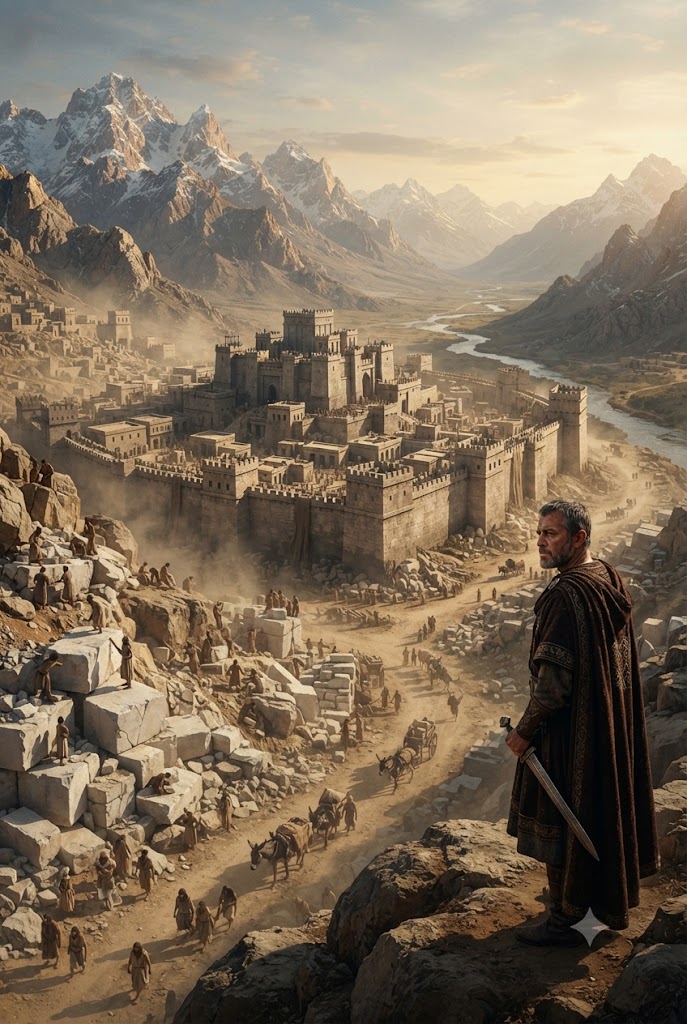
“Cain lay with his wife, and she became pregnant and gave birth to Enoch. Cain was then building a city, and he named it after his son Enoch.” (Genesis 4:17)
What was God’s sentence upon Cain? To be “a restless wanderer on the earth” — someone without roots, without territory, without a home.
What did Cain immediately do? He built a city. He constructed the most permanent, most rooted, most territorial thing a human being can create.
This is not incidental irony. It is the text’s first and most pointed illustration of the human impulse to override divine judgment through self-constructed security. Cain refused the sentence of vulnerability. Instead, he built walls.
The Hebrew word for city — ʿîr — carries rich connotations beyond mere habitation. It implies defensive fortification, administrative organization, collective governance, and the capacity for self-determination independent of outside authority. When Cain built a city, he was declaring that he needed no divine protection. He would manufacture his own.
This makes the City of Enoch the prototype of what Genesis 11 later develops more fully at Babel — the human ambition to construct a civilization that replaces dependence on God with the achievements of human ingenuity and power.
② What the City of Enoch Produced: The Three Pillars of Godless Civilization
One of the most striking passages in the Cain narrative is the brief genealogical note in Genesis 4:20–22, describing the accomplishments of Cain’s descendants:
“His brother’s name was Jubal; he was the father of all who play stringed instruments and pipes.” (Genesis 4:21)
“Jabal… was the father of those who live in tents and raise livestock.” (Genesis 4:20)
“Zillah also had a son, Tubal-Cain, who forged all kinds of tools out of bronze and iron.” (Genesis 4:22)
Three domains of human civilization emerge from Cain’s line in rapid succession: pastoral economics (Jabal), musical arts (Jubal), and metal technology (Tubal-Cain).
These are not arbitrary achievements. They are precisely the three foundational capacities of advanced ancient civilizations: the ability to generate food surpluses, the ability to create culture, and the ability to manufacture weapons and tools. Cain’s descendants built, in just a few generations, the complete infrastructure of self-sufficient human society.
Archaeology consistently locates the earliest evidence of all three of these capacities in the same geographical region where the biblical text places Cain and his descendants — the Zagros Mountain foothills and the adjacent Mesopotamian plains.
③ The Land of Nod: Pinpointing the Location
“So Cain went out from the Lord’s presence and lived in the land of Nod, east of Eden.” (Genesis 4:16)
The text provides explicit geographical coordinates: east of Eden. To locate the Land of Nod, we must first establish where Eden was.
Genesis 2:10–14 provides the key. The text names four rivers flowing from Eden: the Pishon, the Gihon, the Hiddekel (Tigris), and the Euphrates. Two of these — the Tigris and Euphrates — are precisely identifiable as the great rivers of Mesopotamia, which originate in the highlands of eastern Turkey and flow southward through Syria and Iraq.
The most academically defensible location for the Eden headwater region is the Armenian Highlands of eastern Turkey, where the Tigris and Euphrates both originate within proximity of each other. The broader Mesopotamian basin — extending from southeastern Turkey through Syria and into Iraq — forms the geographical context for the Edenic narrative.
From this region, moving directly eastward takes us into the Zagros Mountain range — the dramatic highland barrier that today forms the border between Iraq and western Iran.
The name Nod itself carries geographical and theological significance. In Hebrew, nôd (נוֹד) derives from the verbal root meaning to wander, to be restless, to be driven away — precisely the nature of the curse God pronounced on Cain. The land’s name is not a neutral geographical designation. It is a permanent memorial to the verdict that sent its first inhabitant there.
④ What Archaeology Finds in This Region
The correlation between the biblical text and the archaeological record of the Zagros Mountain region is striking.
The Zagros foothills and the adjacent Fertile Crescent contain some of the world’s earliest known sites of settled agricultural and pastoral communities. Sites including Jarmo (northwestern Iraq), Ali Kosh (western Iran), and Ganj Dareh (western Iran) have yielded evidence dated to approximately 8000–7000 BCE of the earliest-known domestication of goats and sheep, early grain cultivation, and the rudimentary beginnings of settled community life.
Moving into slightly later periods, the same geographical corridor — the eastern edge of Mesopotamia moving into the Zagros highlands — becomes the cradle of early metallurgy. The Bronze Age innovations that would eventually define ancient Near Eastern civilization trace their origins precisely to this region.
This is the area the Bible places east of Eden. It is the area archaeology identifies as the origin point of pastoral economics, early craft specialization, and the social organization that precedes urban civilization. The convergence is too precise to be coincidental.
⑤ Two Men Named Enoch — A Deliberate Literary Contrast
One of the subtler literary features of Genesis 4–5 is easily overlooked: the name Enoch appears twice, in two very different genealogical lines.
Enoch, son of Cain (Genesis 4:17) — the child after whom the first city was named. His name becomes synonymous with human civilization constructed apart from God: walls, achievement, self-determination, and ultimately the line that produces Lamech’s boastful song of violence.
Enoch, descendant of Seth (Genesis 5:21–24) — the man who “walked faithfully with God” and was taken by God without experiencing death. His name becomes synonymous with the ultimate aspiration of human existence: not the building of earthly kingdoms, but the intimacy of walking with the Creator himself.
The same name. Two entirely different destinies. Two entirely different relationships with God. The symmetry is unmistakably intentional. The author of Genesis is contrasting two civilizational visions — the City of Enoch built by human hands for human glory, and the walk of Enoch sustained by divine presence for divine glory.
🔍 Act Three — What All of This Means for Us Today
① The Bible’s Silence Is Not Contradiction
The absence of Cain’s wife’s name from the text is not a textual gap, an editorial oversight, or evidence of a suppressed tradition. It is the product of a deliberate and consistent literary principle: ancient Hebrew genealogical writing records what matters for the covenant narrative and omits what does not.
Understanding this resolves not only the mystery of Cain’s wife, but dozens of similar apparent silences across Genesis. The text is not trying to give us a comprehensive historical record of early humanity. It is tracing the line of God’s redemptive purpose through history. Everything outside that line is systematically abbreviated.
Once this principle is grasped, the perceived contradictions of Genesis dissolve — not because we lower our standards for the text, but because we raise our understanding of what kind of text it is.
② Human Civilization Can Be Built Without God — But Watch Where It Goes
The City of Enoch teaches something sobering.
Human beings, separated from God, are entirely capable of building remarkable civilizations. Cain’s descendants gave the world its pastoral economy, its musical traditions, and its foundational metallurgy — in just a few generations. The technological and cultural achievements of the Cainite line were genuinely impressive by any measure.
But the moral trajectory of that civilization is equally clear. Within a few more generations, Lamech — Cain’s descendant — is singing a celebration of his own violence: “I have killed a man for wounding me, a young man for injuring me. If Cain is avenged seven times, then Lamech seventy-seven times.” (Genesis 4:23–24)
This is the pattern Genesis establishes with unflinching clarity. Human civilization built on the impulse to self-secure rather than to walk with God will generate genuine achievements — and then turn those achievements toward violence, self-glorification, and ultimately self-destruction. Technology becomes weaponry. Art becomes self-indulgence. Economics becomes exploitation.
By the time we reach Noah’s generation, the offspring of this Cainite civilizational project has produced a world of which God says: “every inclination of the thoughts of the human heart was only evil all the time.” (Genesis 6:5)
The City of Enoch built the world that required the flood.
③ Cain’s Fear and the Grace Within the Judgment
“Whoever finds me will kill me.”
Cain’s fear is the first fear recorded in the post-Eden world that is not fear of God — it is fear of other human beings. Having broken his relationship with God, Cain immediately becomes afraid of his fellow creatures. This is the spiritual logic of sin: when we flee from God, we do not find freedom. We find a world full of threats.
Yet what is God’s response to this terror? He places a mark of protection on the man who just committed the first murder. He does not abandon Cain to the consequence of his choices. He limits that consequence. He sustains the life of the man who defied him.
This is the first biblical portrait of what theologians call common grace — God’s ongoing care and provision for all of humanity, including those who have turned against him. The mark of Cain is not primarily a mark of shame. It is a mark of protection. It is an act of mercy toward a murderer.
The God of Genesis is not a God who dismisses the guilty easily — the judgment is real and the consequences lasting. But he is also a God who, even in judgment, sustains the life of those who bear his image.
🕊️ Reflection — East of Eden, or Building Bethel?
Cain went east of Eden to the Land of Nod. There he built a city. A civilization without God. Walls instead of worship. Human achievement as the substitute for divine presence.
But Seth’s descendants walked a different path. Genesis 4:26 records the pivot: “At that time people began to call on the name of the Lord.”
Not building. Calling. Not constructing walls. Invoking the presence of the One who made them.
Two civilizational visions emerge from the fourth chapter of Genesis and extend across the entire sweep of human history. The City of Enoch — built by human hands for human glory. And the community of those who call upon the name of the Lord — sustained not by walls but by the faithfulness of God himself.
The same choice presents itself to us today. Not necessarily in the dramatic form of a city being built, but in the quieter decisions of what we trust, what we construct, and what — or whom — we call upon when we are afraid.
Are you building an Enoch? Or calling out the name of the Lord?
“What are you building today — and is it built in the name of God, or in the place of him? The choice between the City of Enoch and the altar of Seth is the choice that shapes every civilization, and every life.”
#CainsWife #CityOfEnoch #Genesis4 #LandOfNod #EastOfEden #BiblicalGeography #ZagrosMountains #BiblicalArchaeology #AncientCivilization #Genesis #BibleStudy #OldTestament #ChristianBlog #BibleMysteries #FaithAndReason #BiblicalHistory #GenesisStudy #Scripture #ChristianFaith #GodsPlan