PROLOGUE — Looking Back on the Wilderness to Prepare for the Future
Deuteronomy 8 contains one of the most widely quoted verses in this entire book — “man doth not live by bread only.” Moses theologically interprets the meaning of the forty wilderness years, delivering a lesson of humility Israel absolutely had to remember as they stood before a coming season of abundance.
ACT ONE — The Wilderness Was a Test (verses 1–5)
“And thou shalt remember all the way which the LORD thy God led thee these forty years in the wilderness, to humble thee, and to prove thee, to know what was in thine heart, whether thou wouldest keep his commandments, or no.”
To humble thee… and to prove thee. The forty wilderness years were never merely punishment or a detour — they were a deliberate school in which God tested and trained Israel’s heart.
The core lesson of this test follows.
“And he humbled thee, and suffered thee to hunger, and fed thee with manna, which thou knewest not, neither did thy fathers know; that he might make thee know that man doth not live by bread only, but by every word that proceedeth out of the mouth of the LORD doth man live.”
Man doth not live by bread only. Through manna — a strange food entirely beyond human control or prediction — God taught Israel that the ultimate source of life was never material provision, but God’s own word itself. Jesus quoted this exact verse when tempted in the wilderness, using it to resist Satan’s temptation (Matthew 4:4).
Moses also reminded them of God’s meticulous protection.
“Thy raiment waxed not old upon thee, neither did thy foot swell, these forty years.”
ACT TWO — A Good Land, But a Dangerous Season (verses 6–10)
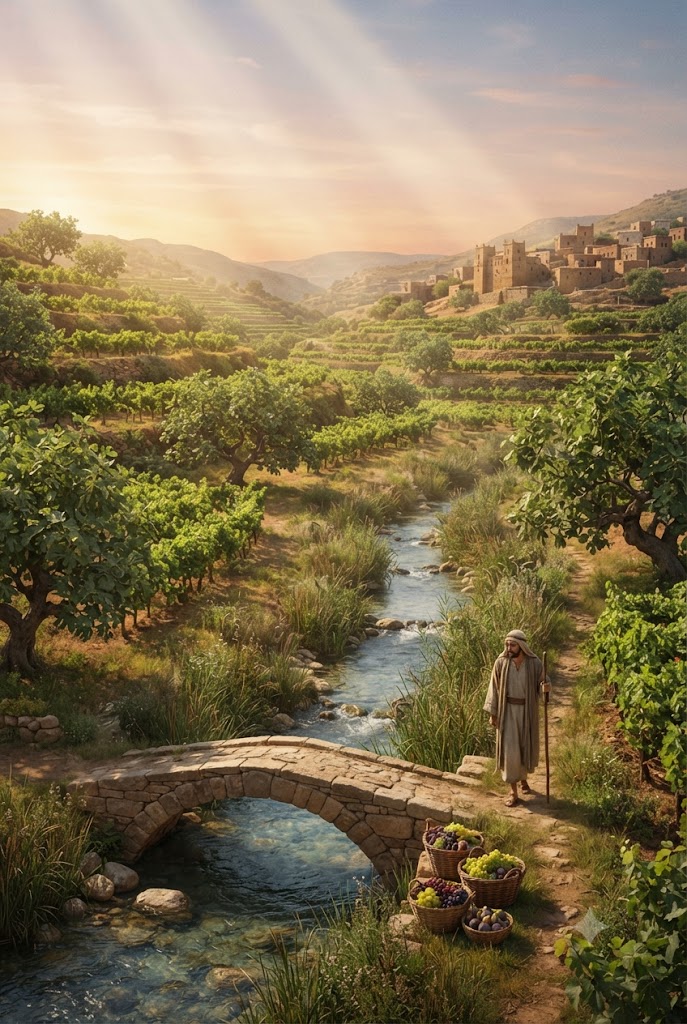
Moses vividly describes the abundance of the land of Canaan they were about to enter.
“For the LORD thy God bringeth thee into a good land, a land of brooks of water, of fountains and depths that spring out of valleys and hills; A land of wheat, and barley, and vines, and fig trees, and pomegranates; a land of oil olive, and honey… when thou hast eaten and art full, then thou shalt bless the LORD thy God for the good land which he hath given thee.”
Interestingly, this abundant description leads immediately into a warning — abundance itself was never the goal; God had to continue to be praised even amid that abundance.
ACT THREE — Lest Your Heart Become Proud (verses 11–20)
The most serious warning of this chapter follows.
“Beware that thou forget not the LORD thy God, in not keeping his commandments, and his judgments, and his statutes, which I command thee this day: Lest… thine heart be lifted up, and thou forget the LORD thy God… And thou say in thine heart, My power and the might of mine hand hath gotten me this wealth.”
My power and the might of mine hand hath gotten me this wealth. This is the most fundamental danger repeatedly warned against throughout Deuteronomy — that prosperity gives rise to the illusion of self-achievement. Moses firmly rebuts this illusion.
“But thou shalt remember the LORD thy God: for it is he that giveth thee power to get wealth, that he may establish his covenant which he sware unto thy fathers, as it is this day.”
It is he that giveth thee power to get wealth. Even the ability to acquire wealth itself was never an independent human achievement, but a gift given by God. This shift in perception — from “I have gained this” to “He gave me the power” — was the decisive line dividing faith from pride.
REFLECTION — A Memory Needed Even More When Full
What Deuteronomy 8 teaches us is that remembering God is, in fact, harder — and therefore more important — in seasons of abundance than in seasons of scarcity. In the wilderness, the daily manna naturally awakened dependence on God; but in a prosperous land, that dependence had to be consciously remembered.
Even when your life is prosperous and secure, do you consciously remember that the source of it all is not your own ability, but God’s grace?
NEXT EPISODE PREVIEW
Deuteronomy Chapter 9 — the humbling truth that the land is given not because of Israel’s righteousness, but because of God’s own faithfulness, follows.
Tags: #Deuteronomy8 #ManDothNotLiveByBreadOnly #TheWildernessWasATest #ThyRaimentWaxedNotOld #MyPowerAndTheMightOfMineHand #HeGivethTheePowerToGetWealth #Deuteronomy #BibleDevotional #ChristianBlog #BibleStudy #OldTestament #Bible #Church #Devotion #Christianity #HumilityAmidAbundance #Matthew4 #DailyDevotional