PROLOGUE — Not from the People, But from Family
Numbers 12 is one of the most personal and painful chapters in this book. Until now, resistance to Moses came from the general people. But now the challenge comes from those closest to him — his sister Miriam and his brother Aaron.
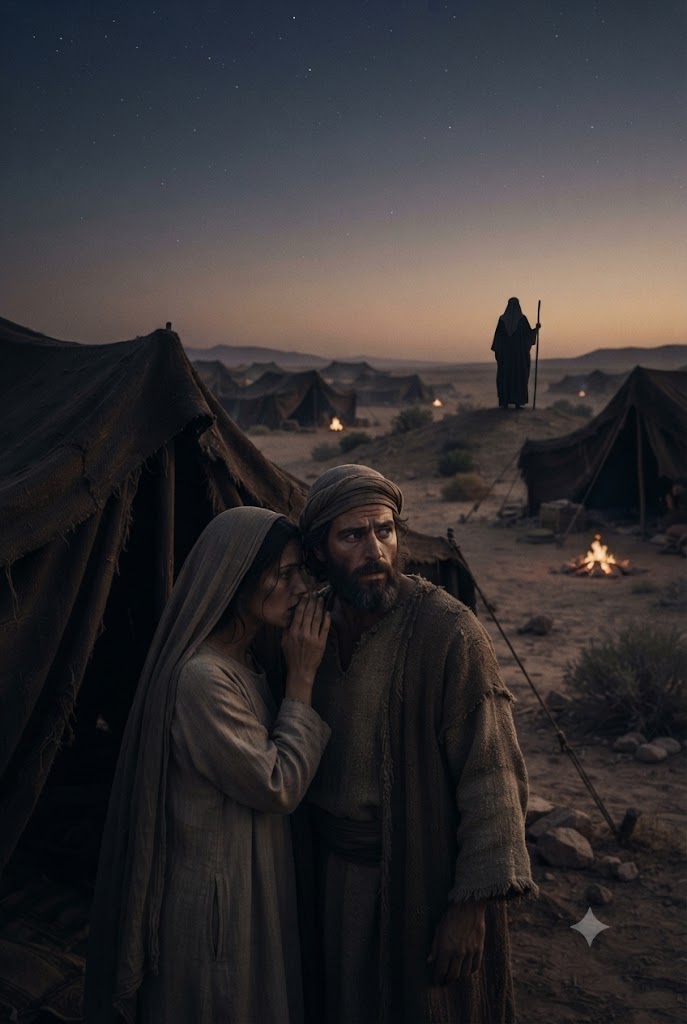
ACT ONE — Speaking Against Him Over a Cushite Wife (verses 1–2)
“And Miriam and Aaron spake against Moses because of the Ethiopian woman whom he had married: for he had married an Ethiopian woman. And they said, Hath the LORD indeed spoken only by Moses? hath he not spoken also by us? And the LORD heard it.”
Spake against Moses because of the Cushite woman. The stated reason was Moses’s marriage, but the real grievance surfaces immediately after — “Hath the LORD indeed spoken only by Moses?” This shows that behind the surface issue of ethnic prejudice lay a deeper envy over authority and position.
And the LORD heard it. This brief sentence foreshadows what follows. No matter how quietly spoken, God heard it.
ACT TWO — Moses the Meek, and God’s Direct Intervention (verses 3–9)
“Now the man Moses was very meek, above all the men which were upon the face of the earth.”
Very meek, above all the men. Moses did not defend himself. Because he would not defend himself, God intervened directly.
“And the LORD spake suddenly unto Moses, and unto Aaron, and unto Miriam, Come out ye three unto the tabernacle of the congregation… My servant Moses is not so, who is faithful in all mine house. With him will I speak mouth to mouth, even apparently, and not in dark speeches; and the similitude of the LORD shall he behold: wherefore then were ye not afraid to speak against my servant Moses?”
Mouth to mouth, even apparently. God explicitly declared that His relationship with Moses was qualitatively different from that with every other prophet. To others He spoke through visions and dreams; with Moses He spoke directly, as though face to face. This was never a declaration of Moses’s personal superiority, but a statement of how serious a challenge to God’s own established order truly was.

ACT THREE — Miriam’s Leprosy, and Moses’s Intercession (verses 10–16)
“And the cloud departed from off the tabernacle; and, behold, Miriam became leprous, white as snow: and Aaron looked upon Miriam, and, behold, she was leprous.”
The cloud departed… and Miriam became leprous. Interestingly, judgment fell only on Miriam, not on Aaron who had spoken alongside her — perhaps suggesting she was the instigator of this accusation (in the Hebrew text, Miriam’s name is mentioned first in the sentence structure).
But the most moving part of this chapter follows.
“And Aaron said unto Moses… let her not be as one dead… And Moses cried unto the LORD, saying, Heal her now, O God, I beseech thee.”
Heal her now, O God, I beseech thee. Moses interceded for the very sister who had spoken against him. His meekness was never mere silence — it flowed into active forgiveness and mercy.
God healed her, but had her remain outside the camp for seven days — consequence still followed, but it was not total exclusion.
REFLECTION — Wounds from Those Closest to Us, and a Meek Response
Numbers 12 teaches us a deeply realistic truth — the deepest wounds often come from those closest to us. But Moses’s response shows us a different path. He did not defend himself; instead, he prayed for the very person who had spoken against him.
When wounded by someone close to you, can you intercede for them rather than defend yourself?
NEXT EPISODE PREVIEW
Numbers Chapter 13 — twelve men are sent to spy out the land of Canaan, and their report becomes the decisive turning point that changes Israel’s fate.
Tags: #Numbers12 #MiriamAndAaronSpeakAgainstMoses #VeryMeekAboveAllMen #MouthToMouth #MiriamsLeprosy #MosesIntercession #Numbers #BibleDevotional #ChristianBlog #BibleStudy #OldTestament #Bible #Church #Devotion #Christianity #WoundsFromThoseClose #HealHerNowOGod #DailyDevotional