Genesis Chapter 16
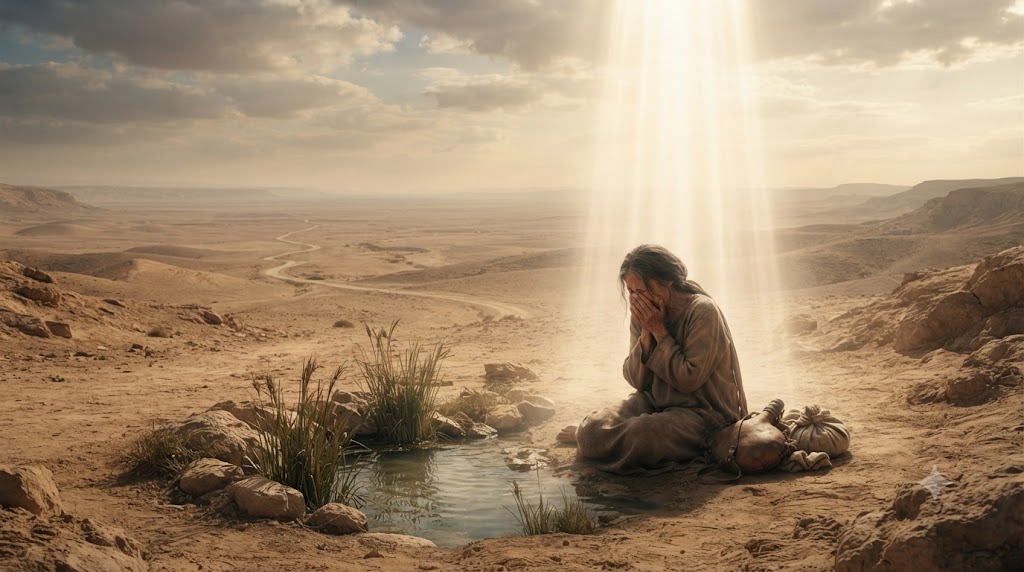
🔥 Prologue — A Heavy, Realistic Silence Following the Cosmic Display of Stars
The breathtaking emotion of the Torch Covenant—where God directed Abram outside to view the cosmos, promising “so shall your offspring be”—gradually dissolved into a heavy, protracted silence. A staggering ten years had marched past since they occupied the territory of Canaan, yet Sarai’s womb remained completely locked, devoid of any vital biological activity. The divine decree seemed entirely suspended in the heavens, while the cruel reality of their aging bodies confronted them inside the tent every single morning.
Ultimately, the exhaustion of human waiting forced open a compromised threshold. Abandoning the timing of the Lord, Sarai introduced a common cultural substitute of the ancient Near East, delivering her Egyptian servant Hagar into Abram’s embrace. Yet, the tactical alternative manufactured by human intellect birthed intense domestic friction and bitter alienation rather than covenant blessing. Discover the poignant chronicle of a vulnerable servant weeping in a desolate desert, and the gentle, sovereign Voice that intercepted her at the spring of despair.
🌙 Act One — Sarai’s Calculated Proposal, Hagar’s Pregnancy, and Domestic Fracture (Verses 1–6)
Now Sarai, Abram’s wife, had borne him no children. But she had an Egyptian slave named Hagar; so she said to Abram, “The LORD has kept me from having children. Go, sleep with my slave; perhaps I can build a family through her.” Abram agreed to what Sarai said. So after Abram had been living in Canaan ten years, Sarai his wife took her Egyptian slave Hagar and gave her to her husband to be his wife.
“He slept with Hagar, and she conceived. When she knew she was pregnant, she began to despise her mistress…”
Then Sarai said to Abram, “You are responsible for the wrong I am suffering. I put my slave in your arms, and now that she knows she is pregnant, she despises me. May the LORD judge between you and me.” Abram replied, “Your slave is in your hands. Do with her whatever you think best.” Then Sarai mistreated Hagar; so she fled from her. Human impatience had successfully planted a volatile seed that dismantled the emotional sanctuary of the home.
💛 Act Two — The Angel of the LORD Intercepting the Runaway Slave (Verses 7–12)
The angel of the LORD found Hagar near a spring in the desert; it was the spring that is beside the road to Shur. And he said, “Hagar, slave of Sarai, where have you come from, and where are you going?” The Creator was completely aware of her identity and her affliction. She answered, “I’m running away from my mistress Sarai.”
The angel of the LORD commanded her, “Go back to your mistress and submit to her,” but immediately cushioned this heavy instruction with a massive, sovereign legacy promise:
“I will increase your offspring so much that they will be too numerous to count…”
The angel of the LORD also said to her: “You are now pregnant and you will give birth to a son. You shall name him Ishmael, for the LORD has heard of your misery.” The divine nomenclature ‘Ishmael’ explicitly translates to ‘God Hears.’ Though he was a child conceived through a compromised human detour, the Lord refused to ignore the crying of an Egyptian slave in the wilderness. He added, “He will be a wild donkey of a man; his hand will be against everyone and everyone’s hand against him, and he will live in hostility toward all his brothers.”
👐 Act Three — Beer Lahai Roi, The Sovereign God Who Sees (Verses 13–16)
Hagar responded to this supernatural intervention by carving a profound name over the presence of the LORD who spoke to her.
“She gave this name to the LORD who spoke to her: ‘You are the God who sees me’…”
For she said, “I have now seen the One who sees me.” That is why the well was called Beer Lahai Roi (the well of the Living One who sees me); it is still there, between Kadesh and Bered. Inside the patriarch’s estate, she was treated as an invisible, disposable foreigner, but in the desolate contours of the desert, the Living God explicitly traced her coordinates.
So Hagar bore Abram a son, and Abram gave the name Ishmael to the son she had borne. Abram was eighty-six years old when Hagar bore him Ishmael. Years had trickled away since the global treaty of fire was finalized, but before the genuine covenant child Isaac could emerge, the tents of Abram echoed loudly with the crying of Ishmael—the permanent signature of human deliberation.
🕊️ Reflection — The Detours of Our Design Versus the Remnant Spring of El Roi
Genesis Chapter 16 maps out the severe emotional and spiritual consequences that unravel when we attempt to execute divine promises using human velocity, contrasted with the breathtaking manner in which God personally tracks down a discarded soul caught in the crossfire of our failures. When our prayers enter an extended season of divine silence, we easily become paralyzed like Sarai. We manufacture resentment, concluding “the Lord has kept me from fulfillment,” and lunge for a logical worldly alternative (the Egyptian servant Hagar). We successfully birth an ‘Ishmael’—a monument to our own striving—only to discover it introduces friction, isolation, and deep systemic dysfunction into our immediate spheres.
Yet, the ultimate sanctuary of this narrative is found in the fact that the Almighty personally stepped onto the desert path to intercept a running slave. Wiping away the tears of an outsider who was heavily mistreated inside a faith community, He declared, “I have heard your misery.” The reality of Beer Lahai Roi—the well of the Living One who sees me—remains an active spiritual fountain for anyone weeping in a personal desert today. “Today, are you panicking under a prolonged delay, exhaustively working to manufacture an Ishmael in your own strength? Or have you been wounded by the calculations of others, driven out into a lonely, dry wilderness? Will you stop running, turn your face to the horizon, and drop your anchors beside the Living God who intimately tracks your tears and hears your misery?”
📣 Coming Up Next
Genesis Chapter 17 — The Covenant of Circumcision: I Am God Almighty, Walk Before Me and Be Blameless Following a staggering thirteen years of absolute silence after the birth of Ishmael, God re-enters the canvas of Abram’s 99-year-old life. Discover the narrative of the changing of names to Abraham and Sarah, and the institutionalization of the cutting of circumcision as an eternal token of blood in our next episode.
#Genesis16 #HagarAndIshmael #SaraisImpatience #BeerLahaiRoi #TheGodWhoSeesMe #SpringInTheDesert #HumanStriving #Christian #Bible #Meditation #Genesis #TheWord #BibleStudy #Church #ChristianBlog #BibleMeditation