🔥 Prologue — The Cosmic Weight Hidden in a Sticky Ritual
One phrase recurs throughout the Bible with a frequency that demands explanation.
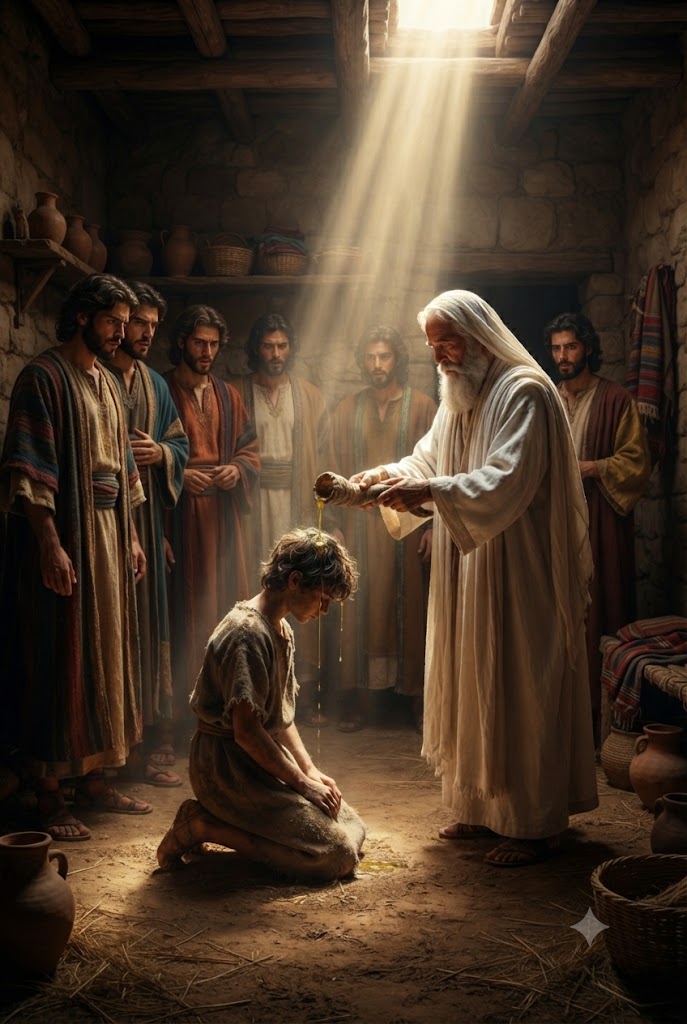
“And he anointed him.”
When kings were crowned. When priests were commissioned. When prophets were called. Oil was poured. And this endlessly repeated ritual compressed itself into a single Hebrew word.
Mashiach (מָשִׁיחַ). The Anointed One.
In Greek translation — Christos (Χριστός).
Christ.
The name we speak every day — Jesus Christ — carries inside it the entire history of anointing in the ancient world. Thousands of years of poured oil. Centuries of consecrated kings and priests. The accumulated weight of every anointing Israel ever knew — compressed into one name.
What was this ritual? Why oil, of all substances? What specific oil was used? And how does all of this converge in Jesus of Nazareth? These questions deserve deep answers.
🫒 Act One — Understanding the Oil Itself: The Cultural Weight of Olive Oil
① What Olive Oil Meant in the Ancient World
To modern readers, olive oil is a kitchen staple — a commodity on a supermarket shelf.
In ancient Israel and the broader ancient Near East, olive oil occupied an entirely different position in human life and consciousness.
Medical function: Olive oil was the preeminent medicine of the ancient world. Applied to wounds, it protected skin, prevented infection, and promoted healing. When the Good Samaritan poured oil on the injured man’s wounds (Luke 10:34), the action was not symbolic — it was the most effective medical treatment available.
Illuminating function: Oil was the fuel of the Temple menorah. It produced light. It drove back darkness. It kept the sacred space visible and functioning. Without oil, the sanctuary went dark.
Nutritional function: Oil was both food and the medium through which food was prepared. The grain offerings of the Temple were mixed with oil — the finest of what Israel produced, offered to God.
Economic function: Oil functioned as currency. Taxes were paid in oil. Trade was conducted in oil. A household’s wealth could be measured in its oil reserves. To pour oil on someone was to pour value on them.
Consecrating function: And finally — oil was the instrument of holy separation. It set apart. It distinguished the sacred from the ordinary.
All five of these functions were loaded into a single substance. Healing, light, life, wealth, holiness. When that substance was poured over a person’s head, all of these meanings descended with it. The person received, in a single tangible act, the declaration that they were now carriers of healing, light, life, value, and sacred distinction.
② The Sacred Anointing Oil — Not Ordinary Olive Oil
The oil used in anointing ceremonies was not common kitchen oil. God gave Moses the precise formula for a specialized compound — a blend of extraordinary materials that made this oil radically different from anything else in Israelite life.
“Take the following fine spices: 500 shekels of liquid myrrh, half as much of fragrant cinnamon, 250 shekels of fragrant calamus, 500 shekels of cassia — all according to the sanctuary shekel — and a hin of olive oil.” (Exodus 30:23–24)
Five ingredients. Olive oil as the base. Four rare and expensive spices added to it.
Each ingredient carried its own resonance.
Myrrh: The most precious aromatic substance of the ancient Near East, imported from Arabia and East Africa at extraordinary cost. Myrrh was used in royal anointing — and in burial anointing. It was the gift the Magi brought to the infant Jesus, traditionally interpreted as a gift prophetically marking his death. The substance of coronation and the substance of burial were the same — myrrh connected kingship and death in a single aromatic molecule.
Cinnamon and Cassia: Imported from Ceylon and China along trade routes of immense length and cost. These spices would have represented, in today’s terms, hundreds of thousands of dollars in raw material. Their presence in the anointing oil was a statement about the incomparable value of the person being anointed.
Calamus (Fragrant Reed): An aromatic reed associated with marshes and water sources. Its aquatic associations made it a natural symbol for the flowing, life-giving movement of the Spirit — water imagery was frequently used in Hebrew Scripture to describe the Spirit’s activity.
The result of blending these ingredients into olive oil was a compound of extraordinary rarity and value. When this oil was poured on a person, it was not a token gesture. It was the pouring of the most costly thing Israel possessed. The extravagance was the statement.
👑 Act Two — Three Offices, Three Anointings: Kings, Priests, and Prophets
① The Anointing of Kings — Where Does Authority Come From?
In ancient Israel, the anointing of a king was not a ceremony of state conferring authority through an institutional chain. It was something entirely different — a divine commission expressed through a human act.
The king’s authority did not originate in the military, the aristocracy, or hereditary right. It originated in God. And the anointing declared this publicly, unmistakably, and permanently.
When Samuel anointed Saul as Israel’s first king, the language was exact:
“Samuel took a flask of olive oil and poured it on Saul’s head and kissed him, saying, ‘Has not the Lord anointed you ruler over his inheritance?'” (1 Samuel 10:1)
The Lord has anointed you. Samuel was the instrument. God was the actor.
The anointing of David was even more revelatory:
“So Samuel took the horn of oil and anointed him in the presence of his brothers, and from that day on the Spirit of the Lord came powerfully upon David.” (1 Samuel 16:13)
In the moment of physical anointing — the Spirit of the Lord came. The outward sign and the inward reality were simultaneous. The oil did not cause the Spirit to come; it was the visible marker of the Spirit’s arrival.
And the reverse was equally true. When the Spirit withdrew from Saul:
“Now the Spirit of the Lord had departed from Saul, and an evil spirit from the Lord tormented him.” (1 Samuel 16:14)
Anointing = Spirit’s presence. Spirit’s departure = end of anointed kingship. The equation was explicit.
David’s refusal to harm Saul — even when he had the opportunity, and even when Saul was actively trying to kill him — rested entirely on this principle:
“The Lord forbid that I should do such a thing to my master, the Lord’s anointed.” (1 Samuel 26:11)
The Lord’s anointed — meshiach Yahweh in Hebrew — was inviolable. Not because of personal worth, not because of political position, but because the anointing placed the person under divine protection. To strike the Lord’s anointed was to strike at God’s own choice.
② The Anointing of Priests — The Transfer of Holiness
The priestly anointing was functionally different from the royal anointing. Where the royal anointing transferred authority, the priestly anointing transferred holiness.
When Aaron was installed as Israel’s first high priest, Moses poured the anointing oil on his head:
“He poured some of the anointing oil on Aaron’s head and anointed him to consecrate him.” (Leviticus 8:12)
The theological necessity of this anointing was acute. The high priest entered the Holy of Holies — the innermost sanctuary where God’s presence rested between the cherubim above the ark. Any unholiness in the presence of God’s perfect holiness was instantly lethal. The unapproachable holiness of God would consume the impure as fire consumes dry wood.
The priest therefore needed to be covered in something that made him capable of surviving the divine presence. The anointing oil was not primarily about authority — it was about protection. Consecration. Being made suitable to enter a space that would destroy anything less than holy.
Psalm 133 captures this in extraordinary poetry:
“It is like the precious oil poured on the head, running down on the beard, running down on Aaron’s beard, down on the collar of his robe.” (Psalm 133:2)
The image is of oil flowing from the head downward — from Aaron, as high priest, through the priestly community, and from the priesthood into the life of the nation. The anointing was not merely personal. It created a channel of divine blessing flowing from the consecrated person into the wider community.
③ The Anointing of Prophets — The Rarest and Most Mysterious
Of the three offices, the prophetic anointing was the least frequently described through physical ritual — and the most spiritually transparent in its nature.
The clearest example is suggestive rather than prescriptive. When God commanded Elijah to anoint Elisha as his prophetic successor (1 Kings 19:16), Elijah’s actual action was to throw his cloak over Elisha — not to pour oil on his head. Yet the effect was identical to an anointing: Elisha received the call, responded, and entered his prophetic ministry.
This tells us something important: the physical oil was always a sign of a spiritual reality. The reality could arrive without the sign when God chose to dispense with the outward form.
Isaiah 61 records a prophet experiencing this spiritual anointing directly:
“The Spirit of the Sovereign Lord is on me, because the Lord has anointed me to proclaim good news to the poor.” (Isaiah 61:1)
The Lord has anointed me — not a human mediator, but God himself. The oil was the Spirit. The anointing was the Spirit’s arrival. No priest, no ceremony, no flask of compound oil — only the direct act of God consecrating and commissioning his prophet.
It was this passage that Jesus read in the synagogue in Nazareth at the beginning of his public ministry, then sat down and declared: “Today this scripture is fulfilled in your hearing.” (Luke 4:21)
Jesus identified himself as the fulfillment of this prophetic anointing. The prophet anointed directly by God’s Spirit — that was Jesus, who had received not oil but the Spirit of God himself at his baptism.
🌊 Act Three — The Shepherd and the Sheep: The Practical Background of Anointing
① The Nose Fly and the Oil — Psalm 23’s Hidden Image
“You anoint my head with oil; my cup overflows.” (Psalm 23:5)
This verse contains a pastoral detail invisible to most modern readers — a detail that transforms the image from abstract theological statement to vivid and protective action.
In the dry heat of an Israeli summer, shepherds faced a specific and lethal threat to their flocks: the nose fly (Oestrus ovis). This parasite laid its eggs in the soft tissue around the sheep’s nostrils, eyes, and ears. The larvae would hatch and burrow into the sheep’s skull, causing a maddening inflammation that drove the animal to distraction — smashing its head against rocks, running wildly, endangering itself and the flock.
Infested flocks lost the ability to rest, graze, or function. A flock in the grip of nose fly season was a flock in chaos.
The shepherd’s remedy was precise: a mixture of olive oil and sulfur, applied thoroughly to the sheep’s head and face. The oil created a barrier the fly could not penetrate. A properly oiled sheep could lie down in green pastures — even in midsummer — without the torment of infestation.
Psalm 23 places this image immediately after “Even though I walk through the darkest valley” — the shadow of death, the presence of enemies. The sheep faces real threats. The shepherd does not remove the threats. He anoints the sheep’s head with oil. And the sheep rests.
The theological application is precise. God does not always remove our enemies or eliminate our dangers. But he anoints our heads — covers us with the protection that our greatest threats cannot penetrate. And in the presence of enemies, our cup overflows.
② The Oil on Wounds — The Language of Healing
The healing function of oil created another theological dimension to the anointing tradition.
James 5:14–15 connects anointing and healing explicitly in the life of the Church:
“Is anyone among you sick? Let them call the elders of the church to pray over them and anoint them with oil in the name of the Lord. And the prayer offered in faith will make the sick person well.”
The anointing of the sick combined physical and spiritual realities in a way that resists modern categorization. It was not merely medical (applying oil to a wound) and not merely symbolic (a ritual gesture). It was the physical enactment of bringing the sick person under the protection, healing, and consecrating care of God.
The act said: this person’s suffering is being brought before God. This body is being placed in God’s hands. The healing we pray for comes not from our competence but from the power that the oil represents — the Spirit of the one who anoints.
✡️ Act Four — The Messiah: The Final and Ultimate Anointing
① From Hebrew to Greek: Messiah = Christ
The Hebrew word Mashiach (מָשִׁיחַ) derives from the verb mashach (מָשַׁח) — to pour, to smear, to anoint. It literally means the anointed one.
In the Septuagint — the Greek translation of the Hebrew Bible produced approximately 250 BCE — mashiach was consistently rendered as Christos (Χριστός), from the Greek verb chriō (χρίω): to anoint.
Jesus Christos is therefore, etymologically and theologically, Jesus the Anointed One.
But this name is not merely a title. It is the compression of an entire historical institution into a person. The name carries within it every royal anointing, every priestly consecration, every prophetic commission that Israel had ever known.
The royal anointing is in this name — Jesus came as the Son of David, the eternal King. The priestly anointing is in this name — Jesus is, as Hebrews declares, “a priest forever, in the order of Melchizedek” (Hebrews 7:17), the great high priest who offered himself as the sacrifice. The prophetic anointing is in this name — Jesus came as the fulfillment of Isaiah 61, the one upon whom the Spirit of the Sovereign Lord rested to proclaim good news to the poor.
Three offices. One name. One anointing. Christ.
② The Baptism of Jesus — The Most Public Anointing
When Jesus began his public ministry, he came to John for baptism in the Jordan River. What happened at that moment was the most public and spectacular anointing in biblical history.
“As soon as Jesus was baptized, he went up out of the water. At that moment heaven was opened, and he saw the Spirit of God descending like a dove and alighting on him. And a voice from heaven said, ‘This is my Son, whom I love; with him I am well pleased.'” (Matthew 3:16–17)
No anointing oil. No human priest. No flask of myrrh-infused compound. Instead: the Spirit of God himself descended. The invisible reality that the oil had always signified arrived in its actual form.
All three persons of the Trinity were present and active simultaneously. The Son received the anointing. The Spirit descended as the anointing itself. The Father declared the identity of the anointed one. The fullness of the Godhead gathered at the river Jordan for the consecration of the one toward whom every previous anointing had been pointing.
The act of Peter’s sermon at Pentecost named this event directly:
“God anointed Jesus of Nazareth with the Holy Spirit and power.” (Acts 10:38)
God anointed Jesus. The divine anointing — not oil, but Spirit — was the source of everything Jesus did.
③ Mary’s Perfume — The Anointing for Death
At the end of Jesus’s public ministry, one of the most theologically charged anointing scenes in Scripture unfolded in Bethany.
“A woman came to him with an alabaster jar of very expensive perfume, which she poured on his head as he was reclining at the table.” (Matthew 26:7)
The disciples were indignant. Waste. Extravagance. The perfume could have been sold for a year’s wages.
Jesus silenced them:
“She poured this perfume on my body to prepare me for burial.” (Matthew 26:12)
Royal anointing for burial. Not the anointing of coronation — the anointing of death. The myrrh in the anointing oil had always carried the double resonance of kingship and burial. In Bethany, the two converged. Mary poured funeral oil on the living Messiah, anointing the body that would go to the cross.
And Jesus enshrined this act with extraordinary honor:
“Truly I tell you, wherever this gospel is preached throughout the world, what she has done will also be told, in memory of her.” (Matthew 26:13)
The anointing of death would be remembered wherever the good news of resurrection was proclaimed.
🌍 Act Five — The Geography of Anointing
① The Wilderness Tabernacle — A Moving Anointing Place
The first official anointing ceremony in Israel’s history took place in the wilderness tabernacle — a portable sanctuary that accompanied Israel through forty years of desert wandering.
The geographical stage for this event is today’s Sinai Peninsula — the triangular landmass east of the Suez Canal, politically part of modern Egypt. The traditional location of Mount Sinai (Horeb), where Moses received the Law and the instructions for the Tabernacle, is identified by many scholars with Jebel Musa in the southern Sinai — a 2,285-meter peak still visited by pilgrims today.
In the desert beneath these mountains, Israel’s priestly system was established. Aaron and his sons were anointed. The Tabernacle and its furnishings were consecrated with oil. The nation’s covenant relationship with God was given its institutional form.
This barren desert cradle is where anointing became Israel’s defining sacramental act.
② The Jerusalem Temple — The Permanent Center of Anointing
When the wandering ended and Solomon built the permanent Temple in Jerusalem, anointing found its enduring geographical home.
The Temple was constructed on Mount Moriah — the same mountain where Abraham had brought Isaac, where David had erected an altar on the threshing floor of Araunah, where the city of Jerusalem and its sacred center would stand for centuries.
Today, this site is known as the Temple Mount (Har HaBayit) — a 36-acre elevated platform in the eastern quarter of Jerusalem’s Old City. On this platform currently stands the Dome of the Rock — one of Islam’s holiest sites, constructed in 691 CE. At the center of the Dome is the Foundation Stone (Even HaShetiyyah) — the sacred rock that Jewish tradition identifies as the site of the Holy of Holies, the innermost sanctuary of both the First and Second Temples.
On this ground — the most contested religious real estate on earth — Israel’s kings were anointed. High priests were consecrated. The prophets stood and spoke. The entire anointing tradition of the Hebrew Bible converged on this small elevated platform in the Judean hills.
And it was in Jerusalem — in proximity to this sacred mountain — that Jesus died, was buried, and rose. The one toward whom all anointing had been pointing accomplished his work in the city that anointing had made holy.
③ Gethsemane — The Garden Whose Name Means Oil Press
The last night of Jesus’s earthly freedom was spent in Gethsemane.
The word Gethsemane comes from the Aramaic Gat Shemanim (גַּת שְׁמָנִים) — meaning oil press or place where olives are pressed.
An olive press is the machine that extracts oil from olive fruit through crushing pressure. You place the olive in the press. You apply weight. The olive is crushed. And from the crushing, the oil flows.
The Messiah — the Anointed One — spent his night of ultimate anguish in a place literally named the olive press. He was pressed there. The weight of the world’s sin was applied. Sweat like drops of blood fell to the ground. And from this pressing — the ultimate anointing flowed. Not oil from olives, but life from death. Not ritual consecration, but cosmic redemption.
Gethsemane is located on the western slope of the Mount of Olives (Har HaZeitim) — directly east of the walls of the Old City of Jerusalem, across the Kidron Valley. The site today is marked by the Church of All Nations (Basilica of the Agony), built over the traditional location of Jesus’s prayer. Within the church’s grounds stand several ancient olive trees believed to date to the first century — the very trees, according to tradition, beneath which Jesus knelt in his final hours.
They are still alive. Still producing olives. Still bearing oil.
🕊️ Act Six — The Anointing That Comes to All Believers
① Every Believer Is an Anointed One
In the Old Testament, anointing was restricted to specific individuals in specific offices. Kings, priests, prophets — the exceptional few whom God selected for exceptional roles.
The New Testament radically expands this.
“But you are a chosen people, a royal priesthood, a holy nation, God’s special possession.” (1 Peter 2:9)
Royal priesthood. In the Old Testament, combining the royal and priestly offices was forbidden — King Uzziah’s attempt to perform priestly duties resulted in his being struck with leprosy (2 Chronicles 26:16–21). Yet the New Testament declares that every believer occupies both offices simultaneously.
John’s first letter makes the anointing explicit:
“But you have an anointing from the Holy One, and all of you know the truth.” (1 John 2:20)
You have an anointing from the Holy One. Every believer. Not a special category of Christian. Every person in whom the Spirit of God dwells has received the anointing that was once reserved for kings and priests and prophets.
The name Christian — Christianos in Greek — carried this meaning from its first use. It did not merely mean follower of Christ. It meant one who belongs to the Anointed One, one who participates in his anointing. The community of Christians was the community of the anointed.
② The Spirit as the Oil — The New Testament’s Completion of the Image
On the day of Pentecost, the Spirit descended on the gathered disciples. Not oil, but fire. Not a physical substance, but the very presence of God.
This was the fulfillment of every anointing Israel had ever known — not the sign, but the reality. Not the oil that pointed to the Spirit, but the Spirit himself.
Paul drew the connection explicitly:
“Now it is God who makes both us and you stand firm in Christ. He anointed us, set his seal of ownership on us, and put his Spirit in our hearts as a deposit, guaranteeing what is to come.” (2 Corinthians 1:21–22)
God has anointed us. The Spirit in our hearts is the anointing. The same Greek verb used for the anointing of kings and priests — chriō — is used here for what God has done to every believer.
The anointing has come to all who are in the Anointed One. The oil has become the Spirit. The ritual has become reality.
🌟 Reflection — You Anoint My Head with Oil
Return to Psalm 23:5.
“You anoint my head with oil; my cup overflows.”
The enemies were present. The valley was dark. The flies were threatening.
But the Shepherd anointed. And that was enough. The oil protected. The oil healed. The oil set apart. The oil commissioned. The cup overflowed.
Today, the same anointing is available to every believer. In Jesus Christ — the Anointed One — the Spirit of God comes to rest on all who belong to him. That Spirit covers you. Distinguishes you. Protects you. Empowers you.
You are anointed.
In the presence of enemies, in the middle of wilderness, in the season when the flies threaten — God anoints your head. And the cup overflows.
The oil that once ran down Aaron’s beard is now flowing — invisibly, inwardly, permanently — in every heart where the Spirit of God has made his home.
“Has the anointing come to you? In Christ, you are the anointed one — set apart, commissioned, protected, and empowered by the Spirit who is the true oil. That changes everything.”
#Anointing #Messiah #Christ #HolySpirit #Mashiach #Christos #BiblicalHebrew #KingPriestProphet #AnointingOil #Gethsemane #TempleMountJerusalem #BibleStudy #OldTestament #ChristianBlog #BiblicalTheology #Scripture #ChristianFaith #GodsPresence #SpiritOfGod #JesusChrist