Leviticus Series — Episode 10
😢 Prologue — Judgment Arriving Right After a Moment of Glory
Chapter 9 reached its climax with fire descending from heaven and the glory of the LORD.
But Leviticus 10 shifts, before that glorious moment has even faded, into an event of an entirely different character. Aaron’s two sons, Nadab and Abihu, die. This sudden tragedy is one of the most shocking scenes in all of Scripture, soberly reminding us that holiness can never be treated lightly.
🔥 Act One — Strange Fire, Sudden Death (Verses 1–7)
“Then Nadab and Abihu, the sons of Aaron, each took his censer and put fire in it, put incense on it, and offered profane fire before the LORD, which He had not commanded them.”
Fire which He had not commanded them. This short phrase is the heart of this tragedy. The text does not explain in detail exactly what went wrong. Perhaps they were hasty, or careless, or failed to follow the prescribed procedure. But what is clear is that they approached in a manner God had not commanded.
The consequence was immediate.
“So fire went out from the LORD and devoured them, and they died before the LORD.”
Fire went out from the LORD. This expression is exactly identical to the one used in chapter 9. But where in chapter 9 that fire had been a sign of grace, accepting the offering, here it functioned in precisely the opposite way. The same fire appeared as confirmation for obedience, and as judgment for disobedience.
Moses explains the meaning of this event.
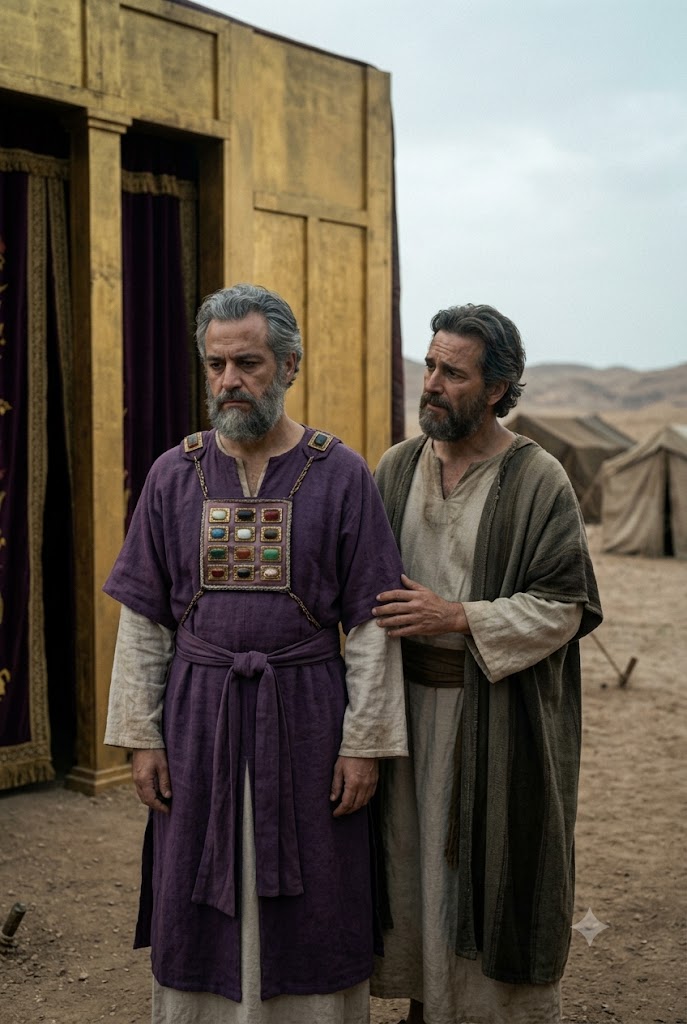
“And Moses said to Aaron, ‘This is what the LORD spoke, saying: “By those who come near Me I must be regarded as holy; and before all the people I must be glorified.”‘ So Aaron held his peace.”
So Aaron held his peace. This short sentence is one of the heaviest silences in all of Scripture. At the moment a father lost two sons so suddenly, he did not protest, did not complain. His silence was grief, and at the same time, submission before the holiness of God.
Moses continues with practical instructions.
“Then Moses called Mishael and Elzaphan, the sons of Uzziel the uncle of Aaron, and said to them, ‘Come near, carry your brethren from before the sanctuary out of the camp.'”
And a solemn command is given to Aaron and his remaining sons.
“You shall not uncover your heads nor tear your clothes, lest you die, and wrath come upon all the people.”
Even the ordinary gestures of mourning—loosening the hair, tearing garments—were forbidden. Those in the priestly position had to place their sacred office above their personal grief.
🍷 Act Two — Wine and Strong Drink Forbidden (Verses 8–11)
Immediately after this tragedy, God gives Aaron a new regulation directly.
“Then the LORD spoke to Aaron, saying: ‘Do not drink wine or intoxicating drink, you, nor your sons with you, when you go into the tabernacle of meeting, lest you die. It shall be a statute forever throughout your generations.'”
Do not drink wine or intoxicating drink. It is significant that this regulation appears immediately after the deaths of Nadab and Abihu. Many commentators see these two events as connected—perhaps hinting that their carelessness was related to intoxication.
And the purpose of this regulation is stated explicitly.
“That you may distinguish between holy and unholy, and between unclean and clean.”
Distinguish between holy and unholy. This was the point. The priest’s role was, at its core, a role of discernment. A drunken mind could not carry out that careful discernment.
🍞 Act Three — Eating the Remaining Offerings, and Moses’ Anger (Verses 12–20)
After the tragedy, life had to continue. Moses instructs the remaining sons to eat their portion of the grain offering and peace offering.
“The grain offering… eat it in a holy place, in the court of the tabernacle of meeting… for it is most holy.”
But Moses then finds a problem in how the sin offering had been handled.
“Then Moses made careful inquiry about the goat of the sin offering, and there it was—burned up. And he was angry with Eleazar and Ithamar, the sons of Aaron who were left, saying, ‘Why have you not eaten the sin offering in a holy place?'”
Moses was angry. This shows that, even on this tragic day, precise obedience to the regulations still mattered. Grief did not nullify the regulations.
But Aaron’s response was remarkably wise.
“And Aaron said to Moses, ‘Look, this day they have offered their sin offering and their burnt offering before the LORD, and such things have befallen me! If I had eaten the sin offering today, would it have been accepted in the sight of the LORD?'”
In this response, Aaron judged that, on this day of grief over losing two sons, eating that meat would not have suited the true spirit of worship. And remarkably—
“So when Moses heard that, he was content.”
Moses accepted Aaron’s judgment. This shows that the regulations were never merely mechanical rules—they required the wisdom to understand and apply their underlying spirit.
🕊️ Reflection — Silence Before Holiness, and the Wisdom of Discernment
The truth that presses most heavily upon us in Leviticus 10 is Aaron’s silence. A father who had lost two sons so suddenly did not protest—he remained silent. This is not an easy lesson for us. But it shows that, before God’s holiness, there are moments that go beyond our own understanding.
And the regulation forbidding wine. This teaches that clear-mindedness and discernment are essential for those who carry out holy work.
Finally, that brief exchange between Moses and Aaron. This shows that precisely keeping a regulation, and understanding the spirit of that regulation, must go together. Just as Moses accepted Aaron’s wise judgment, we too must sometimes discern the underlying spirit of a rule, rather than only its letter.
Can you, like Aaron, remain silently submissive even before a moment you cannot understand?
📣 Coming Up Next
Leviticus Chapter 11 — Regulations concerning clean and unclean food follow. Through what to eat and what not to eat, we see how holiness extends even to the ordinary dinner table, in the story that unfolds in the next episode.
Tags: #Leviticus10 #NadabAndAbihu #StrangeFire #AaronHeldHisPeace #WineAndStrongDrinkForbidden #DistinguishHolyAndUnholy #TheConversationBetweenMosesAndAaron #Leviticus #BibleStudy #ChristianBlog #OldTestament #Scripture #Church #DailyDevotional #BiblicalFaith #GodsWord