Leviticus Series — Episode 6
🔥 Prologue — From the Worshiper’s View to the Priest’s
From chapter 1 through chapter 5, Leviticus explained each offering from the worshiper’s perspective.
But starting in Leviticus 6, the perspective shifts. The text now addresses how the priests themselves were to handle each offering—detailed, practical instructions. And at the center of this chapter stands a deeply symbolic image: a fire on the altar that must never be allowed to go out.

🔥 Act One — The Fire of the Altar Must Never Go Out (Verses 1–13)
First, the priest’s practical duties concerning the burnt offering are explained.
“The burnt offering shall be on the hearth upon the altar all night until morning, and the fire of the altar shall be kept burning on it.”
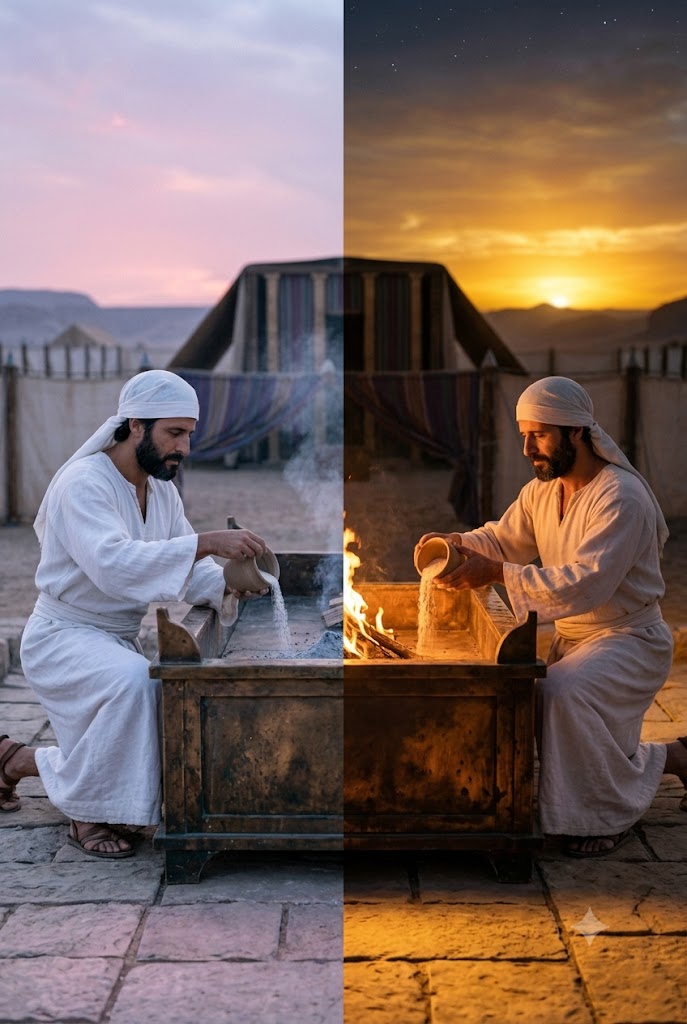
All night until morning, kept burning. This expression recalls once more the image of continual fire and lamp already mentioned in Exodus 27 and 30. The fire of the altar was never to go out, not even for a single day.
The morning ritual is specifically regulated.
“And the priest shall put on his linen garment, and his linen trousers he shall put on his body, and take up the ashes of the burnt offering which the fire has consumed on the altar, and he shall put them beside the altar.”
Wearing linen garments. This pure clothing shows that even this humble task of handling ashes had to be treated as a holy procedure.
And fresh wood had to be added every single day.
“And the priest shall burn wood on it every morning, and lay the burnt offering in order on it; and he shall burn on it the fat of the peace offerings. A fire shall always be burning on the altar; it shall never go out.”
Within this passage, the expression “a fire shall always be burning on the altar; it shall never go out” is emphasized repeatedly. This was not accidental style—it was a theological declaration that Israel’s worship must never be interrupted.
🌾 Act Two — The Grain Offering and the Priests’ Portion (Verses 14–23)
Now the priestly regulations concerning the grain offering follow.
“This is the law of the grain offering: The sons of Aaron shall offer it on the altar before the LORD… he shall take from it his handful of the fine flour of the grain offering, with its oil, and all the frankincense which is on the grain offering, and shall burn it on the altar for a sweet aroma, as a memorial to the LORD.”
The principle already addressed in chapter 2 is reaffirmed here, along with the confirmation that the rest becomes the priests’ portion.
But a new regulation appears in this chapter—a daily grain offering for the priests themselves.
“This is the offering of Aaron and his sons, which they shall offer to the LORD, beginning on the day when he is anointed: one-tenth of an ephah of fine flour as a daily grain offering, half of it in the morning and half of it at night.”
In the morning, and at night. The priests themselves were no exception. They too had to offer their own grain offering every single day. This shows that even those in a position to intercede and serve on behalf of others could not neglect coming continually before God themselves.
And an interesting regulation is added regarding this offering.
“For every grain offering for the priest shall be wholly burned; it shall not be eaten.”
Another person’s grain offering could be eaten by the priest, but the priest’s own grain offering was for himself, and so had to be burned entirely. This careful distinction shows just how seriously the priesthood was treated.
🩸 Act Three — Regulations for the Sin Offering and the Guilt Offering (Verses 24–30)
Finally, priestly regulations concerning the sin offering and guilt offering follow.
“And the LORD spoke to Moses, saying, ‘Speak to Aaron and to his sons, saying, “This is the law of the sin offering: In the place where the burnt offering is killed, the sin offering shall be killed before the LORD. It is most holy.”‘”
The regulation concerning who may eat this offering is equally detailed.
“Everyone who touches its flesh must be holy. And when its blood is sprinkled on any garment, you shall wash that on which it was sprinkled, in a holy place. But the earthen vessel in which it is boiled shall be broken… If, however, any of its blood is brought into the tabernacle of meeting to make atonement in the holy place, it shall not be eaten; it shall be burned in the fire.”
This distinction reaffirms the principle already mentioned in chapter 4—that a sin offering whose blood was brought into the sanctuary had to be entirely burned outside the camp. Depending on the degree of holiness involved, the manner of handling the offering also differed with careful precision.
🕊️ Reflection — A Devotion That Never Goes Out, and a Priest’s Own Humility
The most striking truth in Leviticus 6 is that repeated phrase—”a fire shall always be burning on the altar; it shall never go out.” This was not merely a practical instruction, but a theological declaration that worship must never be interrupted. Neglect it for even a single day, and that fire could go out. Faithfulness demanded repeated, daily maintenance.
And the fact that the priests themselves also had to offer a grain offering every morning and evening. This teaches us an important humility. Even those in a position to intercede for and serve others could not neglect their own devotion. Those who serve, too, must continually come before God themselves.
Is the fire of your own devotion still burning today, unextinguished?
📣 Coming Up Next
Leviticus Chapter 7 — Detailed regulations for the guilt offering and a final summary of the priests’ portion follow. The story that brings all five offerings to their conclusion unfolds in the next episode.
Tags: #Leviticus6 #AFireThatNeverGoesOut #ThePriestsLinenGarment #ThePriestsOwnGrainOffering #MorningAndEveningOffering #TheSinOfferingIsMostHoly #RepeatedFaithfulness #Leviticus #BibleStudy #ChristianBlog #OldTestament #Scripture #Church #DailyDevotional #BiblicalFaith #GodsWord