Leviticus Series — Episode 3
🍽️ Prologue — A Sacrifice With a Table
The burnt offering was consumed entirely; most of the grain offering became the priests’ portion.
But the peace offering introduced in Leviticus 3 has an entirely different structure. Three parties share in this offering—God, the priest, and the worshiper himself. The Hebrew word for this offering derives from “shalom,” meaning peace, wholeness, and restored relationship. This was, quite literally, an offering close to God and the worshiper sharing a meal together.
🐂 Act One — The Peace Offering of the Herd (Verses 1–5)
“When his offering is a sacrifice of a peace offering, if he offers it of the herd, whether male or female, he shall offer it without blemish before the LORD.”
Whether male or female. This is a striking difference. The burnt offering and the grain offering required a male, but the peace offering allowed either male or female. This flexibility hints that the peace offering carried a different character than the other sacrifices—a more personal, voluntary form of thanksgiving and fellowship.
The procedure of laying on hands and slaughtering follows similarly to the burnt offering.
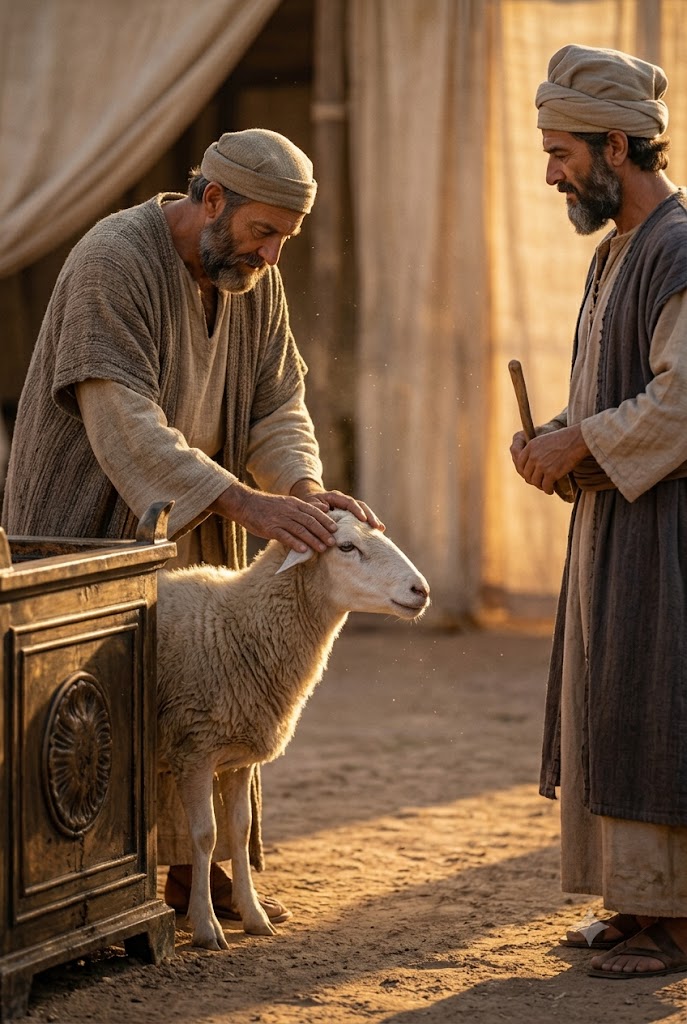
“And he shall lay his hand on the head of his offering, and kill it at the door of the tabernacle of meeting; and Aaron’s sons, the priests, shall sprinkle the blood all around on the altar.”
But the portion given afterward is decisively different.
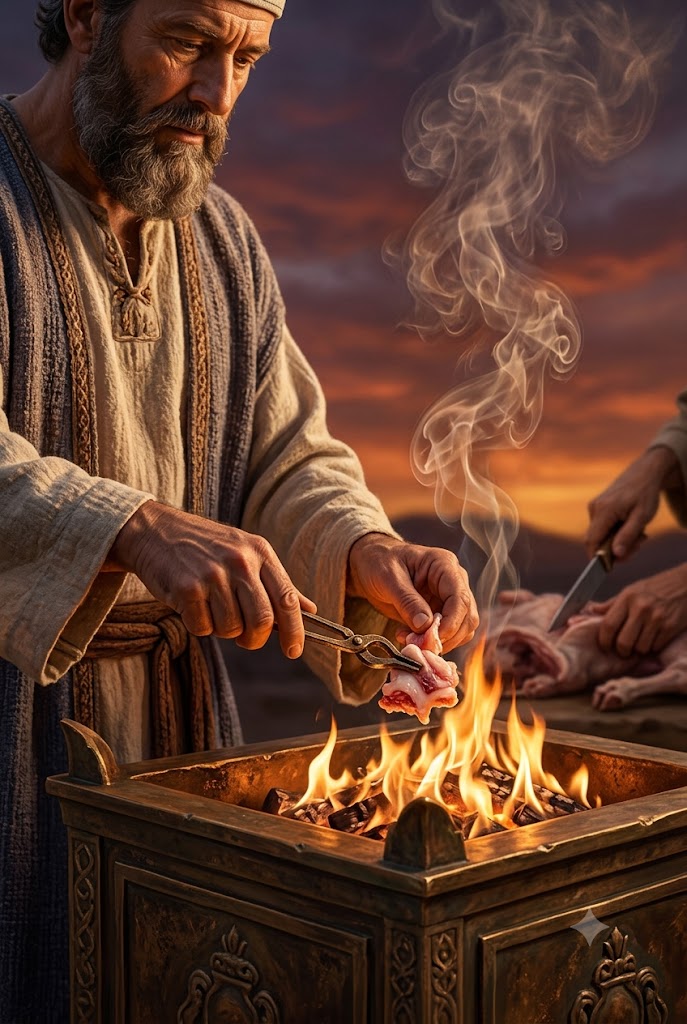
“Then he shall offer from the sacrifice of the peace offering, as an offering made by fire to the LORD, the fat that covers the entrails and all the fat that is on the entrails, the two kidneys and the fat that is on them by the flanks, and the fatty lobe attached to the liver above the kidneys, he shall remove.”
The fat and the kidneys. The burnt offering consumed the whole animal, but with the peace offering, only the fat portions of the internal organs were burned on the altar. In ancient Hebrew thought, fat was regarded as the best, richest part of an animal. The best portion was given to God, and the rest became the shared portion for the priest and the worshiper together.
🐑 Act Two — The Peace Offering of Sheep and Goats (Verses 6–17)
The peace offering could also be made from sheep or goats.
“If his offering as a sacrifice of a peace offering to the LORD is of the flock, whether male or female, he shall offer it without blemish.”
For sheep, a specific mention is added regarding the especially fatty tail.
“And from the sacrifice of the peace offering he shall bring as an offering made by fire to the LORD its fat and the whole fat tail, which he shall remove close to the backbone.”
For the goat, a similar procedure is repeated. This detailed repetition emphasizes that, regardless of which animal was offered, the same principle applied—the best part belonged to God.
And a very solemn warning appears in this chapter.
“You shall eat neither fat nor blood. This shall be a perpetual statute throughout your generations.”
Neither fat nor blood. These two things belonged to God alone. As already noted, fat symbolized the very best part; blood symbolized life itself (explained more clearly in Leviticus 17:11). What a person could eat was everything except these two things. This boundary continually reminded the people of the fundamental distinction that existed between God and humanity.
🕊️ Reflection — When Sharing Becomes Worship
The deepest truth in Leviticus 3 is this: the peace offering was the only sacrifice in which the worshiper himself could eat the meat. The finest portion—fat and kidneys—was given to God; a designated share went to the priest; and the rest was shared among the worshiper, his family, and his friends.
This shows that worship was never necessarily solemn and distant. At the peace offering’s table, there was laughter, conversation, a meal shared together. Restoration of relationship with God ultimately flowed into restoration of relationship among people—a table where everyone sat and ate together.
And the solemn boundary forbidding fat and blood. This reminds us that even the closest fellowship never erases the fundamental distinction between God and humanity. Intimacy and holiness always stood together.
Does your own faith have a place of joy like a shared table?
📣 Coming Up Next
Leviticus Chapter 4 — The Sin Offering, a sacrifice for sins committed unintentionally. God’s careful grace, dealing even with the sins we did not know we committed, unfolds in the next episode.
Tags: #Leviticus3 #ThePeaceOffering #ASacrificeOfShalom #FatAndKidneys #ASharedTable #NeitherFatNorBlood #RestoredRelationship #Leviticus #BibleStudy #ChristianBlog #OldTestament #Scripture #Church #DailyDevotional #BiblicalFaith #GodsWord