Leviticus Series — Episode 1
🔥 Prologue — What Was Needed After the Tabernacle Was Finished
Exodus ended with the glory of the LORD filling the Tabernacle.
But the story did not end with that glorious dwelling place being raised. The real question had only just begun: how could sinful human beings approach that holy presence? Leviticus is God’s answer to exactly this question.
Leviticus 1 is the first chapter of that answer. The burnt offering—a sacrifice in which the entire animal was consumed by fire, without exception. This is the first of the five major offerings introduced in Leviticus, and it reveals the most fundamental form of devotion.
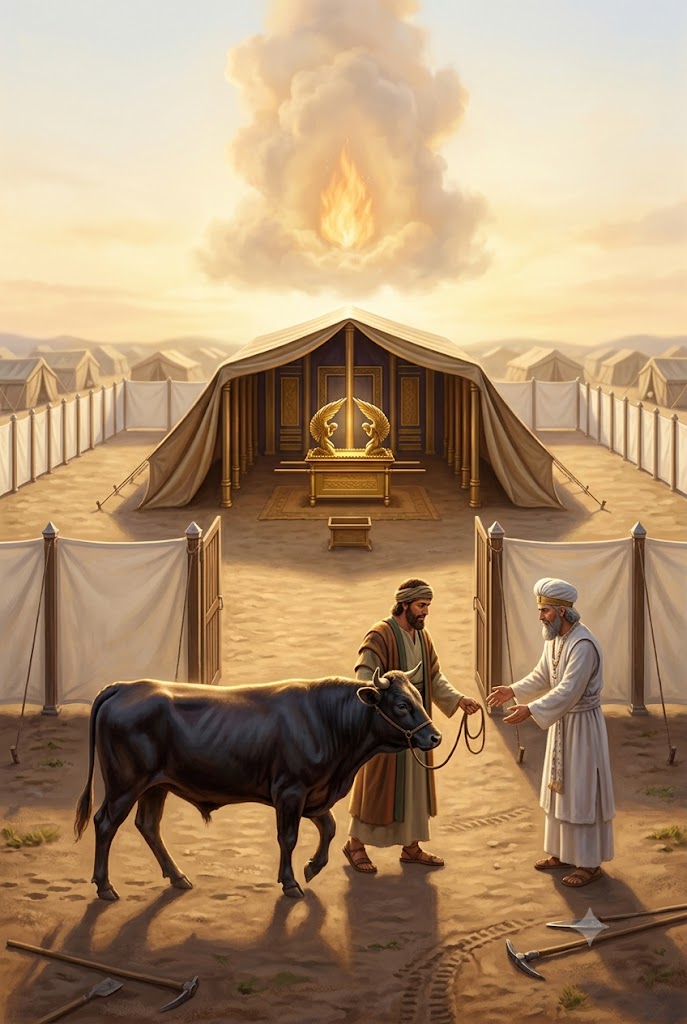
🐂 Act One — The Burnt Offering of the Herd (Verses 1–9)
“Now the LORD called to Moses, and spoke to him from the tabernacle of meeting, saying, ‘Speak to the children of Israel, and say to them: “When any one of you brings an offering to the LORD, you shall bring your offering of the livestock—of the herd and of the flock.”‘”
Called to Moses from the tabernacle of meeting. From that very glorious dwelling place which even Moses could not enter in Exodus 40, God now speaks directly. The distance had not vanished—rather, God Himself had begun closing that distance by speaking.
The first condition of the burnt offering is given.
“If his offering is a burnt sacrifice of the herd, let him offer a male without blemish; he shall offer it of his own free will at the door of the tabernacle of meeting before the LORD.”
A male without blemish. Not just any animal could be offered. The healthiest, most complete animal—the very best one had—had to be given. What was offered to God could not be leftover or lacking; it had to be the finest.
And a deeply significant symbolic act follows.
“Then he shall put his hand on the head of the burnt offering, and it will be accepted on his behalf to make atonement for him.”
Put his hand on the head. This act meant that the worshiper identified himself with the animal. It was a gesture acknowledging that this animal was dying in his place. Afterward the animal was slaughtered, and its blood sprinkled all around the altar.
“He shall kill the bull before the LORD; and the priests, Aaron’s sons, shall bring the blood and sprinkle the blood all around on the altar that is by the door of the tabernacle of meeting.”
This act of sprinkling blood repeatedly impressed upon the people the principle that one life paid the price in place of another.
🐑 Act Two — The Burnt Offering of Flocks and Birds (Verses 10–17)
The burnt offering could be made not only from the herd, but also from sheep or goats.
“If his offering is of the flocks—of the sheep or of the goats—as a burnt sacrifice, he shall bring a male without blemish.”
The same principle—without blemish, male—is repeated. But the scale was smaller. This hints at flexibility according to one’s circumstances.
And a provision follows for the very poorest.
“And if the burnt sacrifice of his offering to the LORD is of birds, then he shall bring his offering of turtledoves or young pigeons.”
Turtledoves or young pigeons. For those who could not afford cattle or sheep, God accepted a far smaller, far more affordable offering. This reveals a deeply important principle. God looked not at the size of the offering, but at the sincerity of the heart bringing it.
The procedure for the bird offering is regulated in careful detail as well.
“And the priest shall bring it to the altar, wring off its head, and burn it on the altar; its blood shall be drained out at the side of the altar.”
Even a single small bird was handled with the same seriousness as an ox or a sheep. A smaller offering never meant that the weight of that worship was any lighter.
🕊️ Reflection — Consumed and Gone, Yet Never in Vain
The most striking thing about Leviticus 1 is that, unlike the other offerings, the burnt offering was consumed entirely. Where the grain offering or the peace offering allowed the priest or the worshiper to eat a portion, the burnt offering, apart from the hide, became ash on the altar in its entirety. Nothing remained.
This asks us an important question. Is our own devotion also a complete giving, one that expects nothing in return? The burnt offering was the archetype of worship that sought no reward.
And the bird offering prepared for the poor. God never built a door meant only for the wealthy. Anyone, within what they had, could come forward with a sincere heart.
Is your worship a complete offering that expects nothing back in return?
📣 Coming Up Next
Leviticus Chapter 2 — The Grain Offering. The special meaning carried by this bloodless offering unfolds in the next episode.