Exodus Series — Episode 27
🔥 Prologue — The First Thing One Encounters: The Altar The instructions so far had begun from the innermost part of the Tabernacle—the Ark of the Covenant, the Most Holy Place, the Holy Place.
But chapter 27 reverses direction. Attention now turns to the outermost part of the Tabernacle—the courtyard. The first thing the people of Israel would encounter when approaching the Tabernacle was the bronze altar, and the boundary of the courtyard surrounding the entire structure.
This order carries deep meaning. The path to God did not begin at the Most Holy Place. It began at the altar—at sacrifice and atonement. Before reaching the holiest place, there was first a place one had to pass through.
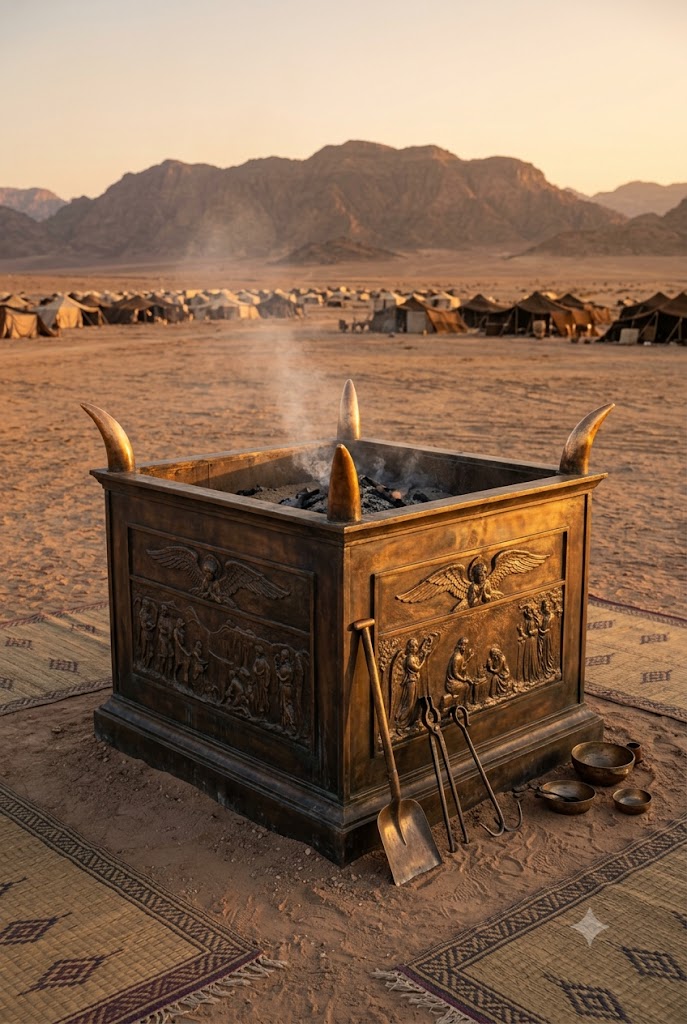
🔥 Act One — The Bronze Altar (Verses 1–8) “You shall make an altar of acacia wood, five cubits long and five cubits wide—the altar shall be square—and its height shall be three cubits.”
This altar was square in shape, and far larger in scale than the other furnishings of the Tabernacle. This was because it was the place responsible for the worship and atonement of the entire people.
“You shall make its horns on its four corners; its horns shall be of one piece with it. And you shall overlay it with bronze.”
Horns on the four corners. This horn shape, common to altars throughout the ancient Near East, symbolized the altar’s strength and majesty. Later in Scripture, grasping the horns of this altar even appears as a symbolic act of seeking refuge (1 Kings 1:50).
The accompanying implements of the altar are also specifically enumerated.
“Also you shall make its pans to receive its ashes, and its shovels and its basins and its forks and its firepans; you shall make all its utensils of bronze.”
Pans for ashes, shovels, basins, forks. These practical tools show that the altar was not merely a symbolic ornament, but an actual workspace used daily. Sacrifice was a recurring, everyday act, and it required tools suited to that ongoing use.
“You shall make a grate for it, a network of bronze; and on the network you shall make four bronze rings at its four corners.”
And an interesting detail follows.
“You shall make it hollow with boards; as it was shown you on the mountain, so shall they make it.”
Hollow. This altar was not a solid, heavy structure, but a hollow one. This was a practical design suited for mobility—like the other furnishings of the Tabernacle, this altar too had to be portable for a people crossing the wilderness.
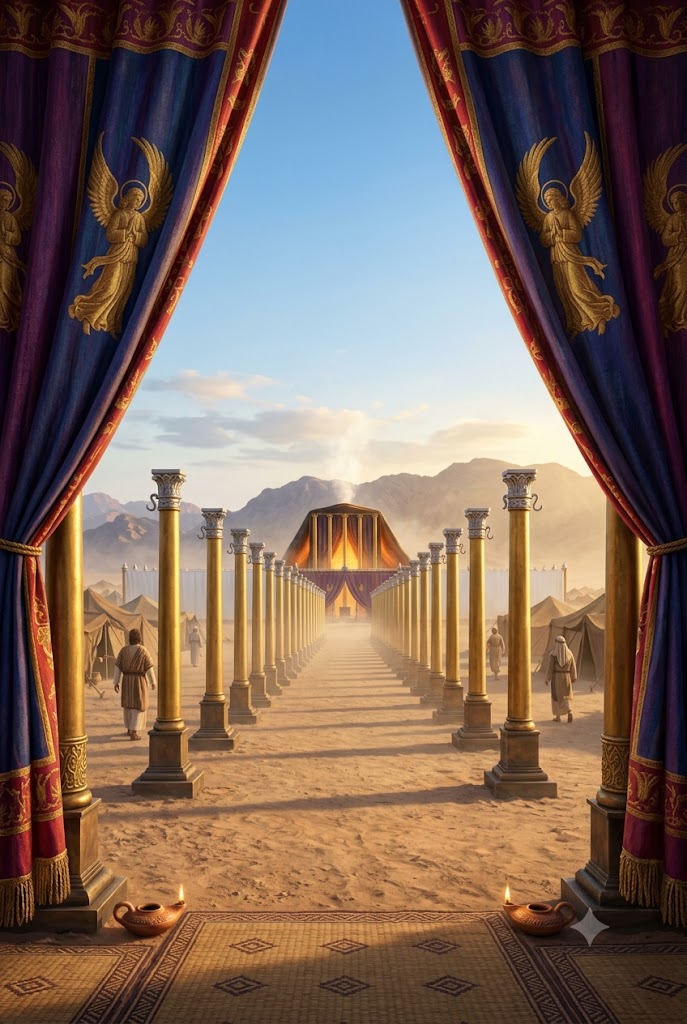
🏕️ Act Two — The Courtyard of the Tabernacle (Verses 9–19) Now instructions are given for the boundary of the courtyard that would enclose the entire Tabernacle.
“You shall also make the court of the tabernacle. For the south side there shall be hangings for the court made of fine woven linen, one hundred cubits long for one side.”
A hundred cubits. This vast scale shows that the Tabernacle was never a small, private space—it was a public place where the entire congregation could gather.
“And its twenty pillars and their twenty sockets shall be bronze. The hooks of the pillars and their bands shall be silver.”
The exact number of pillars, the material of the sockets, even the material of the hooks—every detail is precisely specified. Bronze sockets and silver hooks. These distinct materials hint that each part of the courtyard had its own designated role and rank.
Instructions follow for each of the four directions, and particular attention is given to the entrance leading into the courtyard—the gate.
“For the gate of the court there shall be a screen twenty cubits long, woven of blue, purple, and scarlet thread, and fine woven linen, made by a weaver. There shall be four pillars and four sockets for them.”
The curtain of the entrance was more intricately embroidered with colored thread than the rest of the courtyard’s fencing. This hints that the place of entry—the place where encounter begins—was meant to be adorned with particular beauty.
The chapter closes with the following summary.
“All the utensils of the tabernacle for all its service, all its pegs, and all the pegs of the court, shall be of bronze.”
🕯️ Act Three — Oil for a Lamp That Never Goes Out (Verses 20–21) This short but deeply significant final section of the chapter shifts focus away from the physical structure of the Tabernacle, toward the rhythm of continual worship.
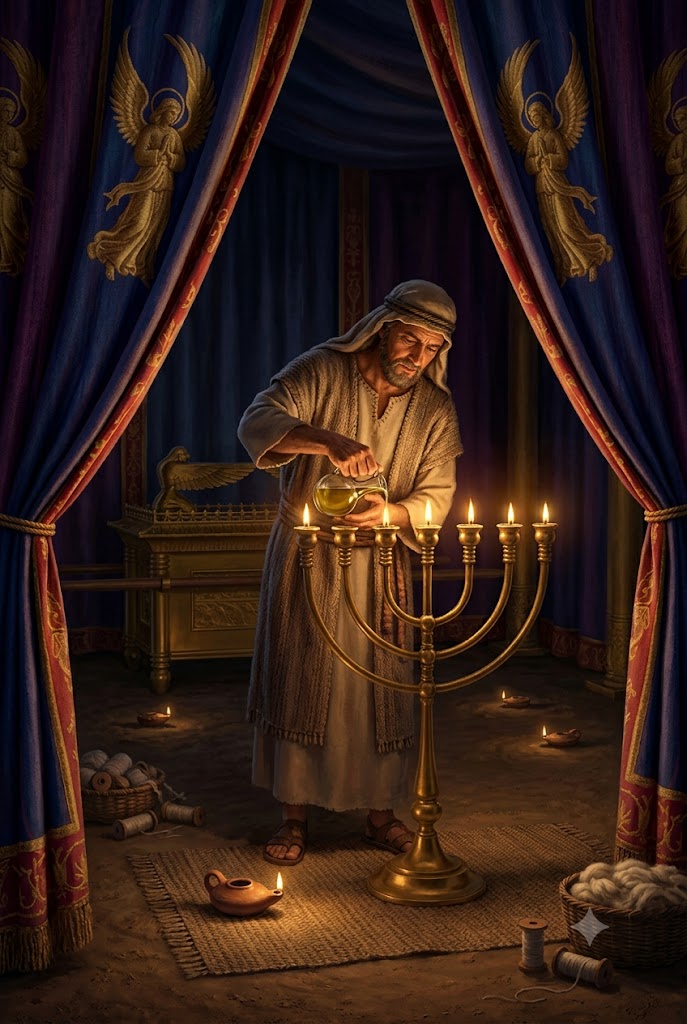
“And you shall command the children of Israel that they bring you pure oil of pressed olives for the light, to cause the lamp to burn continually.”
To burn continually. This phrase is the heart of this brief section. The lamp within the Tabernacle was not something lit only once. It had to be maintained continuously, without interruption.
“In the tabernacle of meeting, outside the veil which is before the Testimony, Aaron and his sons shall tend it from evening until morning before the LORD. It shall be a statute forever to their generations on behalf of the children of Israel.”
From evening until morning, throughout their generations. Tending this lamp was not a single event, but a responsibility to continue across generations. Even after the Tabernacle was completed, the worship within it had to be renewed anew, every single night.
🕊️ Reflection — A Journey Beginning at the Altar, a Flame That Never Goes Out The first truth discovered in Exodus 27 concerns order. The design of the Tabernacle began from its innermost part—the Ark of the Covenant, the Most Holy Place. But the actual journey by which the people approached God began in the exact opposite direction—at the gate of the courtyard, at the bronze altar.
This teaches us an important principle. Before longing for intimate fellowship with God, we must first pass through the place of atonement and sacrifice. There was no shortcut. No one could skip the altar and go directly to the Most Holy Place.
And the vast scale of the courtyard. The Tabernacle was never a hidden place for a privileged few. A courtyard a hundred cubits wide was a communal space where the entire congregation could gather together in worship.
Finally, the lamp that never went out. This flame, which had to burn continuously from evening until morning, generation after generation, symbolically shows that faith must never end in a single moment of exhilaration. Our own worship and devotion, too, must not be a single fervent experience, but a steadiness kept anew, every single night.
“Is the lamp of your faith still burning, unextinguished, even now?”
📣 Coming Up Next Exodus Chapter 28 — The Holy Garments of the Priesthood Detailed ordinances follow concerning the priestly garments Aaron and his sons would wear—the ephod, the breastplate, the turban, and the sash. The deep symbolism carried by the clothing of one who stands before God unfolds in the next episode.
#Exodus27 #BronzeAltar #HornsOfTheAltar #CourtyardOfTheTabernacle #ALampThatNeverGoesOut #FromEveningUntilMorning #AStatuteForeverToTheirGenerations #TheExodus #BibleStudy #ChristianBlog #Exodus #OldTestament #Scripture #Church #DailyDevotional #BiblicalFaith #GodsPower