Exodus Series — Episode 23
🔥 Prologue — The Final Chapter of the Book of the Covenant, Encompassing All of Life Through chapters 21 and 22, God had spoken in turn concerning servants, injury, property, and His heart for the vulnerable of society.
Now we arrive at the final chapter of this collection of laws known as the Book of the Covenant. Exodus 23 divides broadly into three parts. Ordinances for fair judgment; the rhythm of time formed by the Sabbatical year, the Sabbath, and the three great festivals; and finally, God’s promise and warning concerning the journey ahead into Canaan.
After this chapter, Israel responds by agreeing to accept all these laws, and the covenant is formally established. Chapter 23 is the final step preparing for that great moment.
⚖️ Act One — Ordinances for Fair Judgment (Verses 1–9) “You shall not circulate a false report. Do not put your hand with the wicked to be an unrighteous witness.”
A false report, an unrighteous witness. The fairness of judgment begins with truthful testimony. God addresses not only the procedures of judgment, but the earlier stage—the truthfulness of rumor and testimony itself.
An unexpected command follows.
“You shall not follow a crowd to do evil; nor shall you testify in a dispute so as to turn aside after many to pervert justice. You shall not show partiality to a poor man in his dispute.”
You shall not follow a crowd to do evil. This verse is striking. Justice was never to be determined by popular opinion or majority vote. Even favoring the poor—if it distorted the truth—was forbidden. Justice was to lean toward neither side.
The regulation concerning enemies is equally unusual.
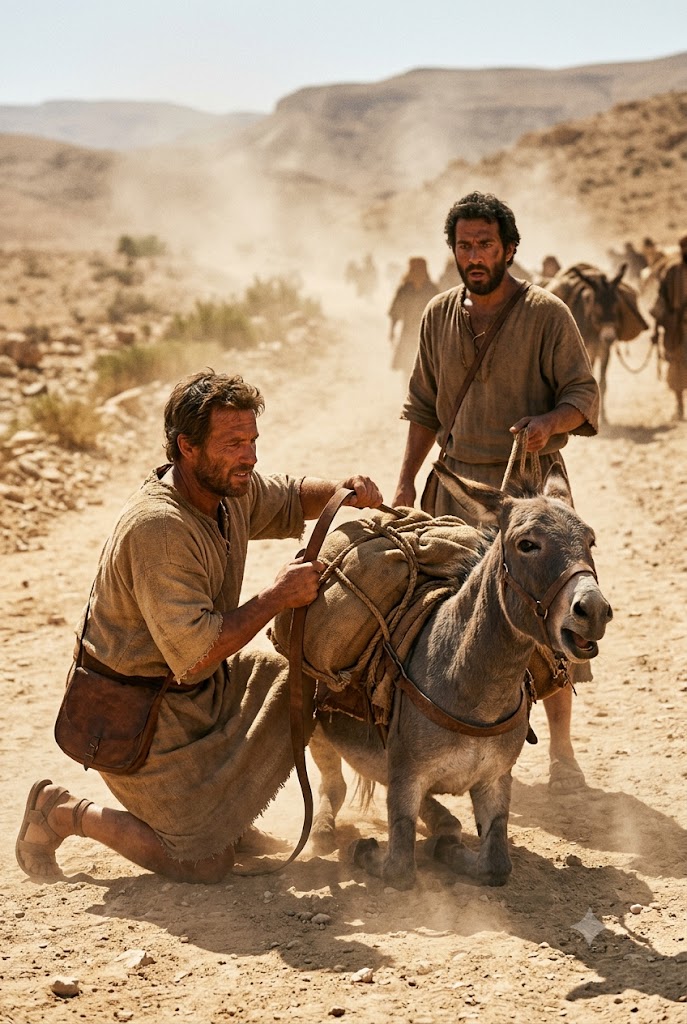
“If you meet your enemy’s ox or his donkey going astray, you shall surely bring it back to him again. If you see the donkey of one who hates you lying under its burden, and you would refrain from helping it, you shall surely help him with it.”
Surely help him with it. Emotional hostility was not permitted to obstruct practical help. This principle becomes the ancient root of Jesus’ later teaching on loving one’s enemies (Matthew 5).
Fairness toward the poor is emphasized once more.
“You shall not pervert the judgment of your poor in his dispute.”
And a powerful warning against bribery follows.
“And you shall take no bribe, for a bribe blinds the discerning and perverts the words of the righteous.”
A bribe blinds the discerning. Even a wise and righteous person’s judgment could grow clouded in the face of a bribe—this was a sober warning. It was a clear-eyed insight into human nature.
This section closes, once again, with a reminder of Egypt.
“Also you shall not oppress a stranger, for you know the heart of a stranger, because you were strangers in the land of Egypt.”
You know the heart of a stranger. This logic, already presented in chapter 22, is reaffirmed here. The suffering once experienced must never be forgotten—it must instead become the very ground of compassion.
🌾 Act Two — The Sabbatical Year, the Sabbath, and the Three Festivals (Verses 10–19) The text now turns to ordinances governing the rhythm of time.
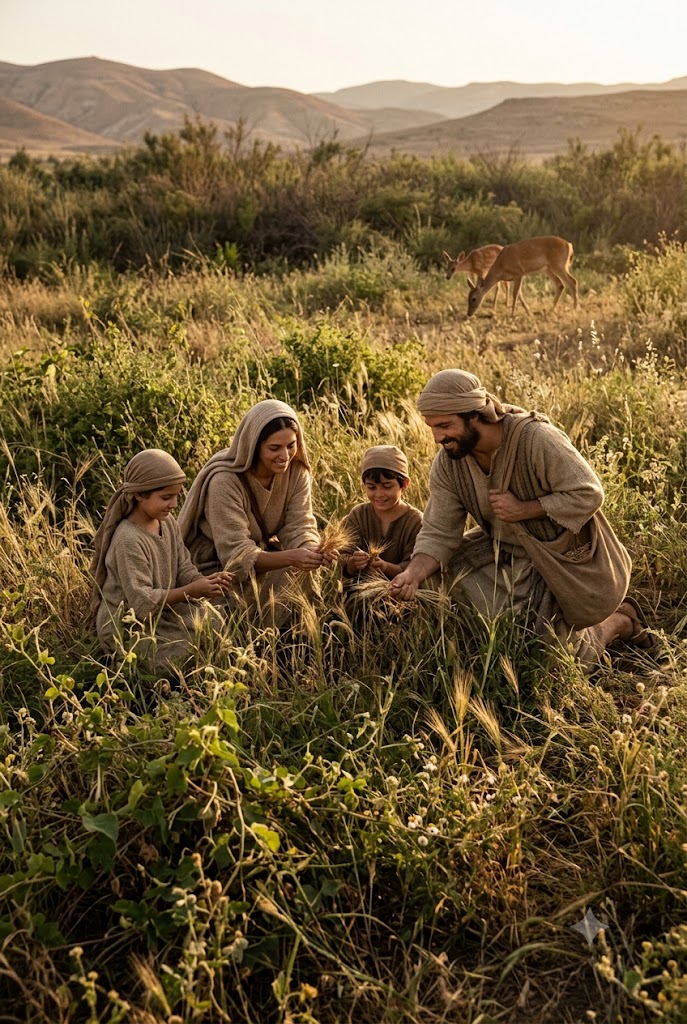
“Six years you shall sow your land and gather in its produce, but the seventh year you shall let it rest and lie fallow, that the poor of your people may eat; and what they leave, the beasts of the field may eat. In like manner you shall do with your vineyard and your olive grove.”
Six years of cultivation, the seventh of rest. Not only people, but the land itself needed rest. And whatever grew during that time of rest belonged to the poor and to the wild animals. The Sabbatical year was not merely agricultural wisdom—it was also a social mechanism for caring for the poor.
The Sabbath is mentioned once more.
“Six days you shall do your work, and on the seventh day you shall rest, that your ox and your donkey may rest, and the son of your female servant and the stranger may be refreshed.”
May be refreshed. This expression shows that the Sabbath was not merely a rule, but a time of genuine restoration. Even the child of a servant, even the stranger—those in the lowest positions of society—were meant to benefit from this rest.
Three great festivals are established.
“Three times you shall keep a feast to Me in the year. You shall keep the Feast of Unleavened Bread… You shall keep the Feast of Harvest… and the Feast of Ingathering.”
The Feast of Unleavened Bread commemorated deliverance from Egypt; the Feast of Harvest, gratitude for the first fruits; and the Feast of Ingathering, gratitude for the full yield of the year’s labor. These three festivals showed that Israel’s life was deeply bound both to God’s saving history and to the rhythm of nature.
“Three times in the year all your males shall appear before the Lord GOD.”
Three times a year. Israel’s people were required to come regularly into God’s presence. Worship was not something scattered randomly through daily life—it lived within a rhythm that repeated with regularity.
👼 Act Three — I Will Send an Angel: The Promise of Conquest in Canaan (Verses 20–33) The final section of this chapter shifts to an entirely new subject—the promise concerning the journey ahead.
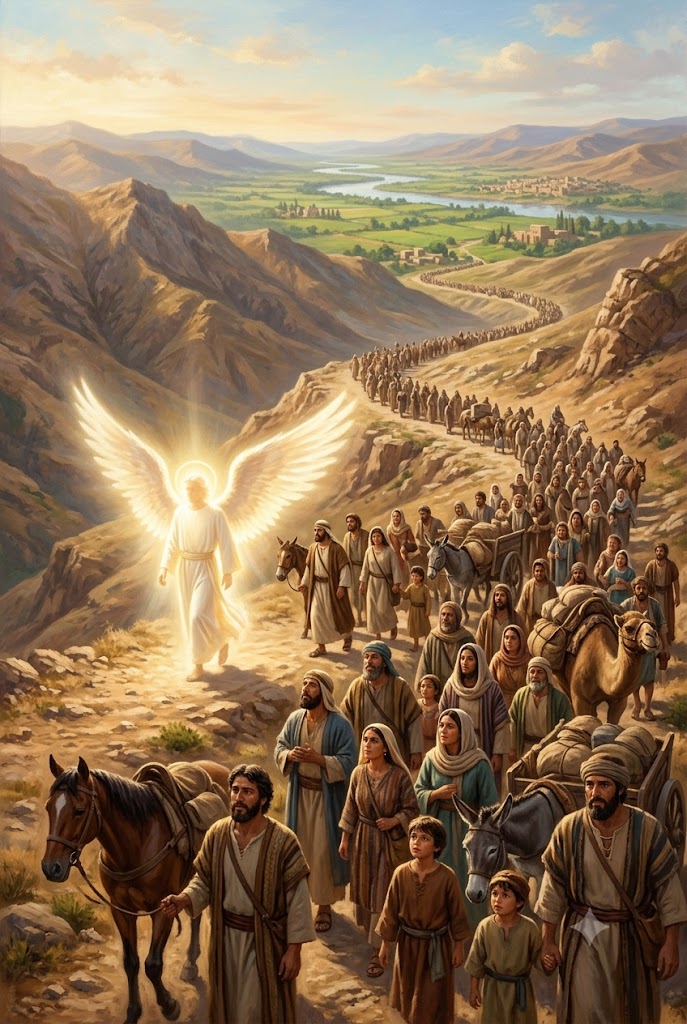
“Behold, I send an Angel before you to keep you in the way and to bring you into the place which I have prepared.”
I send an Angel before you. Israel, having made covenant at Mount Sinai, now had ahead of them a new journey toward the land of Canaan. God did not leave them alone on that road either—He promised to send an angel to go before them.
Obedience to this angel is demanded with gravity.
“Beware of Him and obey His voice; do not provoke Him, for He will not pardon your transgressions; for My name is in Him.”
For My name is in Him. This angel was no mere messenger. He carried God’s own name and authority.
And the outcome of obedience is promised.
“But if you indeed obey His voice and do all that I speak, then I will be an enemy to your enemies and an adversary to your adversaries… So you shall serve the LORD your God, and He will bless your bread and your water. And I will take sickness away from the midst of you.”
God then displays remarkable wisdom concerning the very manner of conquest.
“And I will send hornets before you, which shall drive out the Hivite, the Canaanite, and the Hittite from before you. I will not drive them out from before you in one year, lest the land become desolate and the beasts of the field become too numerous for you. Little by little I will drive them out from before you, until you have increased, and you inherit the land.”
Not all at once, but little by little. God’s wisdom chose an achievable pace over an immediate, total victory—one Israel could actually bear. This was the same principle as in chapter 13, when God chose the wilderness road instead of the Philistine road—a God who considers the condition of His people.
Finally, a grave warning is given.
“You shall make no covenant with them, nor with their gods. They shall not dwell in your land, lest they make you sin against Me. For if you serve their gods, it will surely be a snare to you.”
It will surely be a snare to you. This warning would repeatedly be fulfilled in the books of Judges and Kings to come. Every time Israel compromised with Canaanite culture, that compromise became, exactly as warned, a snare to them.
🕊️ Reflection — Just Judgment and the Angel Who Leads Exodus 23 seems, at first, to address three unrelated topics—judgment, festivals, and conquest—but beneath the surface, a single consistent truth flows through it all. God desired to be present in every sphere of His people’s lives—in the courtroom, in the field, on the journey through the wilderness.
The most striking verse is the warning about bribery. “A bribe blinds the discerning.” This is a sober diagnosis of ourselves. No matter how wise we believe ourselves to be, our judgment can grow clouded in the face of gain. Justice does not preserve itself. It requires deliberate vigilance.
And the command to help an enemy’s stray animal—this asks us to separate feeling from action. We may feel hostility, but that hostility must never tie our hands.
Finally, God’s method: “little by little I will drive them out.” We often expect immediate, complete victory. But God works at the pace we can actually bear. Slowness is not always failure—it can be wisdom.
“In upholding justice, are you following only the truth—not the crowd, and not the lure of gain?”
📣 Coming Up Next Exodus Chapter 24 — The Covenant Is Sealed Moses reads the Book of the Covenant before the people, and they answer with one voice. The covenant sealed with blood, and the beginning of Moses’ forty days with God on the mountain, unfold in the next episode.
#Exodus23 #JustJudgment #WarningAgainstBribes #SabbaticalYear #ThreeFestivals #IWillSendAnAngel #LittleByLittle #TheBookOfTheCovenantCompleted #TheExodus #BibleStudy #ChristianBlog #Exodus #OldTestament #Scripture #Church #DailyDevotional #BiblicalFaith #GodsPower