Exodus Series — Episode 10
🔥 Prologue — Hardness Invites Not Judgment Alone, But Isolation The seventh plague, the hail, had ceased.
Pharaoh had said, “I have sinned,” but the moment the sky cleared, those words vanished with it. Now the eighth plague approaches. And for the first time in this chapter, it becomes clear that Pharaoh is no longer the only one affected.
His own officials begin to waver.
Hardness cannot hold out alone forever. When a king’s stubbornness begins to destroy an entire nation, even those closest to him start to turn away. Exodus 10 is a chapter defined as much by the intensifying plagues as by Pharaoh’s deepening isolation.
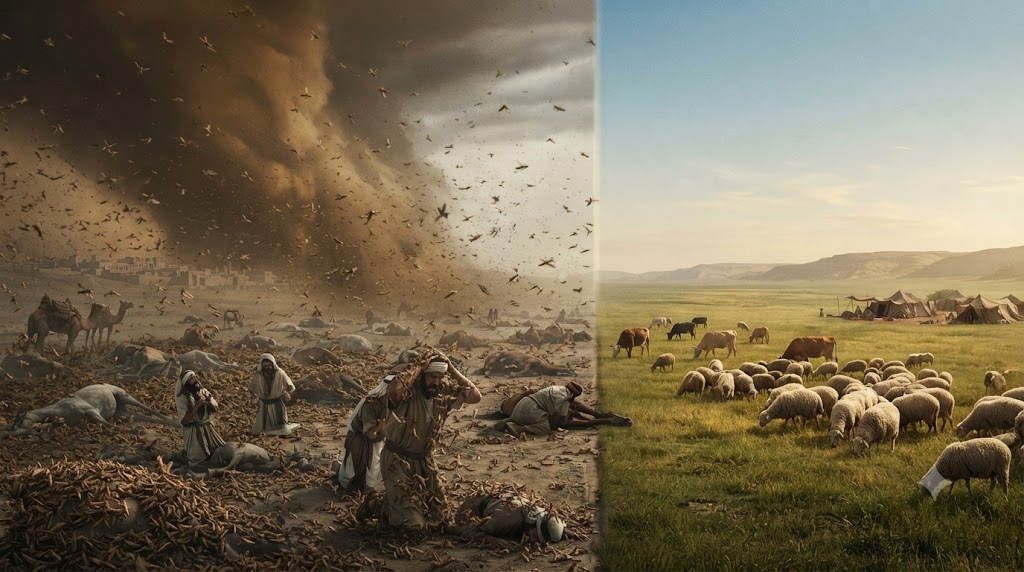
🦗 Act One — The Eighth Plague: Locusts (Verses 1–20) “Then the LORD said to Moses, ‘Go in to Pharaoh; for I have hardened his heart and the hearts of his servants, that I may show these signs of Mine before him.'”
Before this plague, God restates His purpose.
“And that you may tell in the hearing of your son and your grandson the mighty things I have done in Egypt, and My signs which I have done among them, that you may know that I am the LORD.”
This was never merely about breaking Pharaoh. It was a story meant to be carried across generations—a testimony of God’s power to be told to children and grandchildren.
Moses and Aaron delivered the warning to Pharaoh.
“How long will you refuse to humble yourself before Me? Let My people go, that they may serve Me. Else, if you refuse to let My people go, behold, tomorrow I will bring locusts into your territory.”
The locusts would cover the land and devour everything the hail had spared—every remaining plant, every remaining fruit. Whatever the hail had destroyed, the locusts came to consume what was left.
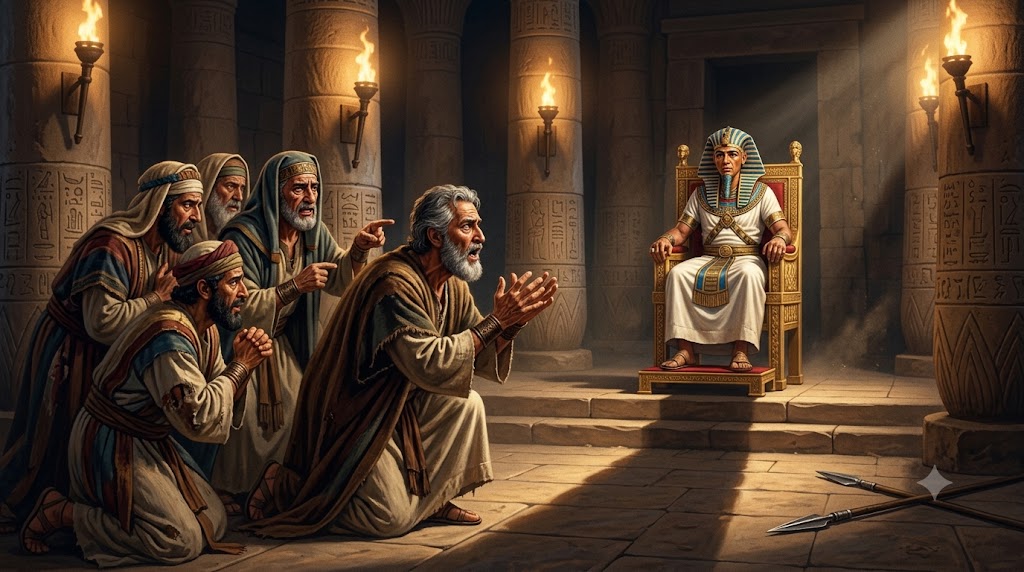
And here, for the first time in the narrative, Pharaoh’s own officials speak up.
“Then Pharaoh’s servants said to him, ‘How long shall this man be a snare to us? Let the men go, that they may serve the LORD their God. Do you not yet know that Egypt is destroyed?'”
Do you not yet know that Egypt is destroyed? Even his own officials could no longer bear it. In their eyes, the nation was already collapsing. Yet Pharaoh, even now, attempts negotiation rather than surrender.
“So Moses and Aaron were brought again to Pharaoh, and he said to them, ‘Go, serve the LORD your God. Who are the ones that are going?'”
Moses answered.
“And Moses said, ‘We will go with our young and our old; with our sons and our daughters, with our flocks and our herds we will go, for we must hold a feast to the LORD.'”
Everyone. Young and old, even the livestock. But Pharaoh, once again, attached conditions.
“Then he said to them, ‘The LORD had better be with you when I let you and your little ones go! Beware, for evil is ahead of you. Not so! Go now, you who are men, and serve the LORD, for that is what you desired.’ And they were driven out from Pharaoh’s presence.”
The third negotiation—only the men. Leave the women, children, and livestock behind; let only the men go. It was a calculated attempt to hold hostages, to keep something in reserve, ensuring their return.
Moses stretched out his rod, and an east wind brought the locusts to cover the whole land of Egypt.
“For they covered the face of the whole earth, so that the land was darkened; and they ate every herb of the land and all the fruit of the trees which the hail had left, and there remained nothing green on the trees or on the plants of the field throughout all the land of Egypt.”
The land was darkened. The locusts were so numerous they blotted out the light. Whatever the hail had not destroyed—the locusts consumed the last of it.
Pharaoh hurried to call Moses and Aaron.
“Then Pharaoh called for Moses and Aaron in haste, and said, ‘I have sinned against the LORD your God and against you. Now therefore, please forgive my sin only this once, and entreat the LORD your God, that He may take away from me this death only.'”
Only this once. The same phrase, again. It had appeared after the sixth plague, after the seventh plague—only this once. Not the language of a changed heart, but the language of someone trying to escape the moment.
Moses prayed, and a strong west wind carried the locusts into the Red Sea. But—
“But the LORD hardened Pharaoh’s heart, and he did not let the children of Israel go.”
Once again, the text attributes the hardening to God. Repeated refusal had, by now, become his fixed condition.
🌑 Act Two — The Ninth Plague: Darkness (Verses 21–29) The ninth plague began quietly, unlike any before it.
“Then the LORD said to Moses, ‘Stretch out your hand toward heaven, that there may be darkness over the land of Egypt, darkness which may even be felt.'”
Darkness which may even be felt. This was not ordinary night. It was a darkness thick enough to be physically sensed, almost tangible to the touch.
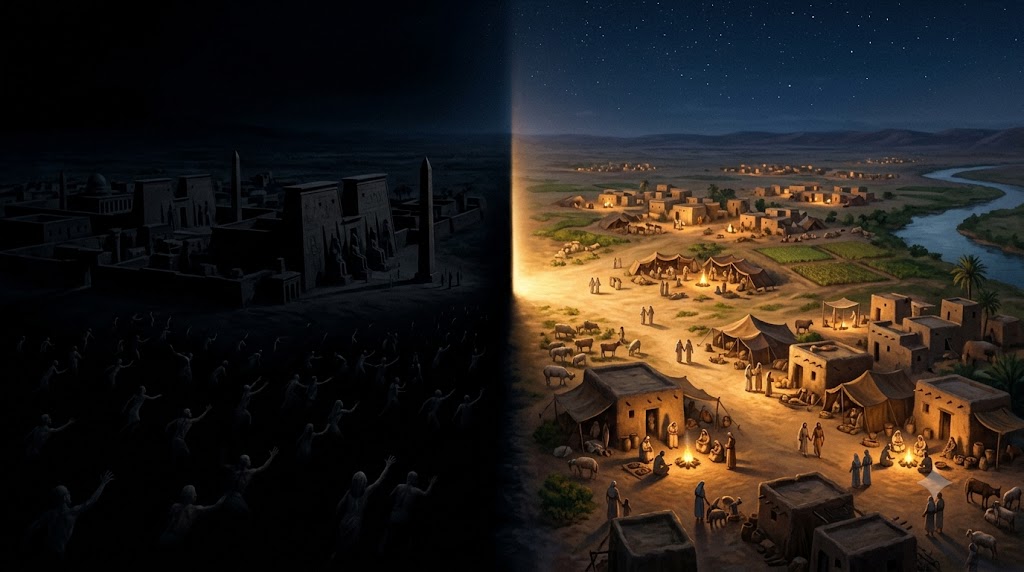
“So Moses stretched out his hand toward heaven, and there was thick darkness in all the land of Egypt three days. They did not see one another; nor did anyone rise from his place for three days.”
Three days. Time itself seemed to stop. No one could see another. No one could move. The entire civilization of Egypt was paralyzed.
And once again—the familiar phrase returns.
“But all the children of Israel had light in their dwellings.”
They had light. Under the same sky, Egypt was trapped in darkness while Israel’s dwellings were filled with light. Even at the ninth plague, the principle of distinction remained unchanged.
In the midst of the darkness, Pharaoh summoned Moses once more.
“Then Pharaoh called to Moses and said, ‘Go, serve the LORD; only let your flocks and your herds be kept back. Let your little ones also go with you.'”
The fourth negotiation—this time reversed. All the people could go, but the livestock must stay. Still an attempt to hold something back. A heart that could not fully let go.
Moses refused firmly.
“But Moses said, ‘You must also give us sacrifices and burnt offerings, that we may sacrifice to the LORD our God. Our livestock also shall go with us; not a hoof shall be left behind. For we must take some of them to serve the LORD our God, and even we do not know with what we must serve the LORD until we arrive there.'”
Not a hoof shall be left behind. This was a total demand. Partial obedience was not obedience. Worship could not be a matter of negotiation.
Pharaoh’s heart hardens for the final time.
“But the LORD hardened Pharaoh’s heart, and he would not let them go. Then Pharaoh said to him, ‘Get away from me! Take heed to yourself and see my face no more! For in the day you see my face you shall die!'”
See my face no more. Pharaoh now attempts to end even the negotiations themselves. He shut the door on the conversation by his own will.
Moses’ final reply was brief and resolute.
“So Moses said, ‘You have spoken well. I will never see your face again.'”
🕊️ Reflection — The Hand That Holds Back and the Heart That Surrenders Fully In Exodus 10, Pharaoh attempted four separate negotiations. Send only the men. Let the people go but keep the livestock. Let the adults go but keep the children. Let everyone go but keep the animals. Each time the terms shifted, but the essence remained the same—an unwillingness to surrender completely.
This is a familiar test in our own faith. We offer worship to God but hold back some area of our lives. We give our time but withhold our finances. We appear to give our hearts while our real priorities remain elsewhere. Moses’ answer confronts us—”not a hoof shall be left behind.” Partial devotion is, in the end, not devotion at all.
Yet this chapter also carries another face. Pharaoh’s own officials, for the first time, spoke up against him: “Do you not yet know that Egypt is destroyed?” Even alongside a hardened leader, there were those who found the courage to speak the truth.
And once more—the distinction between light and darkness. Even as darkness covered the whole land, light remained where God’s people dwelt. The more severe the judgment grew, the more clearly God’s protection and distinction shone through.
“What are you offering to God—while still holding something back at the same time?”
📣 Coming Up Next Exodus Chapters 11–12 — The Final Plague and the Passover The tenth plague, the death of the firstborn, draws near. And on that night, death passes over every house marked with the blood of the lamb on its doorposts. The first night of Passover—the climax of the Exodus—unfolds in the next episode.
#Exodus10 #LocustPlague #DarknessPlague #DarknessFelt #NotAHoofLeftBehind #PharaohsHardHeart #LightInGoshen #OfficialsSpeakUp #FullSurrender #TenPlagues #BibleStudy #ChristianBlog #Exodus #OldTestament #Scripture #Church #DailyDevotional #BiblicalFaith #GodsPower