Exodus Series — Episode 5
Exodus Series — Episode 5
🔥 Prologue — The Most Difficult Moment of Faith
Sometimes obedience makes things worse.
Moses had done exactly what God said. He had overcome his fear, traveled the wilderness road, endured five waves of his own objection, and finally presented himself before the most powerful ruler on earth. And Pharaoh laughed. The labor conditions of Israel became brutally more severe. The people turned on Moses with their fury.
This is the most difficult moment in the life of faith. When obedience produces deterioration rather than improvement. When following God’s command intensifies the suffering rather than alleviating it. When prayer produces a door more firmly shut than before.
Exodus Chapter 5 presents this moment with unflinching honesty. No comfort offered prematurely. No spiritual veneer applied to real pain. And yet—within that honesty, the outline of God’s greater architecture becomes visible.
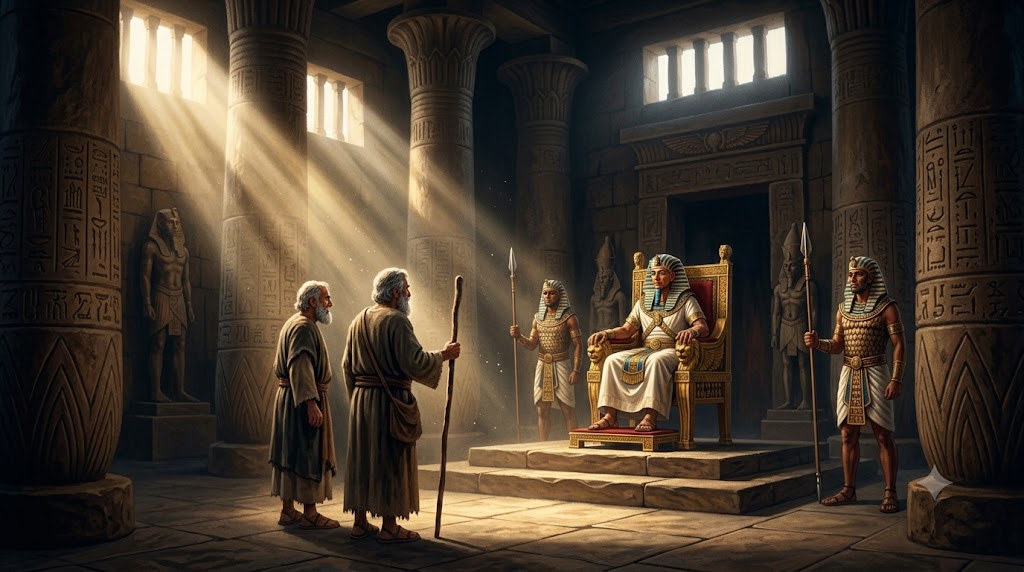
👑 Act One — Moses and Aaron Before Pharaoh: The First Confrontation (Verses 1–5)
“Afterward Moses and Aaron went in and told Pharaoh, ‘Thus says the LORD God of Israel: “Let My people go, that they may hold a feast to Me in the wilderness.”‘”
The moment had finally arrived.
Moses and Aaron stood before Pharaoh. Two brothers—a wilderness shepherd and a Levite priest—positioned themselves before the absolute sovereign of the world’s dominant superpower. No army behind them. No weapons. Nothing but a staff, a calling, and the words of the living God.
“Let My people go.”
This was God’s opening declaration. Not a petition. Not a diplomatic request. A decree. Thus says the LORD—the language of the heavenly court issuing its verdict to the earthly throne. The King of the universe addressing the king of Egypt in the vocabulary of command.
Pharaoh’s response was immediate and contemptuous.
“And Pharaoh said, ‘Who is the LORD, that I should obey His voice to let Israel go? I do not know the LORD, nor will I let Israel go.'”
Who is the LORD? This question is the theological axis around which the entire book of Exodus rotates. Pharaoh genuinely did not know. And he had no intention of finding out. In the ancient polytheistic world where Pharaoh himself held divine status, the concept of a single God—the God of a slave population—commanding the release of imperial labor assets was not merely politically unacceptable. It was cosmologically absurd.
Yet this refusal was not outside God’s sovereign design. The more completely Pharaoh refused, the more magnificently God’s power would be demonstrated. The resistance of Pharaoh was the canvas upon which God would paint His most spectacular self-disclosure.
Moses and Aaron tempered their request.
“So they said, ‘The God of the Hebrews has met with us. Please, let us go three days’ journey into the desert and sacrifice to the LORD our God, lest He fall upon us with pestilence or with the sword.'”
Three days into the wilderness. Not permanent liberation—merely a brief religious observance. Pharaoh refused even this.
“Then the king of Egypt said to them, ‘Moses and Aaron, why do you take the people from their work? Get back to your labor.'”
Return to work. Pharaoh’s first move was dismissal. The God of slaves is beneath my awareness. Go back to your bricks.
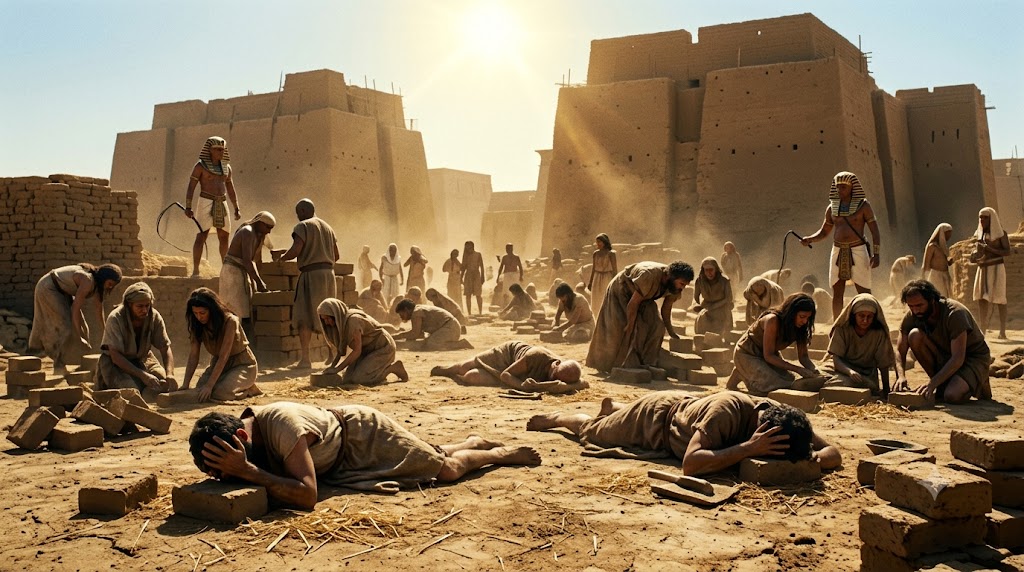
🧱 Act Two — Bricks Without Straw: The Cruelty of Impossible Demands (Verses 6–14)
Pharaoh’s response did not stop at refusal. What followed was an act of calculated brutality.
“And Pharaoh commanded the same day the taskmasters of the people and their officers, saying, ‘You shall no longer give the people straw to make brick as before. Let them go and gather straw for themselves.'”
No more straw. Straw was an essential binding agent in ancient brick production—without it, the clay mixture lacked structural integrity and the bricks crumbled. Yet the production quota remained unchanged.
“And the quota of bricks which they made before, you shall lay on them. You shall not reduce it. For they are idle; therefore they cry out, saying, ‘Let us go and sacrifice to our God.'”
Idle. This was Pharaoh’s diagnosis of the entire situation. The spiritual hunger of an oppressed people, their longing for freedom, their cry for the right to worship their God—all of it reduced in Pharaoh’s calculus to a symptom of insufficient workload. His prescription: more labor.
This is the logic of empire in every generation. Increase the pressure to eliminate the resistance. Multiply the suffering to extinguish the dream. Load the people so heavily with the immediate and urgent that they have no capacity left to imagine the possible.
Israel’s foremen—their own people serving in supervisory roles—were beaten when the impossible quota was not met.
“Why have you not fulfilled your task in making brick both yesterday and today, as before?”
Yesterday and today. The impossible was demanded as though it were ordinary. This was the geometry of Pharaoh’s cruelty—to make the unachievable the baseline expectation, and then punish the failure to achieve it.
😭 Act Three — The Foremen’s Appeal, and the Explosion of Despair (Verses 15–21)
Israel’s foremen went directly to Pharaoh.
“Then the officers of the children of Israel came and cried out to Pharaoh, saying, ‘Why are you dealing this way with your servants? There is no straw given to your servants, and they say to us, “Make brick!” And indeed your servants are beaten, but the fault is in your own people.'”
They pleaded their case directly. We are not at fault. You have withheld the essential material while maintaining the impossible standard. The beatings we are receiving belong to your own system’s failure, not to our negligence.
Pharaoh was unmoved.
“But he said, ‘You are idle! Idle! Therefore you say, “Let us go and sacrifice to the LORD.”‘”
Idle again. For Pharaoh, every manifestation of the people’s spiritual life was interpretable only through the lens of productivity loss. The longing for God. The desire for dignity. The hunger for liberation. All of it—laziness.
“Therefore go now and work; for no straw shall be given you, yet you shall deliver the quota of bricks.”
The audience was over. The appeal had failed. Nothing had changed except that the impossibility of the situation had been officially confirmed.
The foremen withdrew. On the way out, they encountered Moses and Aaron. Their accumulated anguish detonated.
“Then, as they came out from Pharaoh, they met Moses and Aaron who stood there to meet them. And they said to them, ‘Let the LORD look on you and judge, because you have made us abhorrent in the sight of Pharaoh and in the sight of his servants, to put a sword in their hand to kill us.'”
Let the LORD judge you. This was a curse. The condemnation of Moses and Aaron flowed upstream into the condemnation of God Himself. You came with your divine mandate and made everything worse. Your obedience endangered us. Your commission has become our death sentence.
This is the loneliest position in the life of leadership—to have followed God’s explicit instruction and find yourself condemned by the very people you were sent to save.
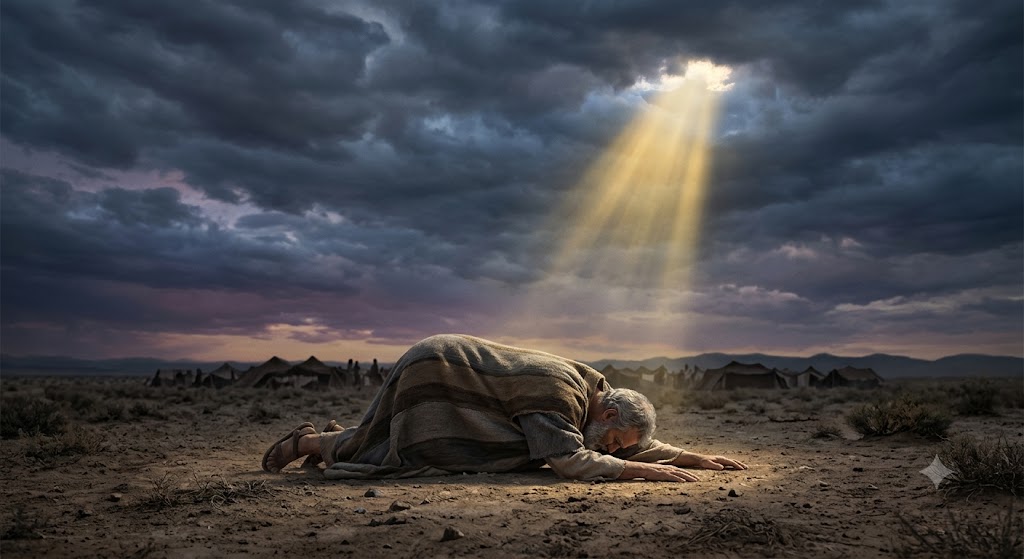
🙏 Act Four — Moses’ Lament: Taking the Pain Directly to God (Verses 22–23)
Moses returned to God.
“So Moses returned to the LORD and said, ‘Lord, why have You brought trouble on this people? Why is it You have sent me?'”
Why. Two times. Moses did not absorb the blow silently. He did not perform spiritual composure. He brought the raw question directly to the only One capable of answering it.
This was not faithlessness. This was the highest expression of faith available to him in that moment—the conviction that God could be approached with the unfiltered question, that He was capable of receiving the protest, that He would not be destabilized by the honest cry of His servant.
“For since I came to Pharaoh to speak in Your name, he has done evil to this people; neither have You delivered Your people at all.”
You have not delivered. The accusation was direct and devastating. I obeyed. The situation got worse. You promised deliverance. The evidence points to the opposite.
This is Exodus Chapter 5’s most raw and honest moment. The undecorated cry of a man caught between an impossible assignment and a people in greater pain than when he arrived. And God—was about to answer.
🕊️ Reflection — When Obedience Produces Deterioration
Exodus Chapter 5 contains an uncomfortable truth that most spiritual narratives prefer to minimize.
Obedience does not guarantee immediate improvement. Following God’s specific instruction can produce more visible suffering in the short term than it alleviates. Faithfulness can intensify resistance before it overcomes it. The door can close more firmly immediately after you knock.
But we read this chapter knowing what comes next. Ten plagues. The parting of the Red Sea. The liberation of an entire nation. The removal of the straw was not God’s abandonment of the plan—it was the compression that would make the eventual explosion of liberation impossible to attribute to anything other than divine power. If human ingenuity could have solved this, God’s power would not have been necessary. The extremity of the situation was the precise preparation for the extremity of the deliverance.
Moses’ lament before God was not weakness. It was directional accuracy. He knew where to bring the pain. When everything collapses around the commission—take it back to the One who gave the commission. That movement toward God in the middle of the catastrophe is itself the act of faith.
Are you in a season where obedience has produced worse conditions than you started with? The hardening of Pharaoh’s heart was always going to be the staging ground for God’s most spectacular demonstration. The impossibility of your current situation is not evidence that God has miscalculated. It is the precise environment in which His power will be most undeniably displayed.
“Has your obedience made things worse? Bring that lament to God. Like Moses. That movement toward Him in the middle of the deterioration is itself the deepest act of faith. He will answer.”
📣 Coming Up Next
Exodus Chapter 6 — God Speaks Again: The Reaffirmation of the Covenant
God responds to Moses’ lament. “I am the LORD.” He reaffirms the covenant made with Abraham, Isaac and Jacob, and declares His unalterable commitment to deliver Israel. The genealogy of Moses and Aaron is revealed. The foundation is being relaid for what is about to come—in the next episode.
#Exodus5 #PharaoharRefusal #WhoIsTheLord #BricksWithoutStraw #IncreasedOppression #IsraelsMurmuring #MosesLament #CostOfObedience #TrialOfFaith #GodsGreaterPlan #BeginningOfExodus #BibleStudy #ChristianBlog #Exodus #OldTestament #Scripture #Church #DailyDevotional #BiblicalFaith #Intercession